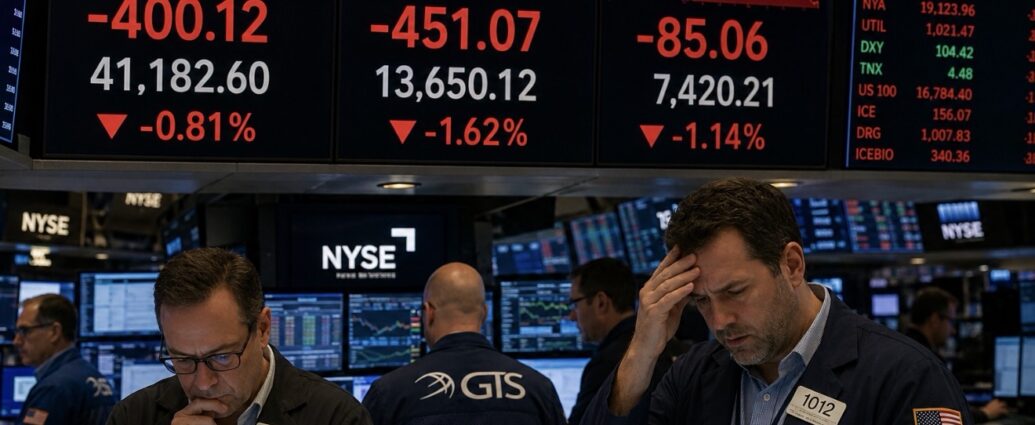
The morning’s soft tape on Wall Street turned into a sharper sell-off into the lunch hour Friday, with losses deepening across the major indexes as a sudden spike in U.S. Treasury yields, a fresh round of corporate layoffs, and the absence of a concrete trade framework out of Beijing combined to push investors firmly out of risk assets — even as small-caps and a handful of mega-cap names ran in the other direction.
The S&P 500 fell 1.14% to roughly 7,420, the Dow Jones Industrial Average dropped 0.81%, or about 400 points, and the tech-heavy Nasdaq Composite retreated 1.62%, shedding more than 450 points. The standout, however, was the small-cap Russell 2000, which climbed 0.67% as investors rotated out of stretched mega-cap technology and into more domestically focused, rate-sensitive names — an unusual divergence given the broader risk-off tone.
The pressure was amplified by a sharp rise in U.S. Treasury yields, with the 10-year yield climbing several basis points as traders pulled forward their assumptions for Federal Reserve patience in the second half of the year. The move followed Wednesday’s Producer Price Index print showing wholesale prices climbing 1.4% in April — the largest monthly jump in nearly four years — and Tuesday’s hotter-than-expected Consumer Price Index report. With inflation running at a 3.8% annual pace and oil pressing higher, futures markets continue to dial back expectations for a near-term Fed cut.
Microsoft was the day’s most-watched winner. The software giant traded higher into midday after Bill Ackman’s Pershing Square Capital Management disclosed a newly built position in the stock, taking advantage of the pullback in mega-cap tech.
“We were able to establish our position at a valuation of 21 times forward earnings, broadly in line with the market multiple and well below Microsoft’s trading average over the last few years,” Ackman wrote in the firm’s investor letter, as reported by CNBC.
The disclosure provided a rare bid in an otherwise heavy mega-cap tape and triggered a wave of sell-side commentary on whether the AI-driven multiple expansion in software has finally reset to investable levels.
Starbucks moved lower after the coffee chain announced it would lay off 300 U.S. corporate employees in its third round of job cuts under chief executive Brian Niccol’s turnaround strategy. The company is also closing some regional support offices, a sign that the operational reset announced last year continues to cut into the corporate workforce even as store-level traffic stabilizes.
The move follows a similar pattern this week at Walmart, which has begun trimming corporate headcount, and Cisco Systems, which disclosed 4,000 layoffs alongside its post-earnings surge.
Several sharp single-stock losers stood out across the midday tape. York Space Systems dropped 18%, Tango Therapeutics lost 14%, and POET Technologies retreated 12.71%, according to data tracked by TheStreet. The breadth of single-stock breakdowns underscored that the sell-off, while concentrated in technology at the index level, was being felt across themes — from defense-adjacent space names to biotech to optical photonics.
Oil prices added to inflation worries and to the day’s risk-off backdrop. West Texas Intermediate crude rose 1.55% to $102.74 a barrel and Brent crude climbed 1.49% to $107.30, after President Donald Trump told reporters in Beijing that China had agreed to purchase American crude oil as part of the summit outcome, according to a readout from NBC News.
The president called the trip a success, telling reporters he had secured “fantastic” trade deals and that “a lot of different problems” had been resolved with President Xi Jinping. Investors, however, focused on the absence of a formal tariff framework or a market-access agreement — the structural changes Wall Street had built into the run-up to the meeting.
Precious metals reversed sharply, with spot gold tumbling 1.43% to $4,583.02 an ounce and silver falling more than 5% to $79.07. Bitcoin firmed about 2.3% to roughly $81,400.
With the Trump-Xi summit now behind investors, attention turns next week to retail earnings from Walmart, Home Depot, Target and Lowe’s — a stretch that will offer fresh evidence on whether the squeeze on lower-income consumers is deepening; to the next print of the University of Michigan’s consumer sentiment index, which collapsed to a record-low 48.2 in the preliminary May reading; and to the ongoing Federal Reserve chair transition, with nominee Kevin Warsh advancing through Senate confirmation as outgoing Chair Jerome Powell prepares to step down from the chair role while staying on as a Fed governor.
JBizNews Desk
© JBizNews.com. All rights reserved. This article is original reporting by JBizNews Desk. Unauthorized reproduction or redistribution is strictly prohibited.