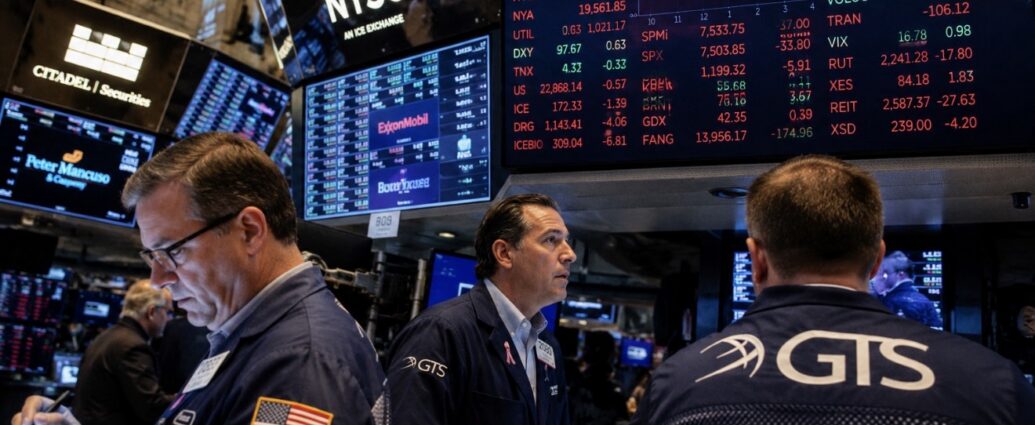
NEW YORK — Wall Street finished sharply mixed on Wednesday, July 8, after President Donald Trump, speaking at the NATO Summit in Ankara, Turkey, declared that the ceasefire and memorandum of understanding between the United States and Iran was “over,” reigniting fears of a broader Middle East conflict, sending oil prices sharply higher and knocking the Dow Jones Industrial Average lower.
The market’s message was clear: geopolitics is once again driving Wall Street.
The Dow Jones Industrial Average fell 576.76 points, or 1.09%, to 52,348.39. The S&P 500 slipped 0.28% to 7,482.71, while the technology-heavy Nasdaq Composite managed to rise 0.20% to 25,870.65, supported by strength in several large technology companies. The Russell 2000 lost about 0.9%, while the CBOE Volatility Index (VIX), Wall Street’s closely watched fear gauge, climbed nearly 4% as investors sought protection against further market swings.
The day’s biggest catalyst came from Ankara.
Speaking to reporters on the sidelines of the NATO summit, Trump said he considered the ceasefire with Iran finished, dismissed further negotiations and warned that additional U.S. military action could follow. His comments came after overnight U.S. strikes on Iranian targets and renewed attacks on commercial vessels near the Strait of Hormuz, one of the world’s most strategically important shipping lanes.
Investors immediately focused on oil.
Brent crude, the global benchmark, surged 5.43% to settle at $78.19 per barrel, while West Texas Intermediate climbed 4.37% to $73.52 per barrel, marking one of the strongest single-day advances in weeks.
Higher oil prices tend to benefit energy producers, but they also raise transportation costs, pressure manufacturers, squeeze airline profits and eventually work their way into gasoline prices and consumer inflation. That combination weighed heavily on many industrial and consumer-focused companies that make up the Dow.
Technology stocks told a different story.
The Nasdaq managed to finish higher thanks to continued strength in several semiconductor and artificial intelligence-related companies.
Broadcom gained after Apple announced an expanded multiyear partnership expected to exceed $30 billion. The agreement calls for more than 15 billion American-made chips and includes a $1.5 billion expansion of Broadcom’s manufacturing facility in Fort Collins, Colorado, representing Apple’s largest domestic manufacturing commitment to date.
Several other technology companies also attracted buyers. Penguin Solutions rallied following its earnings report, while Alibaba, Akamai Technologies and Arista Networks also posted gains as investors continued rotating toward companies viewed as having strong long-term growth prospects.
Not every traditional safe haven moved as expected.
Gold futures fell approximately 1.6%, extending a pullback from record highs reached earlier this year. Rather than moving aggressively into precious metals, investors largely focused on energy markets and selective opportunities within technology.
The Federal Reserve also remained on investors’ radar.
Market participants continued digesting the latest Fed meeting minutes, which highlighted persistent inflation risks despite easing labor-market concerns.
Adam Phillips, Managing Director of Investments at EP Wealth Advisors, said the minutes reinforced the Federal Reserve’s cautious stance.
“The minutes demonstrated the Fed’s hawkish bias, highlighting that upside inflation risks remain while concerns around the labor market have eased,” Phillips said, adding that renewed tensions in the Middle East only increase uncertainty surrounding inflation and monetary policy.
Those concerns were echoed in the latest outlook from the International Monetary Fund, which projects oil prices to remain significantly higher next year while forecasting global inflation of 4.7% in 2026, underscoring the possibility that inflationary pressures may persist longer than many investors had hoped.
There was also notable activity outside the public markets.
Blue Origin, the aerospace company founded by Jeff Bezos, is reportedly seeking approximately $10 billion in its first outside funding round, a transaction that would value the company at roughly $130 billion. Bezos is expected to contribute about $2 billion, alongside major institutional investors.
Meanwhile, SpaceX, which entered the public markets last month under the ticker SPCX, posted a modest gain after a volatile start to life as a publicly traded company.
For business owners, investors and consumers, Wednesday’s trading served as another reminder that events halfway around the world can quickly affect everyday life at home. Rising crude oil prices often translate into higher gasoline prices, increased shipping costs, more expensive airline travel and additional inflationary pressure throughout the economy.
Wall Street’s split performance reflected exactly that reality. Technology continued attracting investment, but companies tied more closely to energy costs came under pressure. As long as tensions surrounding Iran and the Strait of Hormuz remain unresolved, energy markets are likely to remain one of the biggest forces shaping both Wall Street and Main Street.
JBizNews Desk | Wall Street
© JBizNews.com All Rights Reserved. Reproduction or distribution without written permission is prohibited.