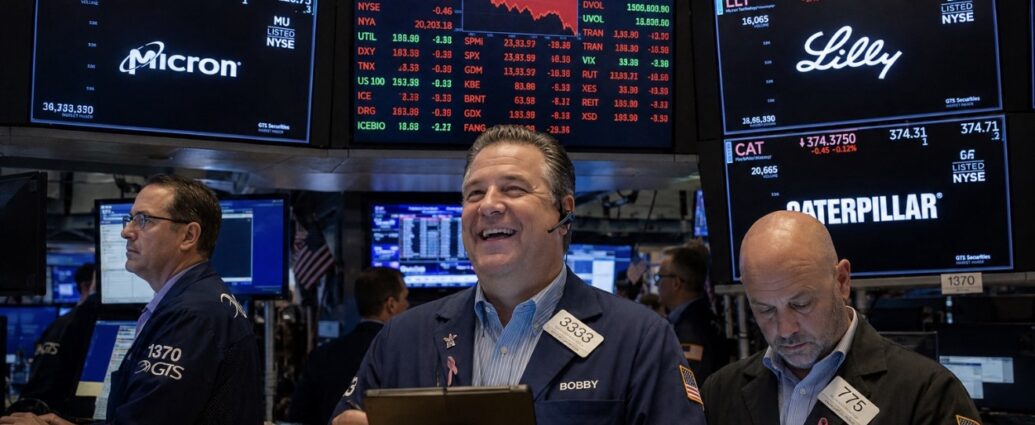
The Dow Jones Industrial Average closed at a fresh all-time high on Thursday, June 25, after the Commerce Department reported that the Federal Reserve’s preferred inflation gauge ran hotter than it has in more than two years, even as a blockbuster earnings report from Micron Technology and a sell-off in Apple split Wall Street down the middle.
The blue-chip index rose roughly 300 points, about 0.6%, to a new record, topping its prior peak set on June 16. The gains came from outside technology, with healthcare, financial, and industrial names carrying the load. The S&P 500 finished little changed, while the tech-heavy Nasdaq Composite slipped about 0.4% as the market’s biggest companies fell out of favor.
The session reflected a market rotating away from the handful of mega-cap technology companies that have powered much of Wall Street’s rally this year and into more traditional sectors viewed as better positioned for a higher-interest-rate environment.
Driving the day’s trading was the latest inflation report. The personal consumption expenditures (PCE) price index, the Federal Reserve’s preferred inflation gauge, rose at a 4.1% annual rate in May, the highest reading since April 2023, while prices increased 0.4% from the previous month. Excluding food and energy, core PCE climbed 3.4% from a year earlier. Although the annual reading matched economists’ expectations, the monthly increase came in slightly below forecasts, helping calm fears that inflation was accelerating even further.
The rise in inflation has been fueled in part by higher energy costs following the U.S.-Iran war, which began on February 28 and pushed oil prices sharply higher during the spring. Chicago Federal Reserve President Austan Goolsbee told CNBC that inflation remains “too high” and is moving in the wrong direction, while many Federal Reserve officials continue signaling that additional interest-rate increases later this year remain on the table.
Market movers
The day belonged to Micron Technology, whose shares surged about 17% after the memory-chip maker reported fiscal third-quarter results that easily exceeded Wall Street’s expectations. The company earned an adjusted $25.11 per share, well above analysts’ estimates of $20.78, while revenue climbed to $41.46 billion, more than four times the $9.3 billion reported during the same period last year.
Micron also forecast approximately $50 billion in revenue for the current quarter and highlighted 16 long-term supply agreements, easing concerns that demand tied to artificial intelligence infrastructure was beginning to cool.
The strong results lifted the broader semiconductor sector. Qualcomm climbed about 10% after raising its outlook for non-handset revenue and announcing a new partnership with Meta Platforms.
Technology’s biggest drag came from Apple, whose shares fell about 4% after announcing price increases across portions of its MacBook and iPad lineup, citing rising memory and semiconductor costs. The move raised fresh concerns that higher component prices are beginning to flow through to consumers.
Microsoft also declined nearly 4% after announcing price increases for several Xbox consoles, including a $100 increase for its 512-gigabyte model and a $150 increase for its 1-terabyte version.
Outside technology, Caterpillar advanced about 5%, while JPMorgan Chase gained roughly 2% after naming Doug Petno and Troy Rohrbaugh as co-presidents, another step in Chief Executive Jamie Dimon’s long-term succession planning.
One of the session’s biggest winners was Bayer, whose U.S.-listed shares soared approximately 16% after the U.S. Supreme Court ruled 7-2 that the company was not required to provide additional warnings regarding alleged health risks associated with its Roundup weedkiller, significantly reducing legal uncertainty surrounding thousands of pending lawsuits.
Food manufacturer McCormick & Company also moved higher after reporting adjusted earnings of 80 cents per share, comfortably exceeding analysts’ expectations of 69 cents, as consumers continued spending more on meals prepared at home.
Commodities and volatility
Oil prices edged higher following reports that Iran’s Revolutionary Guard attacked a vessel in the Strait of Hormuz, renewing concerns about potential disruptions to one of the world’s most important energy shipping lanes. Despite the gains, crude oil remained well below the highs reached immediately after the conflict began earlier this year.
Gold hovered near the $4,000-per-ounce level as investors continued balancing inflation concerns with safe-haven demand.
Meanwhile, the Cboe Volatility Index (VIX), Wall Street’s closely watched fear gauge, remained near 19, suggesting investors remain cautious but not overly concerned about near-term market volatility.
For consumers, Thursday’s trading highlighted two competing realities. Strong gains in industrial, healthcare, and financial stocks suggest the broader economy remains resilient, but persistent inflation and rising technology prices from companies such as Apple and Microsoft indicate households continue facing higher costs for everyday products. At the same time, the Federal Reserve appears more focused on containing inflation than providing relief through lower interest rates.
Investors will now turn their attention to Friday’s final reading of the University of Michigan’s June Consumer Sentiment Index, which could offer additional insight into how Americans are feeling about inflation, spending, and the overall economy.
JBizNews Desk
© JBizNews.com All Rights Reserved. Reproduction or distribution without written permission is prohibited.