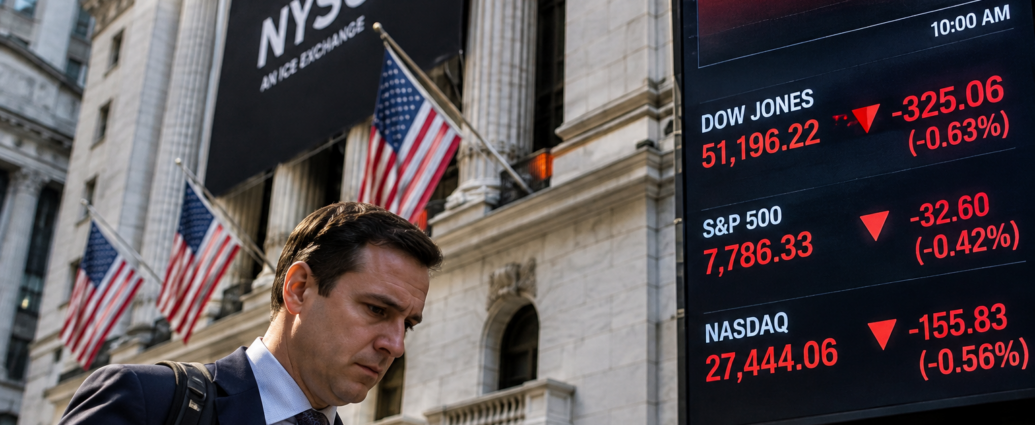
Wall Street opened sharply lower Wednesday, giving back part of Tuesday’s record-setting rally as Treasury yields surged back to multidecade highs and oil climbed above $100 a barrel.
The Dow Jones Industrial Average opened at 51,196.22, down 325.06 points, or 0.63%. The S&P 500 opened at 7,786.33, down 32.60 points, or 0.42%, while the Nasdaq Composite opened at 27,444.06, down 155.83 points, or 0.56%. Selling intensified during the first half-hour, with the Dow down roughly 450 to 500 points, the S&P 500 off about 0.6% and the Nasdaq down close to 0.9%.
That reverses some of Tuesday’s strength, when the S&P 500 and Nasdaq both finished at record highs.
The biggest problem Wednesday morning is once again the bond market.
The 10-year Treasury yield climbed to roughly 5.35%-5.36%, near its highest level since 2002, while the 30-year yield briefly reached 5.7041%, another 24-year high. Investors are demanding significantly more compensation to lend the federal government money long term as they weigh persistent inflation, heavy Treasury borrowing and uncertainty over how many additional Federal Reserve rate increases may still be coming.
For businesses, this is no longer an abstract Wall Street issue. A 10-year Treasury yield above 5.3% feeds directly into mortgages, commercial real-estate loans, corporate borrowing, equipment financing and the cost of refinancing debt.
Wednesday morning’s main U.S. economic report showed that pressure clearly.
The average 30-year fixed mortgage rate jumped 19 basis points to 7.49% last week, its highest level since November 2023, according to the Mortgage Bankers Association. Mortgage applications fell 4.2% from the previous week, with total application volume now at its lowest since February 2025 and nearly 50% below January levels.
That is the morning economic story in one sentence: higher Treasury yields have moved directly into the real economy, and homebuyers are pulling back.
There were no other major national U.S. economic releases before the opening bell Wednesday, leaving bonds, oil, corporate news and the Federal Reserve to drive trading.
Oil is adding to the pressure.
Brent crude climbed above $101 a barrel, while West Texas Intermediate traded around $90 as investors reacted to renewed Middle East fighting and a developing Gulf of Mexico storm that threatens U.S. offshore production. Offshore areas potentially in the storm’s path account for roughly 15% of U.S. crude production and 5% of natural-gas production.
That combination is exactly what markets do not want to see: borrowing costs rising while energy costs rise at the same time.
The International Energy Agency is also discussing another coordinated release of oil and diesel reserves as governments try to contain fuel costs. The G7 has already agreed to a new 100 million-barrel release amid unusually tight diesel markets.
Technology stocks are among the hardest hit as higher yields pressure valuations.
Micron Technology fell more than 2% before the bell after a union representing workers at its Taoyuan operations in Taiwan received authorization to strike. Taiwan is one of Micron’s most important manufacturing centers for DRAM and high-bandwidth memory used in AI servers. Ninety-nine percent of participating union members voted to authorize a strike, although no strike date has been set.
AMD, Broadcom and Marvell also traded lower ahead of the opening, extending the pressure across semiconductors after several days of strong AI-driven gains.
Another major AI story is SpaceX.
The company is reportedly seeking $40 billion in financing led by Apollo Global Management to purchase Nvidia chips, including roughly $10 billion of bank loans and $30 billion of investment-grade debt. The financing would be one of the clearest examples yet of how enormous the capital requirements of the AI buildout have become. Morgan Stanley estimates the industry could require $1.5 trillion of outside financing by 2028. SpaceX shares fell after the report.
That story matters beyond SpaceX. AI companies are increasingly turning not only to cash flow and equity markets but also to enormous debt packages to finance chips and data centers. With Treasury yields above 5%, the price of funding that expansion is becoming an increasingly important part of the AI investment equation.
Constellation Brands fell sharply in early trading, dropping roughly 7% despite beating Wall Street expectations for quarterly profit and sales.
The Corona and Modelo maker reported $2.63 billion in quarterly sales, ahead of the $2.54 billion analysts expected, and adjusted earnings of $3.74 a share, above the $3.56 consensus. But investors focused on management lowering its annual operating-margin forecast to 31%-32% from 32%-33%.
That is a useful consumer signal. Sales are holding up, but higher input costs and softer discretionary spending are making it harder for companies to turn revenue into profit.
On the upside, Neogen jumped more than 14% after reporting first-quarter earnings of 8 cents a share versus the 5 cents analysts expected and revenue of $222.8 million, well above the roughly $204.7 million consensus. The food- and animal-safety company also raised its full-year revenue outlook.
Penguin Solutions also gained after another strong AI-infrastructure report. Quarterly revenue surged 68% to roughly $567 million, while adjusted earnings reached $1 a share. AI-related businesses accounted for 78% of quarterly revenue, and management raised its fiscal 2027 outlook.
One of the morning’s largest individual declines is Webull, which fell roughly 20% after a bipartisan House committee raised national-security concerns over the online brokerage’s ties to China. The company disputed the characterization and says U.S. customer data is controlled domestically, but the report creates a new regulatory risk for the platform.
For the rest of Wednesday, there are three major events capable of moving markets.
At 10:30 a.m. ET, the Energy Information Administration releases weekly U.S. petroleum inventories. With Brent already above $101, a large inventory draw could push energy prices higher and increase inflation concerns.
At 1 p.m. ET, the Treasury will sell $39 billion of 10-year notes. Demand for that auction may be as important for stocks as any corporate headline Wednesday. Weak demand could push the 10-year yield still higher and put another wave of pressure on equities.
Then at 2 p.m. ET, the Federal Reserve releases the minutes from its September meeting, when policymakers unanimously raised rates by a quarter point to 3.75%-4.00%. Investors will be looking for how deeply divided officials are over another increase. Markets currently see only about a 22% chance of an October hike, down from roughly 50% a week ago, but a December increase remains very much in play.
That makes Wednesday’s setup straightforward:
The 10-year Treasury is near 5.36%.
Mortgage rates have jumped to 7.49%.
Oil is back above $101.
And the Fed minutes arrive this afternoon.
Stocks entered Wednesday at record territory.
The question now is how long corporate earnings and AI spending can keep overpowering increasingly expensive money.
JBizNews Desk | New York
© JBizNews.com. All rights reserved. Unauthorized reproduction or redistribution is strictly prohibited.