
Ellen Monique Chits, a 56-year-old Dutch Christian whose grandfather and great-grandparents were recognized as Righteous Among the Nations, spent the last two years seeking permanent residency in Israel after the Interior Ministry rejected her application.
Her attorney argued that the rejection conflicts with a Population and Immigration Authority procedure and a January 2026 District Court ruling that he says extended eligibility to grandchildren of Righteous Among the Nations regardless of age.
Chits has visited Israel repeatedly over the years. Following the October 7 massacre, she returned for extended stays to help Israelis affected by the war. She is currently living in Haifa and studying Hebrew at the University of Haifa.
Chits is the granddaughter of Frederik Jan Kerkhof and the great-granddaughter of Jan Kerkhof and Klaartje Kerkhof-van de Waal. All three were recognized as Righteous Among the Nations after risking their lives to save Jews in the Nazi-occupied Netherlands.
The Kerkhof family protected two Jewish brothers who were being persecuted by the Nazis, hiding them in the attic of the family home before helping them move to other hiding places.
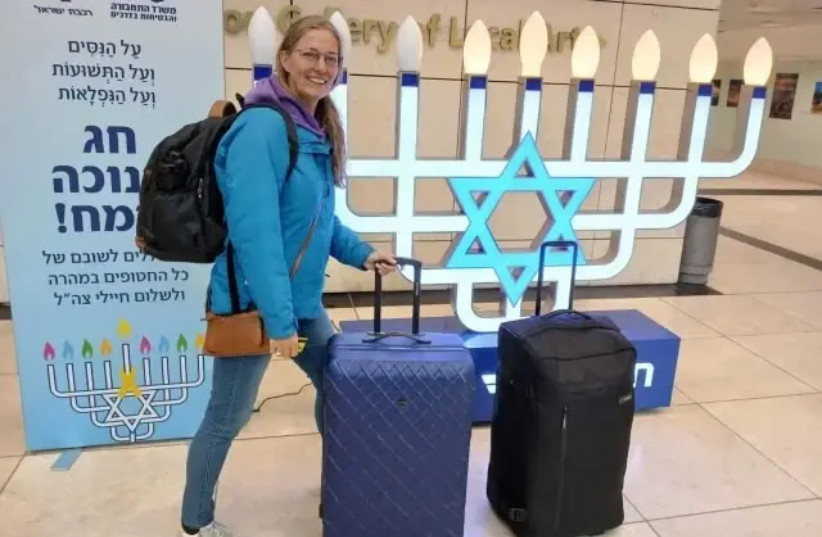
A bond with Israel deepens
In an interview with Walla, Chits described her connection to Israel as a love story that developed gradually, long before she knew she might be eligible to apply for legal status in the country.
She said she first learned about her family’s rescue efforts in 1998, when her grandfather was recognized as Righteous Among the Nations, but did not attach particular significance to the story at the time.
The family’s history became meaningful to her only after she began visiting Israel in 2018, motivated by curiosity and a desire to see the places she had grown up hearing about in biblical stories.
During a visit to Yad Vashem, she said, she quickly found extensive documentation of what her grandfather and his parents had done, saw their names engraved at the site, and learned about the recognition they had received.
Chits then began researching her family’s history and collecting testimony from relatives. She said she felt great pride in a legacy of “selfless love” toward the Jewish people.
Since then, she has developed a strong emotional bond with Israel, she said. She has visited about 10 times, sometimes staying for weeks and sometimes for months, and has felt a “magnetic force” drawing her back each time.
Chits was visiting Jerusalem as a tourist on October 7, 2023. When the war began, she said, she did not want to flee but instead felt compelled to remain and help.
“Sometimes you just have to do the right thing, and you get the opportunity to do the right thing,” she said.
Chits asked her employer to allow her to remain in Israel and help during the war, but the director of the hospital where she worked refused, forcing her to return to the Netherlands.
She continued supporting Israel from there, helping recruit Dutch volunteers for agricultural work, soup kitchens, transportation, and other assistance programs. She also helped about 50 Dutch people find volunteer placements in Israel.
Chits eventually resigned from her position as a healthcare manager and returned to Israel several times to volunteer. Her work included agricultural harvesting, preparing food for people in need, assisting older adults, and volunteering with OneFamily, which supports families affected by terrorism and war.
She now hopes to integrate into Israeli society and find work in the country.
Chits said her connection to Israel comes from two sources: her faith in the God of Israel and long familiarity with biblical stories, as well as a deep identification with the Jewish people and the suffering they have experienced through war and terrorism.
She said she feels “at home” in Israel, believes she has a duty to help people in distress, and views her actions as a natural continuation of the values she was raised with as a descendant of a Righteous Among the Nations.
“Sometimes you just have to do the right thing, and you get the opportunity to do the right thing, and on October 7 I felt I needed to stay here because it was the right thing to do,” she said.
“I did not know what it meant and what the consequences would be. But then people told me I really could stay, and it felt so right to continue in the path of my grandfather, who did the right thing. It may cost me; I have no idea. But what matters most to me is doing the right thing. That is what I will do, and I will not give up. It is that simple.”
Application rejected over age restriction
During that visit, Chits learned that the Population and Immigration Authority had a procedure governing residency permits for the children and grandchildren of Righteous Among the Nations. The English-language version of the government website also appeared to state that grandchildren were eligible.
On that basis, Chits applied for legal status in Israel in July 2024.
Despite submitting all the requested documents, the Population and Immigration Authority rejected her application in November 2024 because she was not a minor.
The authority maintained that, following an update to the procedure in May 2022, eligibility among grandchildren of Righteous Among the Nations was limited to minors. The rejection letter also instructed Chits to leave Israel by January 2, 2025.
Chits filed an internal appeal with the Population and Immigration Authority, which was rejected on November 28, 2024.
She then contacted attorney Yehoshua Pex of the Decker, Pex, Levi law firm, who filed an appeal on her behalf with the Jerusalem Appeals Tribunal.
The appeal asked the tribunal to order the Population and Immigration Authority to grant Chits legal status under the Righteous Among the Nations procedure or, alternatively, to grant her status on humanitarian grounds.
It argued that the Interior Ministry’s position was formalistic, rigid, and failed to consider the purpose of the procedure.
According to Pex, the procedure was not intended to be merely a technical mechanism, but an expression of Israel’s recognition and appreciation of Righteous Among the Nations and their descendants.
“Righteous Among the Nations acted during the Holocaust. Even if a Righteous Among the Nations was very young at the end of World War II, by now he would be 100 or more. Therefore, the requirement that his grandchildren be minors is a requirement that can hardly ever be met, and so this limitation in the procedure drains it of all content.”
Pex also argued that the English-language information published on the government website was incomplete or misleading because it did not clearly state the age restriction.
The authority knew Chits’s age from the beginning of the process, he said, but nevertheless continued asking her to submit additional documents despite knowing that she was not a minor.
The Appeals Tribunal rejected the appeal.
In January 2026, however, the District Court ruled in a similar case that the procedure for obtaining legal status would apply to the children and grandchildren of a Righteous Among the Nations regardless of age, according to Pex.
Following the ruling, Pex submitted a renewed application for legal status on Chits’s behalf. Despite repeated inquiries, he said, the Interior Ministry has not provided a substantive response.
“Ellen Monique Chits is not asking for preferential treatment,” Pex emphasized. “She is asking that her request be examined under the procedure that was designed precisely for cases like this, descendants of Righteous Among the Nations who seek to tie their fate to the State of Israel.”
Chits said her case was not solely a personal matter, but an issue of principle that could affect other children and grandchildren of Righteous Among the Nations.
The number of potential applicants appears to be limited. As of last year, only about 165 people were known to have applied to live in Israel under the procedure, and just 61 had completed the process of obtaining Israeli residency.
“This is a unique procedure formulated for Righteous Among the Nations, their children and grandchildren,” the Population and Immigration Authority told Walla in response. “Within this framework, each request is examined according to its unique circumstances, and comparison is irrelevant. In this case, the applicant previously submitted a request, but because she did not meet the procedural requirements, it was refused. That refusal was upheld in a court ruling. She has now submitted another request, and the request will be examined in accordance with the procedure.”




