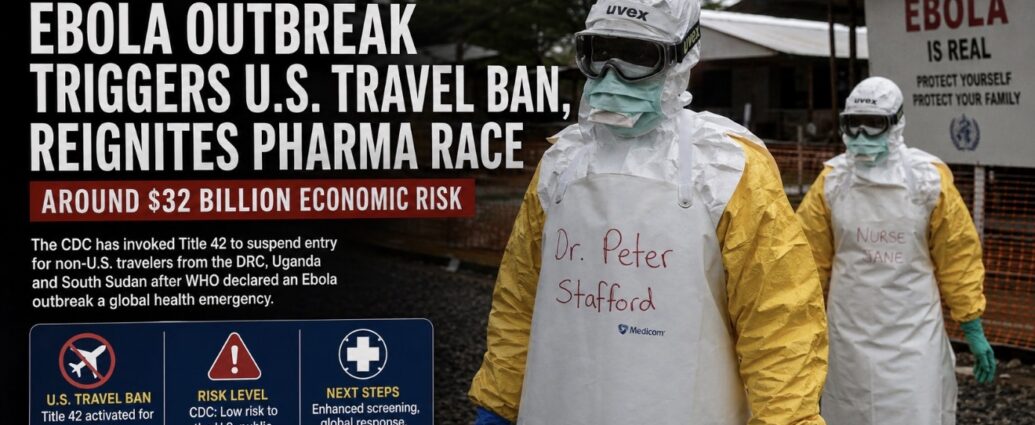
The U.S. Centers for Disease Control and Prevention has invoked Title 42 to suspend entry into the United States for non-American travelers who have recently been in the Democratic Republic of Congo, Uganda or South Sudan after the World Health Organization declared an Ebola outbreak in central Africa a “public health emergency of international concern” and one American missionary doctor working in the region tested positive for the virus. The emergency order, signed Monday by Dr. Jay Bhattacharya and effective immediately, marks only the second major use of Title 42 in the modern era following its controversial deployment during the Covid-19 pandemic and has reignited a global scramble for treatments targeting a deadly Ebola strain for which there is currently no approved vaccine or FDA-authorized drug.
The 30-day travel restriction arrives alongside a State Department Level Four advisory warning Americans against all travel to affected regions. The CDC said the immediate risk to the broader U.S. public remains “low,” but officials emphasized that screening measures and restrictions could expand depending on how the outbreak evolves in coming weeks.
The outbreak, formally declared Sunday by WHO Director-General Dr. Tedros Adhanom Ghebreyesus, is being driven by the rare Bundibugyo strain of Ebola and has already killed at least 131 people with more than 500 suspected cases, according to DRC Health Minister Dr. Samuel Roger Kamba. The first known suspected infection reportedly involved a healthcare worker who developed symptoms in late April, suggesting the virus circulated undetected for weeks before authorities identified the outbreak.
An American Christian missionary physician working in northeastern Congo, Dr. Peter Stafford, tested positive for Ebola while serving at a hospital in Bunia, according to international medical charity Serge. Stafford is being transferred to Germany for treatment along with his wife, children and another physician. None of the accompanying family members are currently symptomatic.
What the Outbreak Actually Is — and How Ebola Spreads
Ebola is a viral hemorrhagic fever — a severe disease capable of causing high fever, organ damage, internal bleeding and, in many cases, death. The current outbreak involves the Bundibugyo strain, one of the rarest known Ebola variants and only the third major Bundibugyo outbreak ever recorded globally.
Unlike Covid-19, Ebola is not airborne.
A person cannot contract Ebola simply by sitting near someone on an airplane, sharing a subway ride or being in the same room with an infected person who is not showing symptoms. The virus spreads only through direct contact with bodily fluids — including blood, saliva, vomit, sweat, diarrhea or contaminated medical equipment — from someone who is already visibly ill.
That distinction dramatically limits transmission potential compared with respiratory viruses.
Dr. Dean Blumberg, an infectious-disease specialist cited by CNBC, emphasized that Ebola does not spread during its incubation period, which can last up to 21 days. In practical terms, a person who appears healthy is generally not contagious.
Symptoms initially resemble severe flu-like illness, including fever, headache, muscle aches and fatigue, before progressing in some patients into vomiting, severe diarrhea, bleeding complications and organ failure.
Historically, Bundibugyo outbreaks have carried mortality rates between roughly 25% and 50%, significantly below the far deadlier Zaire strain responsible for the catastrophic 2014-2016 West African epidemic that killed more than 11,000 people.
How This Affects Americans at Home
For the average American household, the immediate health threat remains extremely limited, according to federal health authorities.
The U.S. government’s emergency order blocks entry for most non-U.S. citizens who have recently traveled through the affected countries. American citizens and military personnel remain exempt but are subject to enhanced screening and monitoring procedures.
Travelers from affected regions are being routed through designated U.S. airports equipped with expanded public-health screening capabilities, and hospitals nationwide have reportedly been placed on alert for potential cases involving symptomatic travelers.
A key reason officials remain relatively calm is that Ebola lacks the asymptomatic airborne transmission dynamics that allowed Covid-19 to spread globally at extraordinary speed.
Past Ebola outbreaks produced isolated cases in the United States — including 11 cases during 2014 — but never triggered sustained community transmission.
Still, the outbreak creates a complicated wrinkle for international travel and major events. The Democratic Republic of Congo’s national soccer team is currently scheduled to base operations in Houston during the 2026 FIFA World Cup, raising new questions about screening, logistics and travel restrictions should the outbreak continue expanding.
Where Americans Will Feel the Impact
Most Americans are more likely to feel the effects economically and psychologically rather than medically.
Travel disruptions are already emerging across parts of central and East Africa as airlines reassess routes, governments tighten screening requirements and travelers reconsider plans. Additional quarantine requirements or flight cancellations could follow if cases spread geographically.
Financial markets are also reacting.
Pharmaceutical companies tied to Ebola countermeasures — including Regeneron Pharmaceuticals, Merck & Co., and Johnson & Johnson — are expected to see heightened investor attention as governments evaluate potential stockpiling contracts and emergency procurement activity.
At the same time, travel-sensitive stocks such as airlines, tourism operators and international hospitality firms could face pressure if outbreak fears intensify.
Public-health officials are also battling something harder to quantify: pandemic fatigue and public anxiety.
The phrase “global health emergency” now carries enormous emotional weight after Covid-19, even though experts stress the current Ebola outbreak operates under very different biological conditions.
The $32 Billion Economic Warning
The economic consequences of uncontrolled Ebola outbreaks are not theoretical.
The World Bank estimated the 2014-2016 West African Ebola epidemic caused approximately $32.6 billion in global economic damage through lost GDP, collapsed tourism, disrupted supply chains, labor-market losses and trade interruptions across affected regions.
Those losses extended far beyond healthcare systems themselves.
Past pandemic modeling by economists has repeatedly shown that infectious-disease outbreaks can trigger cascading effects throughout global commerce, transportation, consumer behavior and investment markets — even when outbreaks remain geographically concentrated.
That economic reality helps explain why governments, global-health organizations and philanthropic groups increasingly treat epidemic preparedness as a national-security and economic-stability issue rather than purely a humanitarian one.
The Pharmaceutical Gap
Despite nearly five decades since Ebola was first identified in 1976, the pharmaceutical industry still lacks approved countermeasures for several Ebola strains, including Bundibugyo.
The only FDA-approved Ebola treatment currently available is Inmazeb, developed by Regeneron Pharmaceuticals and approved in 2020. The only FDA-approved Ebola vaccine is Ervebo, manufactured by Merck & Co. A second vaccine developed by Johnson & Johnson has received authorization in Europe.
However, all existing approved therapies target the Zaire Ebola strain — not Bundibugyo.
Animal studies suggest currently approved vaccines may provide limited protection against the strain now spreading in central Africa.
Dr. Paul Offit, director of the Vaccine Education Center at Children’s Hospital of Philadelphia, said several Bundibugyo-specific vaccine candidates remain stuck in early-stage development, including experimental mRNA platforms under study internationally.
The CDC said the federal government is evaluating experimental monoclonal antibody treatments that have shown protective effects in animal testing.
The Broken Economics of Ebola Drug Development
The absence of fully developed Bundibugyo treatments highlights a longstanding market failure inside global pharmaceuticals.
Developing vaccines for rare outbreak diseases is extraordinarily expensive and often commercially unattractive because outbreaks emerge unpredictably and primarily affect lower-income regions with limited purchasing power.
Industry estimates place advanced vaccine-development costs well above $100 million per strain-specific program, while commercial revenue opportunities remain relatively modest outside emergency procurement periods.
That mismatch leaves governments, nonprofits and international coalitions such as CEPI, Gavi, and BARDA heavily responsible for funding much of the world’s epidemic-preparedness infrastructure.
What This Outbreak Changes
The current outbreak is likely to accelerate three major trends.
First, governments are expected to expand emergency stockpiles of existing Ebola vaccines and therapeutics, potentially benefiting Merck, Regeneron and Johnson & Johnson through new procurement contracts.
Second, funding for Bundibugyo-specific vaccine development is expected to increase sharply, particularly through public-private partnerships and international preparedness programs.
Third, investors are likely to revisit pandemic-preparedness companies and rapid-response biotech platforms, including firms focused on mRNA technologies, antiviral therapies and outbreak-response infrastructure.
The broader question facing policymakers and drugmakers now is whether this outbreak finally produces sustained long-term investment into Ebola preparedness — or whether funding once again fades after the headlines disappear.
JBizNews Desk
© JBizNews.com. All rights reserved. This article is original reporting by JBizNews Desk. Unauthorized reproduction or redistribution is strictly prohibited.