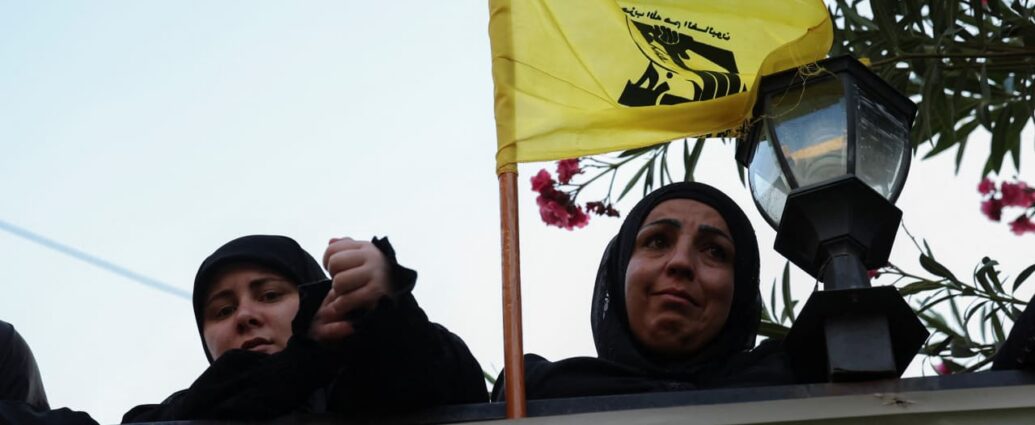
The economic consequences of Hezbollah’s decision to drag Lebanon into another war on behalf of the Islamic Republic have the terror group’s Shiite support base increasingly looking to ideological alternatives, according to an assessment published by the Meir Amit Intelligence and Terrorism Information Center (ITIC).
Still recovering from the cost of Hezbollah’s decision to attack Israel on October 8, 2023, in support of its terror ally Hamas’s attacks on southern Israel, confidence in Hezbollah’s ability to pay the cumulative cost of damage is quickly dampening, and some of its supporter base are beginning to look for political alternatives.
Many want to see a group emerge that is loyal to Beirut, seeking to reduce Iran’s control over Lebanon, though such desires have yet to materialize into a real alternative, ITIC noted in its assessment.
The Forum of Shi’ite Lebanese, established in June 2025, has manifested as a potential future alternative, emphasizing the need to return the powers of security, war and peace to the Lebanese state, strengthen the Lebanese army, and establish a broad national partnership of all components of Lebanese society. The group advocated for positive, but not subordinate, relations with Iran.
A ‘standstill’ in Lebanon
Lieutenant-Colonel (res.) Dr. Moran Levavoni, a researcher with the Institute for National Security Studies, explained to The Jerusalem Post that there was still very much a “standstill” in Lebanon, especially given Iran’s recent success in negotiations with the United States.
“We are in a sort of a standstill. While Hezbollah supporters are celebrating the victory of Iran and especially the approval of Trump to the Iranian victory and patronage over Lebanon, its opponents are very strict with the notion that they don’t want to have Iranian sovereignty over Lebanon,” Levanoni highlighted.
The Islamic Republic asserted during negotiations that it expected a ceasefire on all fronts, including Israel’s war against Hezbollah in Lebanon. The agreement with Washington came as Beirut negotiated its own agreement with Israel through the United States, a course of action that had Hezbollah threatening civil war.
Jerusalem agreed to a ceasefire with the terror group on Friday, though Hezbollah quickly violated the ceasefire on Friday and Saturday by launching waves of attacks on IDF troops in southern Lebanon. One soldier was killed and 13 injured.
Israel’s response to Hezbollah’s violations, strikes on several Hezbollah terrorists and terror infrastructure sites, saw more than 80 people killed, according to Lebanon’s health ministry.
Civilians have often been forced to pay the price for Hezbollah’s actions, ITIC noted. Between October 8, 2023, and November 27, 2024, more than 3,700 were killed, about 30% of them women and children. Though the majority of those killed were understood to be Hezbollah operatives, the conflict also saw nearly 900,000 people were displaced, the overwhelming majority from Lebanon’s Shi’ite areas. This latest round has also seen around 20% of Lebanon’s population internally displaced, according to UN figures.
The reality of the financial consequences has left Hezbollah’s economic arm struggling to compensate those impacted by its actions, ITIC claimed. In addition to high demand, international sanctions and Israeli attacks have weakened Hezbollah’s ability to provide support.
Hezbollah’s support base forced to return to conflict zones
Lebanese reports suggest that civilians in Hezbollah’s support base have been forced to return to conflict zones, no longer able to pay the price of relocation. A poll by Statistics Lebanon showed the economy remains Lebanon’s deepest concern, and a poll by the International Information Company found that around 49% want to see a peace agreement with Israel, an increase of 24% from the year prior.
“The continuing deterioration in living conditions and the economic resilience of families, most of whom have still not recovered from the consequences of the war “in support for the Gaza Strip,” is increasing frustration and the erosion or trust, and is fertile ground for the growing criticism of the conflict and the price Lebanese society in general, and the Shi’ite community in particular, are required to pay,” ITIC noted.
Those in Dahiyeh al-Janoubia, finally able to return home, were forced to flee again in early June, creating a sense of psychological exhaustion, the center assessed, and numerous families have begun to accept that they cannot provide a stable future for their children in these communities. Lebanese journalist Nancy al-Laqis predicted the impact on the displaced generation would be felt in the children’s social identities, creating a gap between ideological narratives and the harsh reality they live.
Highlighting this fall from grace is Hezbollah’s failed Beirut rally in May. A body affiliated with the group managed to gather only dozens of Hezbollah supporters, while previous demonstrations have seen thousands in attendance.
Additionally, last month, Hezbollah quietly allowed entry of the Lebanese army for enforcement activity in the heart of the Dahiyeh al-Janoubia, the organization’s stronghold in Beirut. Al-Sharq al-Aswat reported that Hezbollah didn’t confront the move because of growing public sensitivity.
Though reports have yet to materialize on how the deal will impact Hezbollah, the consequences of months of displacement and years of instability will likely hold for many, despite what has been largely viewed as an Iranian victory.