My parents spent a gap year volunteering on Kibbutz Sa’ad, a religious kibbutz in the South, a few kilometers from Gaza, before university. It moved them enough to make aliyah. Some of their friends from those months still live on kibbutzim today.
So I will not pretend to be neutral about the news that came out of the kibbutz world this week. It gave me goosebumps.
This week, as roughly 500 of the movement’s leaders gathered at the Dead Sea for the 11th Kibbutz Leadership Conference, the two great streams of kibbutz life went public with a decision to build a shared home.
Lior Simcha, secretary-general of the Kibbutz Movement, which represents 259 kibbutzim, and Sara Avron, the first woman to lead the Religious Kibbutz Movement and its roughly 23 communities, put their names to a joint future.
They are careful about the word merger.
The kibbutzim are teaching Israel how to live together again
Avron has said plainly that this partnership is not the religious kibbutzim being swallowed into the larger secular body. It is a bayit meshutaf, a shared home, built so that each side keeps its own face.
Omer Geva, the Kibbutz Ein Shemer member who has driven the initiative, told me they are at “stage two or three of 10”; I have a soft spot for these people, and I am not embarrassed by it.
In an age that rewards the loudest ego in the room, the kibbutz movement keeps producing the opposite: idealists. It has given this country a wildly disproportionate share of its soldiers, its officers, its public servants, and its quiet builders.
Most kibbutzim stopped being socialist experiments a long time ago. What survived the privatization of the 1990s was not the ideology but something sturdier: a way of living bound by community and, in the religious kibbutzim, by tradition.
What makes this week different is that it is not another panel about unity. We have had three years of those. Geva is not even on the movement’s payroll.
He came out of the world of hi-tech and of mergers and acquisitions, and he went looking for social impact. He told me that what pushed him was not October 7 itself.
It was the months that followed, when he watched circles of dialogue and shared art and good intentions dissolve within 24 hours.
“The political space,” he said, “is rewarded by polarization and division.”
He wanted a vector that would hold for decades, not for a weekend. He found it in two movements that had already survived October 7 and the fight over the courts and were still standing.
I put the obvious objection to him. Is this not simply one old elite linking arms with another old elite?
He did not flinch. In his telling, the movement that founded the state was never an elite in any comfortable sense. His mother was one year old when the British killed her father. These were people who bled.
And when I asked why start here, why not the moshavim, the haredim (ultra-Orthodox), or the settlers of Judea and Samaria, his answer was disarmingly humble.
You begin with the people closest to you, and you earn the right to reach further. The moshavim, he said, are next.
Here I owe you a confession. One of my favorite university courses was the history of the kibbutz movement. I loved it.The one thing that nagged at me for years was how little the religious kibbutz appeared in it, a sentence here, a footnote there. I assumed it was an oversight. This week, I learned it was something deeper.
The secular kibbutz movement, Geva explained, poured its spiritual energy into remembering. It built the archives and the research institutes, Yad Tabenkin, Yad Yaari – the whole apparatus that turns a movement into a documented history.
The religious kibbutz did the reverse. It poured itself into the future, into yeshivot and mechinot, the study halls and pre-military academies that shape the next cohort.
One movement learned to preserve. The other learned to renew. That is precisely why a history course is found everywhere, and the other almost nowhere. The religious kibbutz was too busy building tomorrow to spend much time cataloging yesterday.
And that, more than any signing, is why this moved me. The thing each movement lacks is the thing the other holds in surplus. Memory marrying vitality.
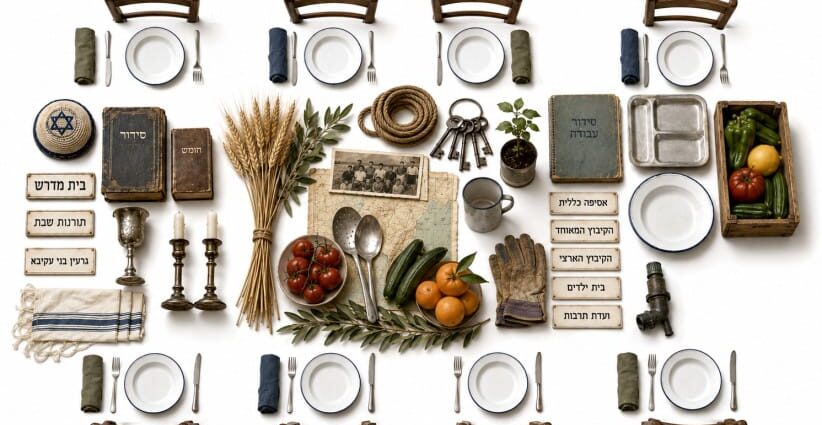
This is not two similar bodies combining to cut costs. It is two halves of a single idea finally sitting at one table.
We learned what that idea is worth over the past two years. When members of these kibbutzim were dragged into the tunnels of Gaza, their communities did not behave like a list of households that happen to share a fence.
They fought for their own as if for family, because that is what they are.
I have written before about the children of the Gaza envelope who were torn from their parents and found themselves in captivity beside neighbors, and how those neighbors watched over them as their own.
In a city, those would have been strangers. On a kibbutz, you are one family, through good times and bad. October 7 was the worst. This is some of the better.
Geva put it to me in a sentence: “We do not have the privilege of refusing to work together, even when we disagree. If we learn how to do that, we will do good for all of Israeli society.”
That course I had loved finally got its missing chapter. It is being written now, in real life, by people who decided that talking was not enough.