By JBizNews Desk
Cairo — May 26, 2026 — Egypt has launched its first nationwide airborne geophysical mineral survey in more than four decades, a major strategic push aimed at transforming the country into a regional mining powerhouse and attracting billions of dollars in foreign investment tied to gold, phosphate, copper and critical minerals.
The announcement was made Sunday by Karim Badawi, Egypt’s Minister of Petroleum and Mineral Resources, during a visit to the country’s flagship Sukari gold mine in the Eastern Desert.
The survey — Egypt’s first comprehensive aerial mineral mapping program since 1984 — comes as Cairo attempts to triple mining’s contribution to national GDP by 2030 while positioning itself as a rising competitor to Saudi Arabia in the global race for strategic mineral supply chains.
Egypt signed the mapping agreement with Spain-based Xcalibur Smart Mapping, one of the world’s leading airborne geophysics firms, under a contract covering six major geological regions stretching across the Eastern Desert, Sinai, the Western Desert and the Bahariya-Abu Tartour corridor.
The project will deploy specialized aircraft equipped with high-resolution magnetic and radiometric sensors capable of identifying underground mineral structures at depths and accuracy levels far beyond Egypt’s existing geological database.
Officials said the resulting data will become the foundation for future international licensing rounds and will headline the revamped Egypt Mining Forum scheduled for September 28–29 in the New Administrative Capital.
The timing reflects a broader strategic shift underway inside Egypt’s economy.
Despite holding significant mineral reserves — including an estimated 9 million ounces of gold and some of the world’s largest phosphate deposits — mining currently contributes less than 1% of Egyptian GDP.
Badawi has publicly committed to raising that figure to approximately 6% by the end of the decade.
The government increasingly sees mining as a critical pillar of foreign direct investment, export revenue and hard-currency generation at a time when Egypt continues operating under an International Monetary Fund stabilization program and faces ongoing pressure on its external finances.
The country has repeatedly devalued the Egyptian pound since 2022 while aggressively seeking new sources of foreign capital.
A modern investor-grade geological database is viewed inside Cairo as one of the key missing ingredients that prevented Egypt from competing effectively with faster-moving mining jurisdictions across the Gulf and Africa.
For years, global exploration firms complained that Egypt’s geological records remained fragmented, outdated and largely unusable for modern resource modeling.
The new airborne survey is designed to change that.
The commercial implications could be significant.
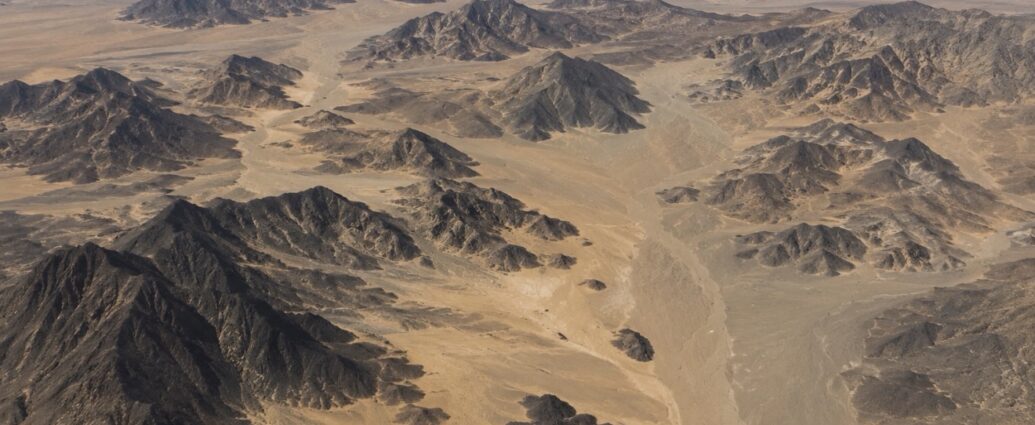
Egypt’s Eastern Desert — particularly the so-called “golden triangle” corridor linking Safaga, Quseir and Qena — is believed to contain extensive reserves of gold, copper, zinc, lead, phosphate and industrial minerals essential to fertilizer production and electric-vehicle battery supply chains.
Global mining companies are already beginning to position themselves.
AngloGold Ashanti entered as a strategic partner in Egypt’s Sukari gold operation, which produced more than 500,000 ounces of gold in 2025 and remains the country’s largest operating mine.
Meanwhile, Chinese industrial giant Hubei Xingfa Chemicals Group has reportedly been negotiating a nearly $2 billion phosphate investment tied to Egypt’s mineral corridor, according to disclosures made earlier this year by Badawi.
The phosphate angle is particularly important because phosphate is a critical input not only for fertilizers but also for lithium iron phosphate battery technology increasingly used across electric vehicles manufactured by companies including Tesla, BYD, Ford and major Chinese battery producers.
Egypt is also attempting to reposition itself legislatively to compete for global exploration capital.
Parliament approved reforms in 2025 converting the former Egyptian Mineral Resources Authority into the more commercially structured Mineral Resources and Mining Industries Authority (MRMIA).
The restructuring gives the authority significantly greater autonomy over contracts, revenue retention and project governance while allowing Egypt to move away from rigid production-sharing frameworks that long discouraged foreign operators.
Badawi has openly acknowledged that Egypt’s previous mining structure left the country uncompetitive compared with jurisdictions such as Saudi Arabia, Australia and Canada.
Saudi Arabia remains Egypt’s clearest regional competitor.
Under Crown Prince Mohammed bin Salman’s Vision 2030 initiative, Riyadh has aggressively expanded its own mining ambitions, unveiling mineral wealth estimates exceeding $2.5 trillion while positioning the Kingdom as a global critical-minerals hub through the Future Minerals Forum and state-backed investments tied to Ma’aden and Manara Minerals.
Egypt is now attempting to market itself as a complementary lower-cost regional alternative with direct access to Red Sea logistics corridors and Suez Canal shipping infrastructure.
The Xcalibur survey is expected to produce detailed mineral mapping data that officials hope will underpin Egypt’s first major international licensing round under the new mining framework.
For commodity markets, fertilizer producers, battery manufacturers and global mining investors, the survey represents more than a technical geology project.
It signals that one of the Middle East and North Africa’s largest untapped mineral jurisdictions is finally opening itself to large-scale competitive development.
After 42 years, Egypt is rewriting its mining maps — and preparing to put its underground wealth on the global auction block.
JBizNews Desk
© 2026 JBizNews. All Rights Reserved. Reproduction or distribution without written permission is prohibited.