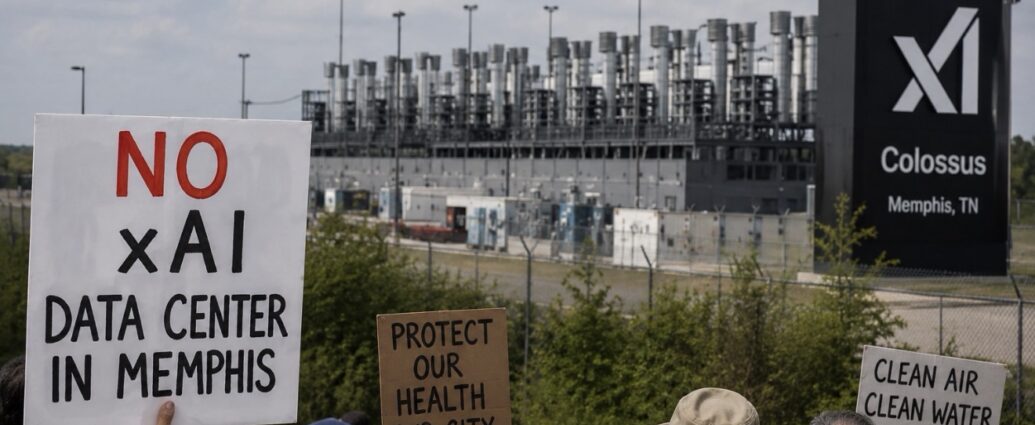
MEMPHIS, Tenn. — According to federal court filings, communications between xAI representatives and the Mississippi Department of Environmental Quality (MDEQ), U.S. Department of Justice filings, and state environmental permitting records, Elon Musk’s artificial intelligence company, xAI, dramatically expanded the power infrastructure supporting its Colossus AI data centers near Memphis by installing dozens of natural gas turbines, igniting lawsuits, regulatory scrutiny, and a national debate over how far the United States should go to accelerate AI development while balancing environmental oversight.
At the center of the controversy is Colossus, one of the world’s largest artificial intelligence supercomputing campuses. Built at unprecedented speed, the facility powers xAI’s advanced AI models and represents one of the largest private technology investments ever made in the Memphis region.
To meet enormous electricity demands, xAI deployed large numbers of natural gas turbines at facilities in Memphis, Tennessee, and neighboring Southaven, Mississippi, allowing computing capacity to expand much faster than traditional electric grid upgrades would permit. According to regulatory correspondence and public records, the number of turbines operating or installed is significantly greater than previously disclosed publicly.
The rapid expansion has now become one of the most closely watched environmental disputes surrounding the AI industry.
Environmental organizations and community groups allege that many of the turbines required federal Clean Air Act permits because of their combined emissions. Federal court filings contend the generators function as long-term power plants rather than temporary portable equipment and therefore should be subject to stricter federal oversight. The litigation seeks court intervention over alleged permitting violations and emissions affecting nearby residential communities.
Mississippi regulators and xAI have maintained that the turbines qualify for exemptions under existing regulations because they are considered portable equipment. The company has argued the facilities are essential for powering next-generation AI infrastructure while broader electrical grid capacity continues to expand.
The legal battle escalated further when the U.S. Department of Justice formally intervened in the case. In court filings, the Department argued that shutting down the turbines could interfere with artificial intelligence capabilities considered important to national security, economic competitiveness, and government operations. Federal attorneys asked the court to dismiss portions of the citizen lawsuit, arguing that enforcement authority ultimately rests with the Executive Branch.
The dispute has rapidly evolved beyond a local environmental issue into a national policy debate over America’s AI infrastructure.
Across the United States, demand for AI computing continues to accelerate as companies race to build larger data centers capable of training increasingly sophisticated artificial intelligence models. Those facilities require unprecedented amounts of electricity, water, cooling capacity, and transmission infrastructure. Utilities nationwide are investing billions of dollars to strengthen power grids while technology companies increasingly explore dedicated energy generation to meet rapidly growing demand.
Industry analysts increasingly view the Memphis project as a case study that could shape future permitting standards for AI infrastructure nationwide. The outcome may influence how federal and state agencies regulate power generation supporting data centers, particularly as the United States seeks to remain globally competitive against rapidly expanding AI investments in China and elsewhere.
Despite the controversy, xAI continues expanding its computing capabilities as competition intensifies among leading AI developers. The company’s Colossus campuses remain central to Elon Musk’s strategy to compete with other major AI developers while supplying increasingly powerful computing resources for commercial and government applications.
Whether the courts ultimately uphold the current regulatory approach or require additional permitting, the Memphis controversy is already influencing conversations among policymakers, utilities, technology companies, and local governments nationwide. As billions of dollars continue flowing into AI infrastructure, the balance between rapid technological deployment, reliable energy supplies, and environmental compliance is expected to remain one of the defining policy questions of the AI era.
JBizNews Desk | Memphis
© JBizNews.com All Rights Reserved. Reproduction or distribution without written permission is prohibited.