NEW YORK — Just a few years ago, some of America’s largest companies declared the college degree outdated.
Executives championed “skills-first hiring,” recruiters celebrated nontraditional talent pipelines, and major employers including IBM, Google, Apple, and Tesla publicly scaled back degree requirements across large portions of their workforce.
Now, the pendulum is quietly swinging back.
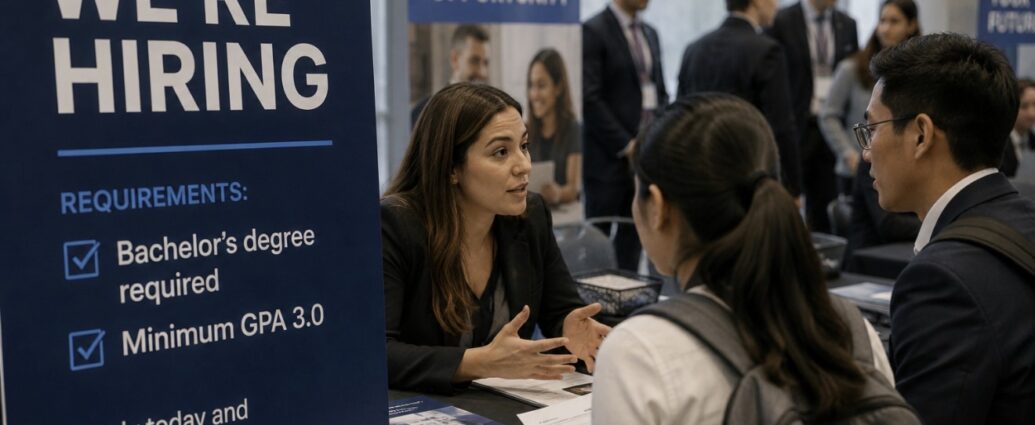
As artificial intelligence rapidly reshapes the labor market, employers are increasingly reinstating college degree expectations and GPA filters — reversing one of the defining hiring trends of the post-pandemic economy and creating new uncertainty for millions of workers who entered the workforce through alternative pathways.
The shift, highlighted in new reporting from Fortune, reflects growing concern among hiring managers that AI is fundamentally changing which human skills remain valuable — and how employers identify candidates most likely to succeed alongside increasingly powerful automation systems.
“Employers are increasingly turning to degree and GPA,” one recruiter told Fortune, describing a noticeable retreat from the “talent is everywhere” philosophy that dominated hiring discussions between 2021 and 2023.
During that period, an unusually tight labor market forced companies to widen recruiting pools aggressively.
Major corporations reduced credential requirements, embraced boot camps and certification programs, and promoted the idea that demonstrated skills mattered more than formal academic pedigree.
The movement also reflected broader criticism of the traditional college system, rising tuition costs, and concerns that rigid credential screening excluded talented workers from lower-income and nontraditional backgrounds.
But the rapid rise of generative AI appears to be changing that calculus.
Across corporate America, artificial intelligence is increasingly automating many of the routine analytical, administrative, and coordination tasks that historically served as entry points for junior and mid-level employees.
That includes functions in:
- Marketing
- Data analysis
- Customer support
- Administrative operations
- Research
- Basic coding
- Financial processing
- Legal review
- Content production
As those tasks become partially automated, companies say the remaining human work is shifting upward toward more complex responsibilities involving judgment, synthesis, relationship management, strategic thinking, and cross-functional coordination.
Many employers increasingly believe those capabilities correlate more strongly with traditional educational pathways — particularly at selective universities.
In effect, AI may be shrinking the category of lower-complexity white-collar work while simultaneously increasing demand for workers perceived as capable of operating at a higher cognitive level alongside advanced software systems.
There is also a more operational reason degree requirements are returning: scale.
As AI-assisted recruiting systems become more common inside hiring pipelines, degree status and GPA scores provide simple, standardized filters that can quickly reduce applicant pools containing thousands or even tens of thousands of resumes.
The irony is difficult to miss.
Artificial intelligence is simultaneously helping automate hiring processes while also contributing to the economic conditions causing employers to rely more heavily on traditional credentials.
The trend is not universal.
In highly technical fields — especially software engineering, cybersecurity, and specialized AI development — portfolio-based hiring and skills assessments remain important, particularly at firms that have already invested heavily in alternative talent evaluation systems.
Startups and smaller firms also continue to rely more heavily on demonstrated capability than formal academic pedigree.
But recruiters say the broader labor market is increasingly drifting back toward credential-based hiring norms, especially for white-collar professional roles where applicant competition has intensified.
That shift carries significant implications for workers who entered the labor force based on the expectation that the economy was permanently moving beyond traditional degree barriers.
Millions of Americans were encouraged over the past several years to pursue certifications, coding boot camps, online learning platforms, and alternative career paths instead of four-year degrees.
Many successfully entered industries that historically would have been difficult to access without traditional academic credentials.
Now, some of those same workers face a labor market in which the signals employers trust appear to be changing again.
The broader question confronting corporate America is whether the return to credential-heavy hiring represents a rational adaptation to an AI-driven economy — or a retreat into familiar habits during a period of extraordinary technological uncertainty.
Critics of renewed degree filtering argue that formal education often measures access, socioeconomic background, and institutional prestige as much as actual capability.
Supporters counter that as AI compresses lower-skill knowledge work, employers naturally become more selective about the human capabilities they prioritize.
What is increasingly clear is that artificial intelligence is not only changing how work gets done.
It is also changing how employers decide who gets hired to do it.
And for many workers navigating the next phase of the labor market, the value of a college degree — once widely declared in decline — may suddenly be rising again.
JBizNews Desk
© JBizNews.com. All rights reserved. This article is original reporting by JBizNews Desk. Unauthorized reproduction or redistribution is strictly prohibited.