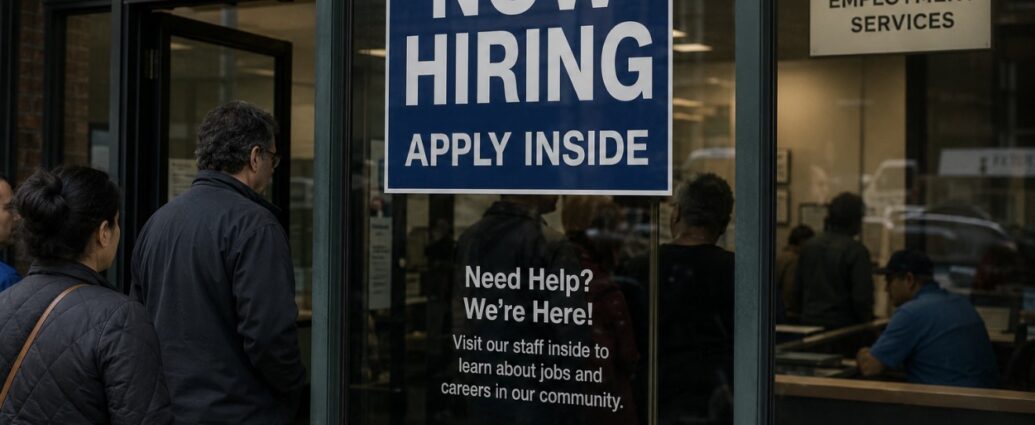
For months, economists have argued that a slower economy would eventually force companies to reduce payrolls. Instead, the opposite happened. The U.S. Department of Labor reported Thursday that first-time applications for unemployment benefits fell to 187,000 during the week ended July 18, the lowest weekly level since September 1969 and well below forecasts, signaling that American employers continue to retain workers despite higher interest rates and softer economic growth.
The unexpected drop caught financial markets off guard. Economists had anticipated roughly 212,000 new claims after the prior week’s revised reading of 209,000, but layoffs instead moved sharply lower. Continuing claims, a measure of workers already collecting unemployment benefits, slipped to 1.796 million, suggesting displaced workers are still finding jobs without prolonged unemployment.
That resilience carries implications well beyond the labor market. Businesses that spent years struggling to recruit and retain employees appear unwilling to repeat those shortages, choosing instead to slow hiring, trim discretionary spending and postpone expansion plans rather than eliminate experienced workers. For consumers, steady employment continues supporting household spending at a time when elevated borrowing costs have cooled demand in housing, manufacturing and other interest-rate-sensitive industries.
For investors, the report strengthens the case that the U.S. economy remains on firmer footing than many had expected entering the summer. Weekly unemployment claims are among the earliest indicators of corporate confidence, and today’s figures suggest executives remain optimistic enough about future demand to keep payrolls largely intact. The stronger labor picture also complicates the Federal Reserve’s policy outlook, as officials continue balancing inflation risks against signs of moderating economic activity.
One weekly report rarely changes the broader economic narrative on its own, but the direction has become difficult to ignore. Layoffs remain historically low, consumer income continues flowing through the economy and employers have shown little appetite to shed workers even after one of the most aggressive interest-rate cycles in decades. That combination has repeatedly challenged predictions that a significant deterioration in the labor market was imminent.
The focus now shifts from layoffs to hiring. If businesses continue holding onto employees while hiring gradually improves, the labor market could remain one of the economy’s strongest pillars through the second half of the year. The next major test comes with next week’s Federal Reserve meeting and the July employment report, both expected to offer a broader assessment of whether today’s unexpected strength reflects a temporary fluctuation or a labor market that continues to outperform expectations.
JBizNews Desk | Wall Street
© JBizNews.com All Rights Reserved. Reproduction or distribution without written permission is prohibited.