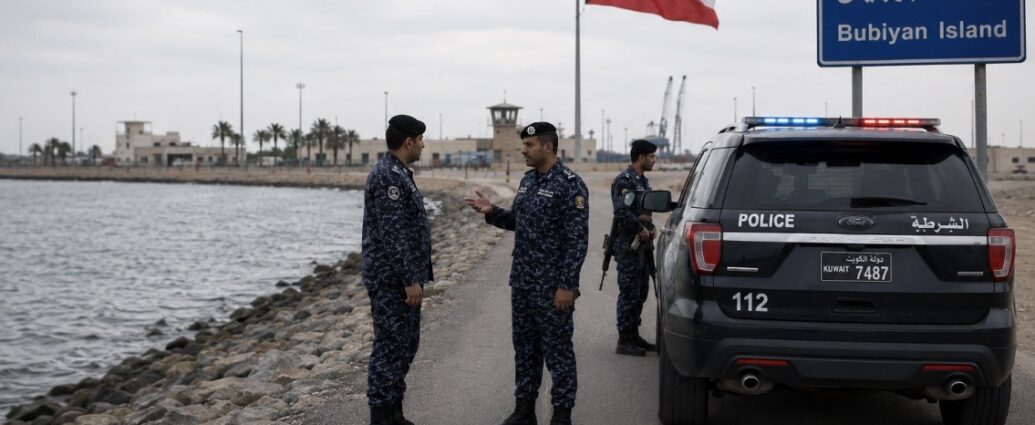
Kuwait has formally accused Iran’s Islamic Revolutionary Guard Corps of carrying out an armed infiltration attempt on Bubiyan Island, escalating regional tensions and raising concerns among investors, shipping operators, and energy markets over the security of critical Gulf trade infrastructure. The Kuwaiti Ministry of Interior said the incident occurred on May 1, when six armed individuals arrived by fishing vessel near the strategically important island before being intercepted by Kuwaiti security forces.
In an official statement carried by Kuwait’s state news agency KUNA, Sheikh Fahad Yousef Saud Al-Sabah First Deputy Prime Minister and Minister of Interior Kuwait said Kuwaiti authorities arrested four men linked to Iran’s Revolutionary Guard Corps after what he described as an attempted “hostile operation” on Kuwaiti territory. Kuwaiti officials said one security officer was injured during an exchange of fire and that two suspects escaped. Iran denied the allegations and stated the vessel had unintentionally entered Kuwaiti waters because of a navigational malfunction.
Kuwait’s Foreign Ministry subsequently summoned the Iranian ambassador and declared the incident a “flagrant violation” of Kuwaiti sovereignty. In a formal diplomatic statement, the ministry said Kuwait reserved “its inherent right to self-defense” under Article 51 of the United Nations Charter. Gulf Cooperation Council member states, including the United Arab Emirates, Qatar, and Bahrain, issued statements backing Kuwait’s position and condemning the incident.
The infiltration attempt has heightened concern because of Bubiyan Island’s economic and strategic importance. The island hosts the Mubarak Al Kabeer Port project, one of Kuwait’s largest infrastructure developments and a central component of the country’s Vision 2035 economic diversification strategy. The project is intended to transform northern Kuwait into a regional logistics and shipping hub connected to regional rail and maritime trade corridors.
According to Kuwait’s Ministry of Public Works, the Mubarak Al Kabeer Port project is designed to expand Kuwait’s cargo handling capacity and strengthen its role in regional trade flows linking the Gulf, Iraq, and broader Asian markets. Chinese companies and financing linked to Beijing’s Belt and Road Initiative have also played a role in broader infrastructure planning surrounding the port and northern Gulf trade development.
The incident is particularly significant because it differs from the recent pattern of missile and drone warfare that has dominated regional hostilities since February. Gulf states including Saudi Arabia, the United Arab Emirates, Bahrain, Qatar, and Kuwait have all faced missile attacks on oil facilities, airports, military bases, and power infrastructure in recent months. Security analysts say the Bubiyan operation suggests a potential shift toward covert maritime infiltration and asymmetric operations targeting infrastructure directly.
Military and shipping analysts note that such operations create a different level of risk for commercial infrastructure investors because they are more difficult to deter using conventional missile defense systems. Regional defense officials have previously acknowledged that prolonged conflict has placed pressure on interceptor stockpiles and maritime surveillance operations throughout the Gulf.
The commercial implications could extend beyond Kuwait. Bubiyan Island sits near shipping lanes connected to the northern Gulf and remains close to infrastructure supporting Kuwaiti oil exports and military facilities. Energy traders and insurers are expected to closely monitor whether the incident increases political risk premiums for shipping and infrastructure projects operating in Gulf waters.
The timing also complicates broader geopolitical dynamics involving China and the United States. China remains heavily invested in Gulf infrastructure development while continuing to maintain strong energy trade ties with Iran. At the same time, Washington has expanded naval and air defense operations in the Gulf following months of attacks on commercial and military assets.
In testimony before Congress earlier this week, Pete Hegseth Secretary of Defense United States Department of Defense said the United States continues to maintain operational control and freedom of navigation in the Strait of Hormuz despite ongoing regional tensions. The strait remains one of the world’s most critical energy chokepoints, handling a substantial share of global crude oil shipments.
Separately, Bahrain this week announced life sentences against three individuals convicted of espionage tied to Iran’s Revolutionary Guard Corps, underscoring broader Gulf concerns over covert Iranian operations across the region.
For investors and multinational companies with exposure to Gulf infrastructure and logistics, the central question is whether the Bubiyan incident represents a single failed operation or the beginning of a broader campaign targeting strategic trade assets during the current ceasefire period. Although direct large-scale military exchanges have slowed since the April ceasefire agreement, regional diplomatic negotiations remain fragile and security risks continue to weigh heavily on energy markets, shipping activity, and long-term infrastructure planning.
As Kuwait pushes forward with plans to position Bubiyan Island as a major regional commercial gateway, the latest security incident is likely to intensify scrutiny over maritime security, project insurance costs, and the resilience of Gulf trade infrastructure in an increasingly volatile geopolitical environment.
JBizNews Desk