
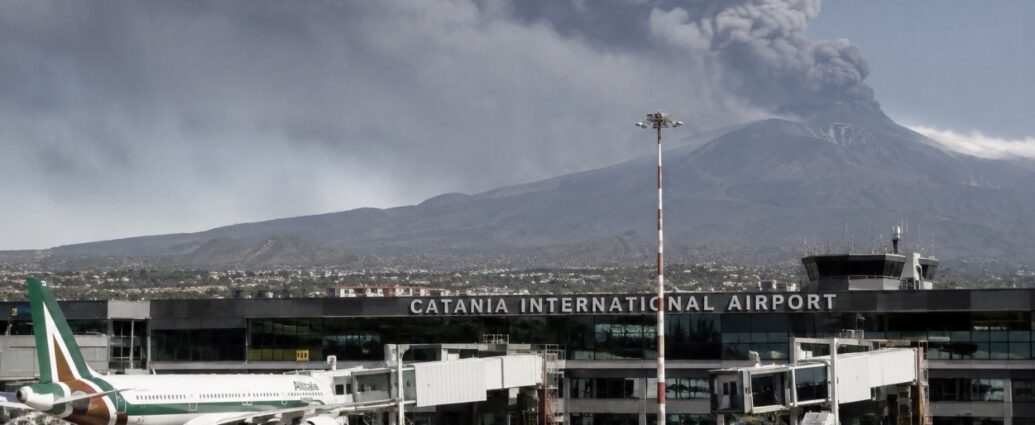
Sicily’s busiest airport has now been shut for five straight days because volcanic ash and jet engines cannot occupy the same sky. Ash from Mount Etna has closed Catania’s airport for a fifth consecutive day, stranding holiday travelers during the biggest travel week of the year, and the airport will stay closed until early Saturday — Ferragosto, the August 15 holiday at the peak of the Italian summer season. Etna sits 30 kilometers, about 20 miles, from the runway, and while its activity interrupts flights there regularly, this is the longest such emergency since 2002.
The hazard is mechanical, not theoretical. Volcanic ash is pulverized rock. Pulled into a jet engine, it melts in the combustion chamber and re-hardens on the turbine blades, which can shut the engine down in flight. So when ash drifts into a flight corridor, aviation authorities close that block of airspace outright rather than let planes pick their way through it. Italian authorities have been shutting the affected sectors around eastern Sicily one at a time as the plume moves, most recently extending the closure to a sector labeled B3, while the National Institute of Geophysics and Volcanology has kept its aviation notice at red, the top level, with vents at roughly 2,750 and 2,360 meters feeding extensive lava fields.
The scale of the disruption is unusual even by Etna’s standards. Between August 6 and 12, roughly 630 flights were diverted to other airports and more than a third of the 1,974 flights scheduled at Catania were canceled. That is better than one flight in three simply erased from the board. Bloomberg put the count at more than 1,350 flights affected over the course of the week. Airport operator SAC’s own figures showed about 400 departures canceled between August 8 and 11 and another 52 on August 12, with roughly 700 flights lost once canceled arrivals are counted. Ryanair, easyJet, ITA Airways and Wizz Air, the four largest carriers at Catania, have absorbed most of the damage.
Passengers have been sleeping in the terminal. Travelers stranded by the prolonged closure have spent days inside the building, bedding down wherever they can and killing time playing cards.
The rest of Sicily is carrying the overflow, and it is showing. On August 12 alone, SAC listed 50 Catania departures leaving instead from Palermo, Trapani and Comiso, with 40 arrivals rerouted to Palermo, 12 to Trapani and five to Comiso; Comiso itself briefly halted flights on the evening of August 11 when ash fell there. Palermo’s mayor said his city’s airport had taken on 190 flights originally booked through Catania, and passengers dumped there complained they got little help getting onward — demand for buses and taxis spiked, and the extra traffic pushed delays at Palermo itself. A traveler landing 130 miles from where the ticket said they were going still has to cross the island, and on Ferragosto weekend that ride is neither cheap nor guaranteed.
The cloud has reached past Italy. A volcanic ash advisory issued Tuesday evening placed the heaviest concentration over Sicily, with thinner ash between eastern Malta and as far south as northern Libya.
For anyone booked through Catania, the practical steps are narrow but they matter. Confirm the flight directly with the airline before leaving for the airport, because the closure has been extended in increments and the terminal has repeatedly filled with people whose flights were already gone. Americans connecting through a European hub should check every leg, not just the transatlantic one — the long-haul segment can operate perfectly while the final hop into Sicily disappears. Under European Union passenger rules, a volcanic eruption counts as an extraordinary circumstance, which means airlines generally do not owe cash compensation for the cancellation. What they do still owe is care and a way out: meals, accommodation where an overnight is forced, and either rerouting or a refund. Passengers should ask for that in writing rather than assume it will be offered.
The repeated shutdowns have also reopened an old argument in Italy about the airport itself. Civil Protection Minister Nello Musumeci has said he flagged the vulnerability of Catania’s Fontanarossa airport back in 1999, when he was president of the Province of Catania and put forward a plan for the site that never won backing. The proposals under discussion run toward hardening Sicily’s secondary fields — Comiso and Trapani in particular — so that eastern Sicily has real capacity to fall back on rather than an overflow arrangement that buckles the moment Etna clears its throat.
Even once the airspace reopens, the airport will not snap back. Aircraft and crews are scattered across four airports and out of position, and clearing a week’s backlog into a holiday weekend takes days, not hours.
JBizNews Desk | Catania, Italy
© JBizNews.com All Rights Reserved. Reproduction or distribution without written permission is prohibited.




