Data This Week: ECB, BoE Rates, and a Fresh Read on EU Confidence
Europe starts the week on uneasy footing. Industrial output is slipping, productivity gaps with the US are widening, and energy markets are being jolted by the most severe supply disruption in decades. The Middle East crisis is reshaping global energy flows in real time. With inflation risks rising just as growth weakens, policymakers and investors are being forced to navigate one of the most complex macro backdrops Europe has faced since the COVID-19 pandemic.
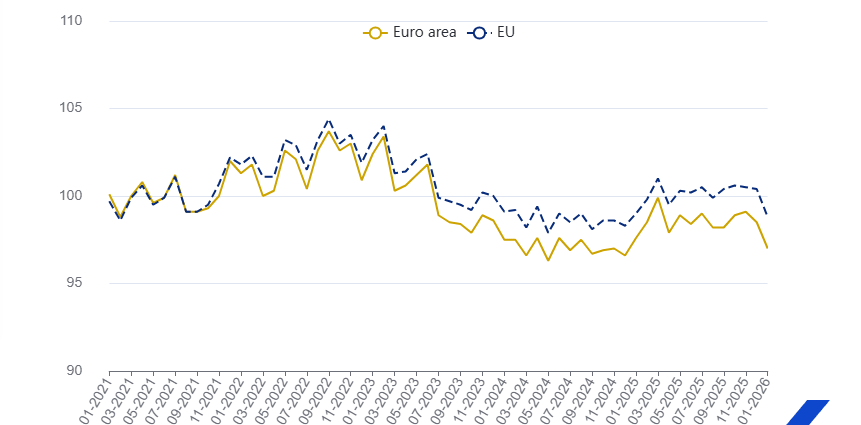
Weekly Chart: Euro Area Production -1.2%
Industrial production weakened in the euro area and in the EU in January. According to first estimates from Eurostat, industrial production fell 1.2% year‑on‑year in the euro area and 0.6% in the EU. On a month‑on‑month basis, seasonally adjusted industrial production declined 1.5% in the euro area and 1.6% in the EU.
Why This Matters: A simultaneous year‑on‑year and month‑on‑month contraction signals weak underlying demand. It widens the competitiveness gap with the US, as highlighted in the IMF’s weekly chart. It also increases pressure on the ECB to consider rate cuts even as Middle East tensions push inflation risks higher.
IMF’s Take on Europe Scaling
Productivity growth in Europe now lags behind that of the US, a gap that has “widened significantly” in recent years. Behind this shortfall is the “staggering difficulty” that European firms face in scaling up. In the US, the stock market valuation of young firms is $42.9 trillion, compared to $5 trillion in the EU. The average European firm that has been in business for 25 years or more employs about 10 workers. A comparable US company employs 70 people.
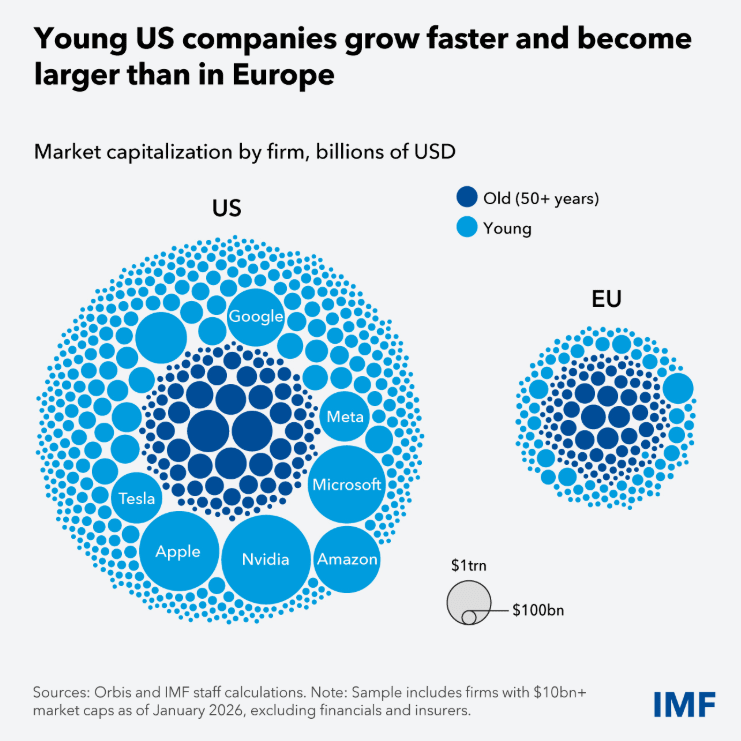
Why This Matters: Europe’s productivity gap is about 20% below US levels, underscoring the structural constraints for the region’s competitiveness. IMF research shows that closing this gap will require deeper integration across Europe’s capital, labor, and consumer markets.
Officials will need to enable more risk‑taking investment, allow workers to move more easily toward opportunity, and give companies access to markets where they can scale. Without progress on these fronts, Europe risks entrenching slower growth, weaker innovation, and a widening transatlantic productivity divide.
Geopolitics: Oil Enters New Week of Uncertainty
Global oil markets are bracing for another volatile week. US strikes hit Iran’s export hub at Kharg Island, heightened concerns about supply risks across the Middle East. Oil prices crossed $100 a barrel last week and have surged about 40% since the start of the US and Israeli bombing campaign.
President Donald Trump said the operation targeted military positions on Kharg Island. He warned that further action could extend to energy infrastructure if Iran disrupts shipping through the Strait of Hormuz.
The US is moving about 2,500 Marines to the Middle East. Tehran has warned that attacks on its …





This post was originally published here