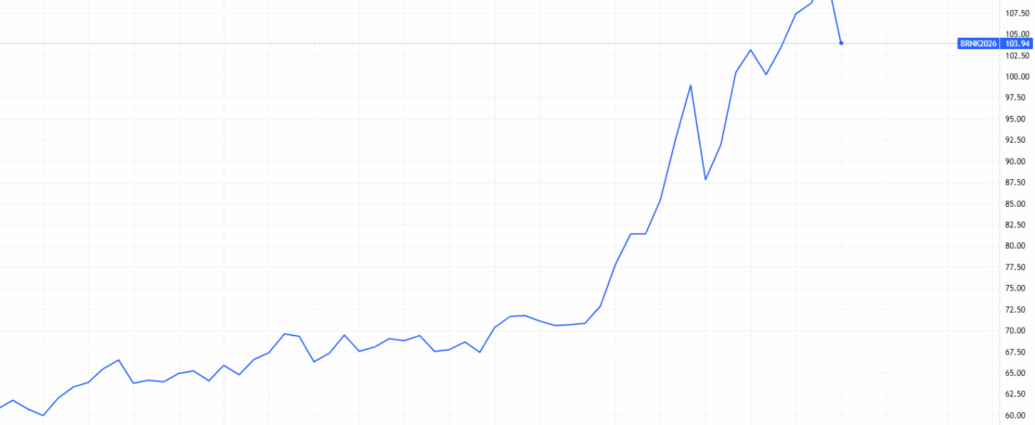
The war in the Middle East has started to impact economic confidence and monetary policy decisions in Europe. Germany and the euro area sentiment fell sharply in March. The European Central Bank (ECB) and the Bank of England (BoE) kept rates unchanged on Thursday, citing the war.
As markets digest the geopolitical shock, this week’s data releases will help clarify whether the downturn in sentiment is spilling into real economic activity. The Euro Area, France, Germany, and the UK will release key manufacturing data this week alongside business and consumer confidence indices.
Weekly Chart: Germany’s Economic Sentiment Plummets
Germany’s ZEW Indicator of Economic Sentiment plummeted by 58.8 points to -0.5 in March 2026. That is down from 58.3 in February, ZEW said on March 17. This was far below market expectations of 39. The conflict in the Middle East has impacted sentiment.
This marks the third-largest monthly decline in the indicator’s history. This followed a 65.6-point drop in April after the US announced new tariffs. After Russia invaded Ukraine, the index fell 93.6 points in March 2022.
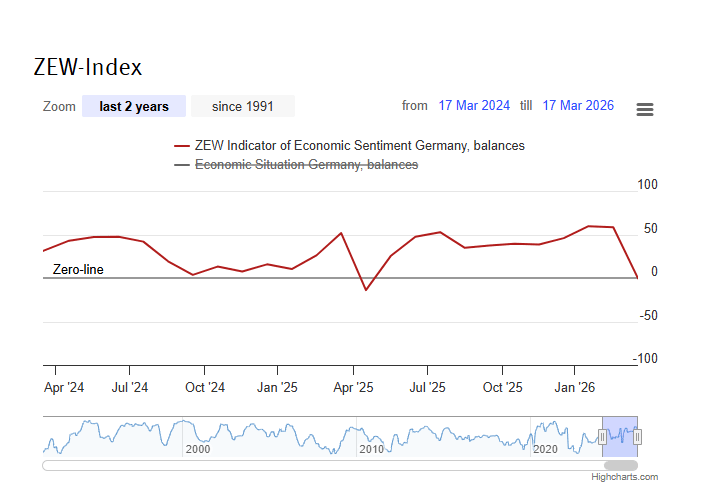
“The ZEW Indicator has collapsed,” ZEW President Professor Achim Wambach said. “The escalation in the Middle East spikes energy prices and increases inflationary pressure. This heightens the risk for the German economy that the emerging trend of economic recovery will slow down.”
The expectations for the eurozone declined strongly in March, plummeting into negative territory and coming in at -8.5 points. Compared to February, the indicator is lower by 47.9 points. The assessment of the economic situation deteriorated to -29.9 points. This is 16.3 points below the previous month’s reading.
Why it matters: Germany’s sentiment reversal is an early signal of how the Middle East conflict is feeding into the economic outlook. The fall in expectations suggests that firms and investors are already pricing in weaker growth, higher energy costs, and a more cautious policy stance from central banks.
Geopolitics: Trump Steps Back from Iran Threat
As sentiment weakens, geopolitical developments continue to drive market volatility.
President Donald Trump said on Monday that the US and Iran have held “productive conversations.” He will hold off on any military strikes against Iranian energy sites for five days. He walked back his threat to strike if Tehran did not allow the full reopening of the Strait of Hormuz.
However, Iran’s foreign ministry said there was “no dialogue” between Tehran and Washington, state‑affiliated media reported. It added that Trump’s statement was “part of efforts to reduce energy prices and buy time for the implementation of his military plans.” Iran had vowed to retaliate by striking energy targets across the Middle East.
Oil prices fell after Trump ordered the military to postpone strikes on Iranian power plants and energy infrastructure. Brent crude was last down more than 7% at $103.5 a barrel. WTI crude futures plunged more than 10% to around $88.5 per barrel.
Full story available on Benzinga.com





This post was originally published here