A closed-door meeting of European conservative and nationalist figures was held in Paris this week under the “Make Europe Great Again” banner, with participants backing a planned London rally on May 16 led by British activist Tommy Robinson.
According to organizers and participants, the meeting aimed to strengthen cooperation between European right-wing movements and Trump-aligned conservatives in the United States. The discussions focused on immigration, national sovereignty, support for Israel, opposition to Iran, Europe’s energy crisis, and calls to rethink sanctions on Russia.
Organizers said the event was kept away from the media to avoid possible disruptions by counter-protesters. The meeting took place in central Paris without reported incidents, according to participants.
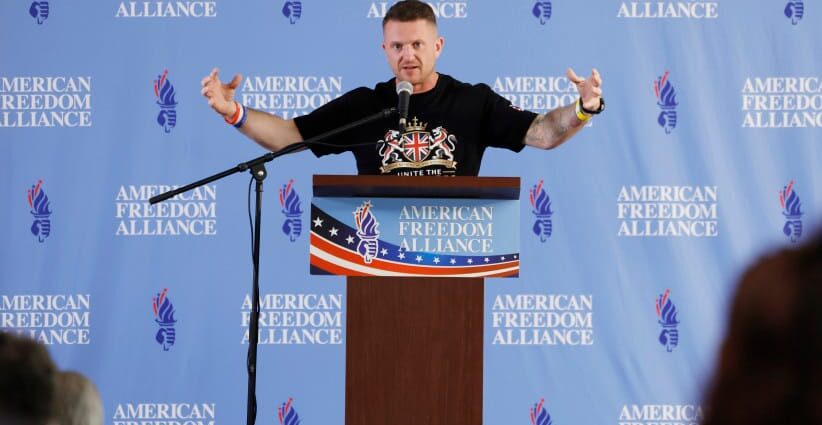
Robinson, who traveled to Paris for the gathering, delivered the keynote address and urged those present to join the upcoming “Unite the Kingdom, Unite the West” demonstration in London. He argued that conservative movements in Europe should move beyond party politics and build larger forms of public mobilization.
“It’s time to move from conventional party politics to large-scale public mobilization,” Robinson said, according to organizers. “Now is the moment to move from protests to a broad campaign for the revival of our continent’s Judeo-Christian heritage.”
The London rally follows Robinson’s September 13 “Unite the Kingdom” demonstration, which drew a far larger crowd than police had expected. Organizers have claimed that more than one million people attended and have described it as the largest modern European protest against mass immigration and radical Islamism.
The Metropolitan Police later put the turnout at between 110,000 and 150,000. A counter-demonstration by Stand Up To Racism drew around 5,000 people.
A pro-Israel event
The September protest also carried a visible pro-Israel element. Reuters reported that some demonstrators carried Israeli and American flags alongside Union Jacks and St. George’s Crosses, and a few Palestinian flags were set on fire. For organizers, that imagery has become part of an effort to present the movement as aligned with Israel and the United States against radical Islamism and Iran.
Speakers in Paris voiced support for Israel and the United States in confronting Iran, which Robinson and other participants described as a central source of regional instability and terrorism. Several speakers praised the approach associated with US President Donald Trump and Prime Minister Benjamin Netanyahu, arguing that Western governments should take a harder line against Tehran and its proxies.
Energy policy was one of the main themes of the meeting. Robinson and other speakers argued that responsibility for rising energy prices in Europe lies less with Western military action against Iran and more with European leaders who imposed sanctions on Russia and moved to cut Russian energy supplies.
A panel on the energy crisis featured the MPs Anna Nguyen of Germany’s AfD, Luxembourg politician Ferdinand Kartheiser, and Bulgarian politician Clement Shopov, according to organizers. All three called for the European Union to reconsider or lift sanctions on Russia.
Shopov argued that the sanctions were harming Europe more than Moscow and weakening the broader West at a time when, in his words, the main strategic priority should be confronting terrorism led by Iran.
Nguyen said European governments should put national interests ahead of what she called “dubious global ambitions,” while Kartheiser spoke positively about a recent visit to Moscow and called for continued dialogue with Russia. Kartheiser also pointed to recent US moves on oil-related sanctions as evidence that Washington was taking a more pragmatic approach to energy markets.
Reuters reported in March that Trump said the United States was waiving certain oil-related sanctions to ensure supply and lower prices. The Trump administration later renewed a temporary waiver allowing countries to buy certain sanctioned Russian oil at sea.
The speakers’ position contrasts with official EU policy since Russia’s invasion of Ukraine. EU figures show that Russian gas fell from 45% to 13% of the bloc’s gas imports between 2021 and 2025, while Russian oil imports dropped from 27% to below 3%, and coal imports from Russia fell to zero. Brussels says cutting dependence on Russian energy is necessary to reduce Moscow’s war revenues; critics on the European right say the policy has damaged European consumers and industry.
A second panel, according to organizers, was chaired by the Belgian MP Filip Dewinter and included Josef Nerušil of Czechia, Fabian Cristian of Romania, and Bryan Graham, described by organizers as a US Republican Party representative. Participants in that discussion also backed lifting sanctions on Russia and called for a negotiated end to the war in Ukraine.
Dewinter said Russia should be brought “back into the fold of Europe,” while MP Nerušil argued that changes in Kremlin policy were unlikely to come through sanctions pressure. Graham, according to participants, argued that Ukraine should consider ceding territories he said “gravitate towards Russia” as part of ceasefire negotiations – a position sharply at odds with Kyiv’s stated policy.
Other figures named by organizers included the rising public star of France, Alice Cordier, head of the French movement Collectif Némésis, and former Austrian vice chancellor Heinz-Christian Strache, who sent a message to the conference. Strache said Europe was entering “a new era” focused not only on illegal immigration but also on what he called a “cultural renaissance of Europe.”
The evening concluded with greetings from US Congressman Brian Babin, a Republican from Texas, who described cooperation between America’s MAGA movement and Europe’s MEGA network as a “historic turning point” toward what he called the revival of Western civilization.
The May 16 demonstration is expected to take place on a sensitive day in London. British media have reported that a pro-Palestine Nakba Day march is scheduled for the same date, alongside Robinson’s rally and the FA Cup final at Wembley. The Metropolitan Police has said it will impose conditions on protest routes and gathering points to prevent serious disruption and disorder.
The policing arrangements have already drawn criticism from some pro-Palestinian campaigners and MPs. An Early Day Motion tabled in the British Parliament accused the Metropolitan Police of giving Robinson’s demonstration access to central London locations while rejecting the preferred route of the Palestine Coalition’s Nakba Day march. Police have said their decisions are based on public order considerations and expected crowd size.
Robinson ended his remarks by inviting the participants to London and calling for further Europe-wide mobilization later this year.