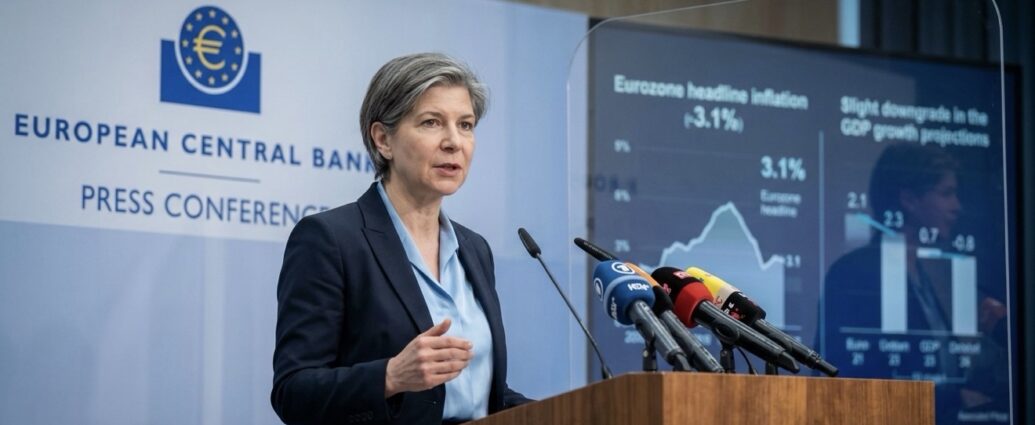
JbizNews —Frankfurt — The European Central Bank must proceed with an interest rate hike at its upcoming June monetary policy meeting regardless of whether ongoing diplomatic negotiations yield a peace deal in the Middle East, according to an explicit policy directive issued on May 26, 2026. ECB Executive Board Member Isabel Schnabel warned that the protracted geopolitical conflict in Iran has inflicted structural damage on the continent’s commercial pipeline, forcing a sharp upward revision in long-term inflation modeling. The central bank’s hardening stance signals that policymakers are preparing to prioritize structural price stability even as external energy shocks rapidly depress corporate profitability and squeeze aggregate consumer demand across the currency bloc.
The hawkish policy maneuver arrives on the heels of the European Commission’s official Spring 2026 Economic Forecast, which systematically downgraded Eurozone gross domestic product (GDP) expansion metrics while accelerating inflation targets. Under the newly calibrated baseline, real GDP growth across the EU is projected to contract to a sluggish 1.1% this year, while the core Eurozone is expected to post a meager 0.9% expansion. Simultaneously, widespread commodity volatility has driven projected headline inflation up by a full percentage point to 3.1% for the current calendar year. This restrictive macroeconomic environment is being directly exacerbated by a severe supply-side disruption following the closure of the Strait of Hormuz, which triggered a 50% spike in regional wholesale natural gas prices and a 65% surge in crude oil baselines between late February and the end of April.
For institutional market participants, the intersection of rising borrow costs and sticky input liabilities is triggering a notable contraction in industrial capital expenditure. European Commission forecasters noted that elevated sovereign yields are compounding corporate debt service burdens, pushing multi-national enterprises to alter near-term hiring and capital expansion plans. While nominal wage pressure remains highly elevated as regional labor unions seek compensation for eroding purchasing power, corporate operating margins are contracting under the weight of utility overhead. Commercial analysts at MUFG Research underscored that because domestic household savings buffers have been largely exhausted over the prior cyclical cycle, private consumption can no longer be relied upon to insulate corporate revenues from broader macroeconomic compression.
The structural fiscal health of member state governments is also fracturing under the financial burden of managing national energy grid interventions. Aggregate public sector deficits across the trading bloc are now anticipated to expand from 3.1% of GDP last year to 3.6% over the medium term. This widening budgetary mismatch is set to push the total EU debt-to-GDP ratio from 82.8% to 84.2% before the conclusion of the fiscal year, with core sovereign weights in the Eurozone hitting a more severe 90.2%. The expanding debt load is being further aggravated by an unfavorable, widening interest-growth differential that increases the long-term cost of rolling over outstanding government securities.
On the commercial labor front, the protracted tightening of the continental labor market has officially peaked. Institutional payroll modeling indicates that aggregate employment growth across the European Union will decelerate sharply to 0.3% this year, a noticeable decline from the 0.5% pace recorded during the prior expansionary leg. Total unemployment is projected to solidify at 6.0%, effectively halting a multi-year downward trajectory that had previously acted as a key pillar of support for corporate services and domestic retail spending.
Despite the prevailing headwinds, certain counter-cyclical sectors are showing strong structural resilience. Public sector capital outlays directed toward defense procurement and localized green energy infrastructure grids are expected to remain highly robust, partially mitigating the capital flight observed in private commercial real estate and residential construction markets. Furthermore, corporate investments into advanced generative artificial intelligence platforms are being cited by institutional economists as a primary supply-side tailwind that could unlock latent industrial productivity, provided that private enterprise implementation can bypass building regulatory friction within the Brussels legislative apparatus.
JBizNews Desk
© JBizNews.com. All rights reserved. This article is original reporting by JBizNews Desk. Unauthorized reproduction or redistribution is strictly prohibited.