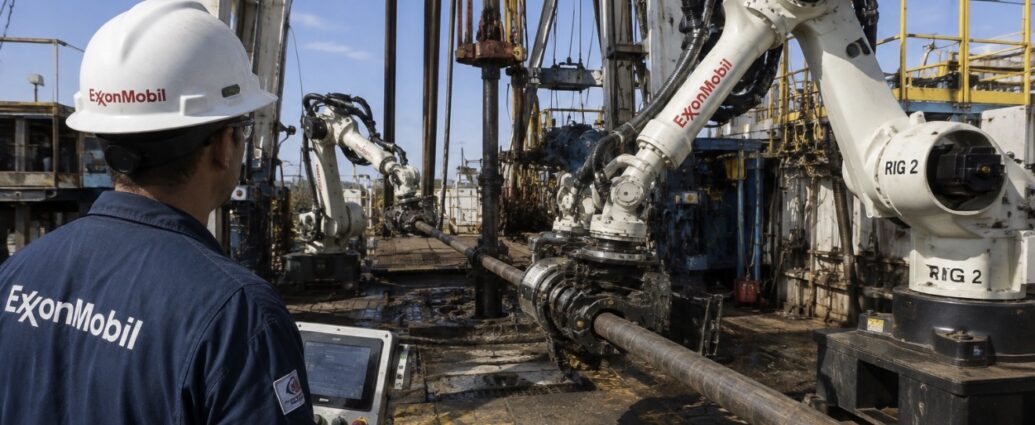
Exxon Mobil is accelerating automation across its Permian Basin operations, with plans to have robots running about half of its drilling rigs by 2028 as the oil giant looks to increase production while reducing the number of workers exposed to some of the most dangerous jobs on a rig floor.
The company currently has two automated rigs operating among more than 30 in the Permian, according to Reuters. Those rigs use robotic systems to move heavy pipe, make connections and handle other repetitive tasks that traditionally required crews working directly around large machinery.
The technology is already showing productivity gains.
Exxon says its first automated rig drilled a roughly two-mile horizontal section in just over six days, demonstrating how robotics can speed up a process that is both physically demanding and operationally expensive.
The company’s broader goal is substantial.
Exxon is targeting nearly 40% growth in Permian production to 2.5 million barrels of oil equivalent per day by 2030, and automation is becoming one of the tools it is using to get there.
The Permian Basin, which stretches across West Texas and southeastern New Mexico, is already the most important oil-producing region in the United States. Any technology that allows operators to drill faster, more safely and with fewer interruptions can have an outsized impact on U.S. energy output.
That is what makes this more than a story about robots replacing manual tasks.
On a conventional rig, workers may need to handle sections of steel pipe weighing around 2,000 pounds while operating near rotating equipment, high-pressure systems and elevated platforms. Those jobs carry obvious safety risks.
Robotic systems can move that pipe without putting workers directly in harm’s way.
For Exxon, that means fewer injuries, lower downtime and more consistent operations.
For the workforce, the shift is more complicated.
Automation does not necessarily eliminate the need for rig crews, but it changes the skills that are valuable. Fewer workers may be needed for some manual tasks, while demand grows for technicians, engineers, software specialists and operators who can monitor and maintain automated systems.
That transition is already playing out across manufacturing, warehouses and logistics.
Now it is moving deeper into the oil field.
The economics are also important.
Drilling rigs are extraordinarily expensive to operate, and every hour saved during a well’s construction can reduce costs. If automated rigs can consistently drill faster while also lowering safety-related disruptions, the savings can compound across hundreds of wells.
That can help producers remain profitable even when oil prices fall.
The move also reflects a broader strategy across the energy industry: use automation and artificial intelligence not simply to reduce headcount, but to extract more production from existing assets with fewer delays and less risk.
Exxon has been investing heavily in the Permian since its acquisition of Pioneer Natural Resources, and the company is under pressure to prove that it can generate more output and better returns from that enlarged footprint.
Robotic drilling is becoming part of that answer.
The first stage is limited.
Two automated rigs out of more than 30 is still a small share of the fleet.
But if Exxon reaches its goal of automating half of those rigs by 2028, one of America’s most labor-intensive industries will have crossed an important threshold.
The oil field will still be powered by drilling equipment, steel and crews.
But increasingly, some of the hardest physical work may be done by machines.
JBizNews Desk | Houston
© JBizNews.com All Rights Reserved. Reproduction or distribution without written permission is prohibited.