By JBizNews Desk
May 11, 2026
A constitutional and corporate collision is rapidly escalating between the Federal Communications Commission and Disney, with the fight now expanding far beyond broadcast licensing into a broader national battle over political speech, media regulation, and the limits of government power over publicly licensed television networks.
At the center of the dispute is ABC, owned by Disney, and an extraordinary campaign by the FCC under Chairman Brendan Carr that has triggered accusations from the agency’s lone Democratic commissioner that the federal government is effectively attempting to pressure and censor one of the country’s largest media companies.
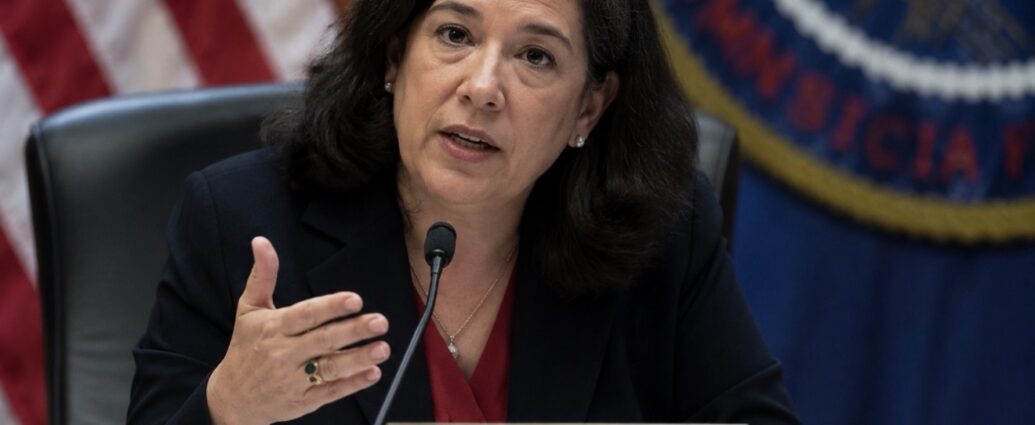
FCC Commissioner Anna M. Gomez publicly warned Disney CEO Josh D’Amaro this week that the agency’s actions represent “the most egregious action this FCC has taken in violation of the First Amendment to date,” accusing the Trump administration and FCC leadership of weaponizing broadcast regulation against a political opponent.
“This is the most egregious action this FCC has taken in violation of the First Amendment to date,” Gomez said. “As part of its ongoing campaign of censorship and control, the White House called publicly for the silencing of a vocal critic, and this FCC has now answered that call.”
The confrontation intensified after Chairman Carr ordered Disney’s eight ABC owned-and-operated television stations to submit broadcast license renewal filings by May 28 — years ahead of their normal renewal schedule, which runs between 2028 and 2031.
Simultaneously, the FCC launched investigations into ABC’s daytime talk show The View over alleged equal-time violations and separately scrutinized ABC’s political debate moderation practices.
Together, the actions amount to one of the most aggressive regulatory offensives against a major broadcaster in decades.
The legal foundation Carr and the Trump administration are relying on centers on the FCC’s equal-time doctrine — a longstanding federal rule requiring broadcasters using public airwaves to provide comparable access to legally qualified political candidates.
Carr argues that major broadcast networks, including ABC, have increasingly transformed publicly licensed spectrum into politically one-sided platforms that disproportionately favor Democratic politicians and liberal viewpoints.
“The general rule, as passed by Congress, is the equal-time provision: if you’re going to have a legally qualified candidate on, you have to give comparable time and airtime to all other legally qualified candidates,” Carr said publicly. “And we’re going to apply that law.”
The FCC itself framed the issue bluntly in public materials, arguing equal-time enforcement “encourages more speech and empowers voters to decide the outcome of elections.”
President Donald Trump has repeatedly attacked major broadcast networks, arguing companies operating on federally licensed public airwaves should not function as what he views as politically hostile institutions funded indirectly through government spectrum privileges.
The immediate flashpoint came after ABC late-night host Jimmy Kimmel made remarks about First Lady Melania Trump, prompting Trump to demand publicly on Truth Social that Kimmel be fired.
ABC refused.
The FCC’s early license-renewal order followed the next day.
Carr denies the action was connected to Kimmel or political retaliation, insisting the dispute instead stems from a separate FCC investigation launched in March 2025 into Disney’s diversity, equity, and inclusion policies.
Carr has argued Disney failed to cooperate fully with document requests tied to that probe.
“It felt to us like they were playing rope-a-dope and weren’t being entirely forthcoming with the production,” Carr told reporters.
But Disney’s legal filings tell a more complicated story.
According to the company, Disney produced more than 6,200 pages of documents between July and September 2025 related to the DEI inquiry, followed by an additional 4,839 pages after later FCC follow-up requests.
One week later, the early-renewal order arrived.
Media lawyers and constitutional scholars have openly questioned whether the DEI investigation is serving as a legal pretext for broader political retaliation.
“This is clearly a pretext. I mean, give me a break,” Commissioner Gomez said. “This is just another part of the pattern of harassment and retaliation in order to bend Disney to this administration’s will.”
The FCC’s investigation into The View has added another explosive dimension.
The agency is examining whether the program violated equal-time rules after hosting Texas Democratic Senate candidate James Talarico without offering comparable airtime to Republican candidates.
Carr has indicated he no longer intends to grant broad equal-time exemptions to programs he believes function primarily as political advocacy rather than legitimate news programming.
Disney argues the enforcement is being applied selectively and inconsistently.
In filings submitted to the FCC, Disney pointed out that conservative AM radio programs — including shows hosted by Mark Levin, Glenn Beck, and Guy Benson — have also hosted political candidates without triggering similar FCC scrutiny.
Carr has stated publicly that his equal-time initiative applies primarily to television broadcasters, not radio.
Disney’s attorneys argue that distinction is constitutionally weak and politically selective.
ABC also noted that the FCC itself ruled back in 2002 that The View qualifies as a “bona fide news interview program,” exempting it from equal-time requirements under existing FCC precedent for more than two decades.
“The View’s exemption from the equal-time rule remains valid,” ABC argued in its filing.
To defend the company, Disney hired former U.S. Solicitor General Paul Clement, one of the country’s most prominent Supreme Court litigators and a former Bush administration official widely respected across conservative legal circles.
In a sharply worded letter to the FCC, Clement called the agency’s actions “extraordinary” and warned they “threaten to limit news coverage of political candidates and chill core First Amendment-protected speech for years and potentially decades to come.”
The political fallout is now spreading across Congress.
Senate Democratic Leader Chuck Schumer, Senators Maria Cantwell, Edward Markey, Ben Ray Luján, and several additional Democratic senators formally demanded the FCC rescind the order, calling it “an egregious abuse of power and a clear violation of the First Amendment.”
Notably, even some Trump allies expressed discomfort with the FCC’s approach.
Senator Ted Cruz and Representative James Comer both publicly criticized aspects of Carr’s actions, highlighting growing bipartisan concern that the agency may be crossing longstanding regulatory boundaries.
Legal experts broadly agree the fight is likely to stretch on for years regardless of the immediate outcome.
Broadcast licenses are almost never revoked, and any denial would trigger prolonged litigation through federal courts and likely eventually the Supreme Court.
Meanwhile, the eight affected ABC stations — including WABC-TV in New York, KABC-TV in Los Angeles, and WLS-TV in Chicago — will continue operating throughout the legal process.
What is ultimately being contested is larger than Disney, ABC, or even the equal-time rule itself.
The central question now confronting regulators, media companies, and courts is whether the federal government can use broadcast licensing authority as leverage over editorial content — and whether Disney under Josh D’Amaro is prepared to become the company that fights that constitutional battle all the way to the end.
— JBizNews Desk
© JBizNews.com. All rights reserved. This article is original reporting by JBizNews Desk. Unauthorized reproduction or redistribution is strictly prohibited.