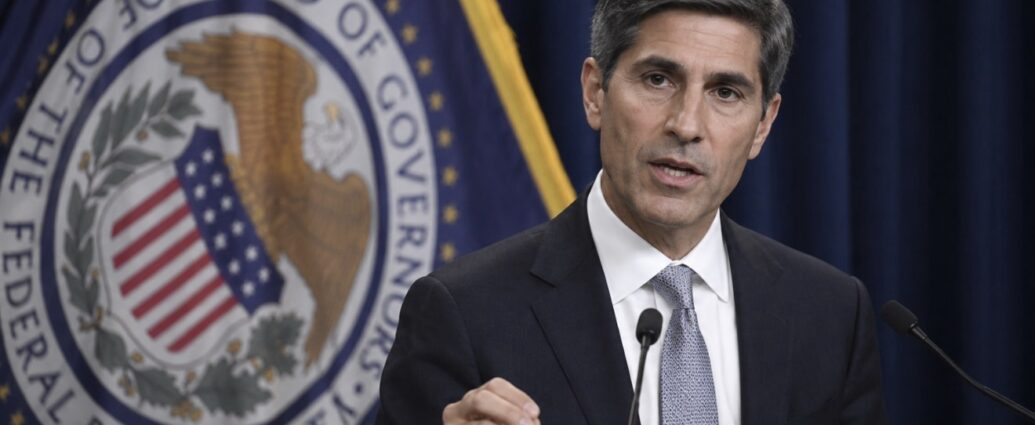
Federal Reserve Chair Kevin Warsh used his first meeting in charge of the central bank this past week to hold interest rates steady and to make clear how he plans to run the place: by borrowing the playbook of Alan Greenspan, the legendary Fed chief who refused to raise rates during the 1990s technology boom. Speaking to reporters after the Fed left its benchmark rate in a range of 3.5 to 3.75 percent, Warsh announced he is creating five internal task forces, including one to study whether artificial intelligence is already changing how productive the American economy is.
The timing was striking. Greenspan died Monday, June 22, at the age of 100, having run the Fed from 1987 to 2006, the second-longest tenure of any chair. His death has reopened a debate that now sits at the center of Warsh’s job: when a new technology promises to make the economy more efficient, should the Fed sit tight and let it run, or raise rates to guard against inflation?
Here is the idea Warsh is reviving, in plain terms. In the late 1990s, the internet was reshaping how companies worked. Greenspan bet that this surge in productivity meant the economy could grow faster without prices spiraling, so he held rates lower than many of his colleagues wanted. Inflation stayed tame, and history largely proved him right. Warsh is making the same wager about AI. He has argued that artificial intelligence could push productivity growth back up toward 3 percent a year, roughly a full point above its long-run average, which in theory would let the economy expand at 3.5 to 4 percent without overheating.
The problem is the backdrop could hardly be more different. Inflation right now is hot. The Consumer Price Index rose to a 4.2 percent annual rate in May, the highest reading since April 2023, pushed up in part by higher oil and gas prices tied to the war with Iran. Core prices, which strip out food and energy, were up 2.9 percent. That leaves Warsh in a bind: cutting rates is hard to justify with inflation this high, yet his whole framework argues against hiking into what he sees as a productivity boom.
There is some evidence on his side. Labor productivity has climbed 2 to 3 percent a year since 2024, up from about 1.5 percent in the prior decade. Treasury Secretary Scott Bessent, who backed Warsh for the job, pressed the case Tuesday, June 23, in a speech at the Economic Club of New York. Bessent said he believes AI could at least double productivity and that Greenspan was correct that the 1990s tech boom did the same. He predicted inflation would fall back toward target as the Iran conflict winds down and gas prices ease, and said the administration’s financial deregulation has unlocked roughly $3 trillion in new lending capacity.
Warsh is also changing how the Fed communicates. The statement accompanying this week’s decision ran about a third shorter than those under his predecessor, Jerome Powell, and carried a more hawkish tone. Warsh has long complained that markets lean too heavily on the Fed’s forward guidance and its “dot plot” of rate projections, treating forecasts as promises. He wants investors to read the economic data themselves. Jeffrey Roach, chief economist at LPL Financial, said the shift marks a return to the Greenspan era, when Fed statements were deliberately minimal and focused on actions rather than explanations.
Not everyone is comfortable with the comparison. Greenspan’s patience in the 1990s helped inflate the dot-com bubble, and his later years saw the loose lending that fed the 2008 housing crash. Alan Blinder, who served as Greenspan‘s vice chair, called the current moment full of eerie parallels and said he hopes it does not end the same way. The deeper worry is simple: the disinflationary tailwinds Greenspan enjoyed—cheap imported goods and a shrinking federal deficit—have reversed. And unlike in the 1990s, the productivity gains from AI have not yet clearly shown up in the official numbers. If Warsh holds rates low and those gains arrive late or never, critics warn he could repeat the Fed’s 2021 mistake, when it called inflation temporary and prices later surged past 9 percent.
For everyday Americans, this is not an abstract argument. The Fed’s rate decisions flow straight into mortgage rates, car loans, credit card bills and the interest paid on savings. Warsh’s bet will determine whether borrowing costs start coming down later this year or stay elevated. As Gargi Chaudhuri, chief investment strategist for the Americas at BlackRock, put it, the real question is no longer what the Fed did this week, but how its new chair frames inflation, AI and the path ahead. Greenspan made his bet and got lucky—or got it right. Whether Warsh can do the same, no one yet knows.
JBizNews Desk
© JBizNews.com All Rights Reserved. Reproduction or distribution without written permission is prohibited.