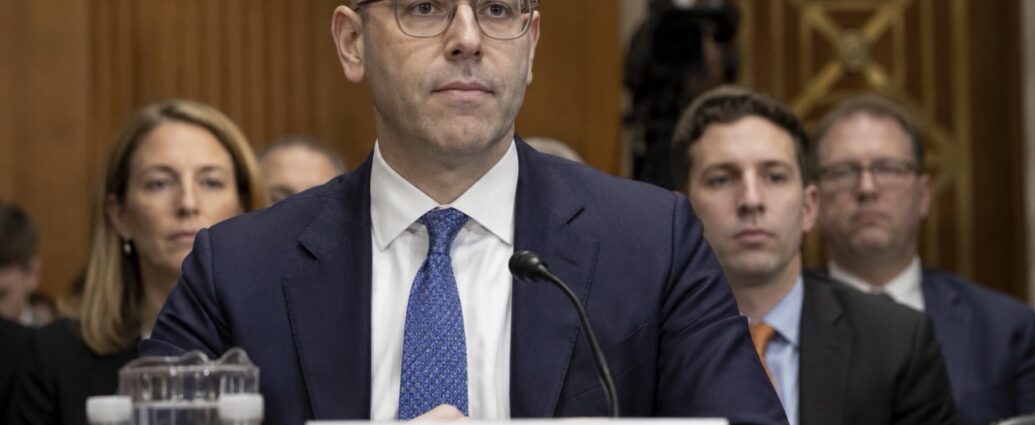
Federal Reserve Governor Stephen Miran, the central bank’s lone consistent vote for aggressive interest-rate cuts, made one final defense of his economic views Thursday in a Bloomberg Television interview, hours before formally vacating his board seat to make way for newly confirmed Fed Chair Kevin Warsh.
In a wide-ranging conversation touching on inflation, energy shocks, recession risks and the structure of the Federal Reserve itself, Miran repeated arguments he has pressed since joining the board last September — and left office without persuading a majority of his colleagues to join him.
At the center of Miran’s position is a belief that the Federal Reserve is keeping borrowing costs unnecessarily high at a moment when households and businesses are already under growing strain from surging energy prices tied to the U.S.-Israeli conflict with Iran.
The federal funds rate currently sits in a target range of 3.50% to 3.75%, levels that directly influence mortgage rates, auto loans, credit cards, commercial lending and broader financing conditions across the American economy.
Miran has repeatedly argued that rates should fall by roughly 150 basis points this year — equivalent to 1.5 percentage points — warning that maintaining restrictive monetary policy while consumers absorb sharply higher fuel and living costs risks pushing the economy into a broader slowdown.
Since taking office, Miran dissented at every Federal Open Market Committee meeting he attended, voting for cuts when colleagues voted to hold rates steady and supporting larger half-point reductions when others backed smaller moves.
The divide became especially pronounced as oil prices surged more than 30% following the escalation of conflict involving the United States, Israel and Iran. Retail gasoline prices nationally climbed above $4 per gallon, raising fears inside the Fed that inflation pressures could spread deeper into transportation, food, manufacturing and consumer goods.
Most Fed officials viewed the energy spike as a reason to maintain higher rates. Miran argued the opposite.
Speaking earlier this spring on Bloomberg Surveillance and reiterating the view Thursday, Miran said an oil shock simultaneously acts as what economists call a “negative demand shock” — meaning higher fuel costs force consumers to cut back elsewhere in the economy.
In practical terms, Americans spending more on gasoline often spend less on restaurants, travel, furniture, entertainment and discretionary retail purchases. Miran warned that layering high interest rates on top of that squeeze could unnecessarily accelerate economic weakness.
The final portion of Thursday’s interview focused on a far more controversial issue: the structure and independence of the Federal Reserve itself.
Miran has long argued that the Fed is insufficiently accountable to elected leadership and too insulated from changing economic conditions. Current Federal Reserve governors serve staggered 14-year terms, a framework created during the Great Depression era specifically to shield monetary policy from political pressure.
In a March 2024 paper co-authored with economist Dan Katz, Miran proposed sweeping reforms that would dramatically reshape the institution. The proposals included reducing governor terms from 14 years to eight, allowing presidents to remove governors more easily, and granting state governors greater influence over the Federal Reserve’s regional bank leadership structure.
Supporters of greater accountability argue the Fed has become too detached from economic realities affecting households and businesses. Critics — including many academic economists and Democratic lawmakers — warn such reforms could politicize interest-rate policy and repeat inflationary mistakes associated with politically pressured central banks during the 1970s.
Miran’s departure carries symbolic weight inside financial markets because many of his views are shared, at least partially, by incoming Chair Kevin Warsh, who officially assumes leadership Friday following a narrow 54-45 Senate confirmation vote.
Warsh has been openly critical of portions of the Fed’s recent policy approach and is expected to face immediate pressure from both markets and the White House over whether borrowing costs should begin moving lower later this year.
But despite becoming chair, Warsh still controls only one vote on the 12-member Federal Open Market Committee.
At the Fed’s April meeting, several influential policymakers — including Beth Hammack of the Cleveland Fed, Neel Kashkari of the Minneapolis Fed and Lorie Logan of the Dallas Fed — reportedly pushed against language implying rate cuts were the likely next move. Some favored maintaining flexibility for possible rate hikes should inflation remain elevated.
That internal divide may significantly limit how aggressively Warsh can shift policy in the near term.
Christopher Hodge, chief U.S. economist at Natixis CIB, told CNN that Warsh could ultimately become “the least influential Fed chair in a long time” if regional Fed presidents continue asserting themselves more aggressively against the chair’s direction.
For consumers and businesses, the stakes are substantial.
Mortgage rates remain elevated near multi-year highs, commercial real estate financing remains tight, and small businesses continue facing some of the most restrictive lending conditions since before the pandemic-era recovery. Any shift in Fed policy over the coming months could directly affect borrowing costs across housing, business expansion, consumer credit and financial markets.
Miran leaves office having lost every policy vote he cast during his brief tenure. Yet many of the ideas he championed — faster rate cuts, skepticism toward tightening during supply shocks, and broader structural reform of the Federal Reserve — now move into an institution led by a chair broadly sympathetic to several of those arguments.
The next major test arrives June 16-17, when the Federal Open Market Committee convenes for its first meeting under Warsh’s leadership.
JBizNews Desk
© JBizNews.com. All rights reserved. This article is original reporting by JBizNews Desk. Unauthorized reproduction or redistribution is strictly prohibited.