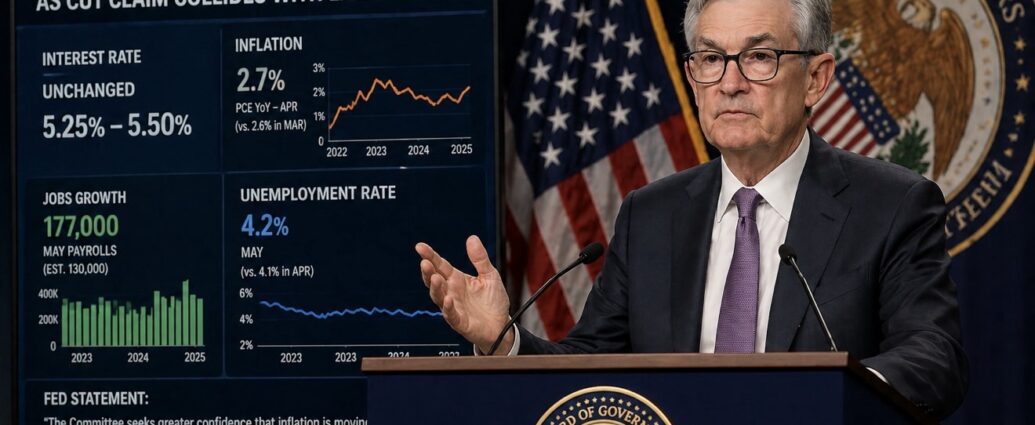
The Federal Reserve has not delivered a new rate cut this week, despite the claim in the source item, and the latest confirmed policy setting remains the central bank’s decision to leave its benchmark rate unchanged at 4.25% to 4.50% at its March meeting. In its March 19 statement, the Federal Open Market Committee said “recent indicators suggest that economic activity has continued to expand at a solid pace” while adding that “inflation remains somewhat elevated,” language that made clear policymakers still see unfinished work on prices.
At a press conference after that meeting, Jerome Powell, chair of the Federal Reserve, said the central bank does “not need to be in a hurry” to adjust rates, according to the Fed’s published remarks and reporting from Reuters and Bloomberg. That stance matters because markets entered 2024 expecting a faster easing cycle, but officials have repeatedly signaled that sticky services inflation and a resilient labor market argue for patience rather than an immediate pivot.
The source item’s reference to a fresh cut on April 28 does not match the Fed’s official calendar or public record. The next scheduled policy decision from the Federal Reserve comes at the conclusion of the May 6-7 FOMC meeting, and the central bank has issued no statement announcing any intermeeting move. CME Group’s FedWatch tool, widely cited by CNBC and MarketWatch, has shown investors assigning high odds to no change at the upcoming meeting, reflecting the broad market view that officials remain in wait-and-see mode.
Inflation data help explain that restraint. The U.S. Bureau of Economic Analysis reported that the core personal consumption expenditures price index, the Fed’s preferred inflation gauge, rose 2.8% from a year earlier in February, while the headline measure increased 2.5%. In remarks and interviews cited by Reuters, several Fed officials have said progress toward the 2% target has slowed, and Jerome Powell said after the March meeting that “we do not need to be in a hurry to adjust our policy stance,” underscoring that one or two favorable prints do not settle the inflation debate.
Labor-market conditions also continue to complicate the case for near-term easing. The U.S. Labor Department reported in early April that nonfarm payrolls rose by a stronger-than-expected 303,000 in March, while unemployment held at 3.8%, a result that Reuters described as evidence of continued economic momentum. John Williams, president of the Federal Reserve Bank of New York, said in recent public remarks reported by the Financial Times that monetary policy remains “restrictive” and well positioned, signaling that officials can afford to wait for more evidence before changing course.
Markets have adjusted accordingly. Treasury yields and rate-cut expectations have swung sharply this month as investors recalibrated to stronger growth and firmer inflation, with Bloomberg and WSJ both reporting that traders pushed back the timing of the first likely cut. Equity investors have largely treated the delay as manageable because earnings growth remains intact, but strategists quoted by MarketWatch and CNBC have warned that richly valued sectors, especially technology, could face pressure if borrowing costs stay elevated longer than expected.
The White House has also avoided any suggestion that a cut is imminent. Treasury Secretary Janet Yellen has said in public appearances covered by Associated Press and Reuters that the U.S. economy remains on a strong footing, while emphasizing that inflation has come down substantially from its peak. That message aligns with the administration’s broader effort to highlight growth and wage gains without appearing to pressure the independent central bank ahead of its next decision.
For executives, the practical takeaway is that financing conditions are unlikely to ease materially before summer unless inflation data soften more convincingly. Analysts at firms including Goldman Sachs and Morgan Stanley, as cited in recent client notes and summarized by Bloomberg and Reuters, have shifted their expectations toward fewer cuts in 2024 than many investors anticipated at the start of the year. The next key tests now include the April jobs report, fresh consumer inflation readings, and the May FOMC meeting, all of which will shape whether the Fed can begin cutting later this year or keeps policy restrictive for longer than markets, borrowers and corporate planners would like.
JBizNews Desk Reporting