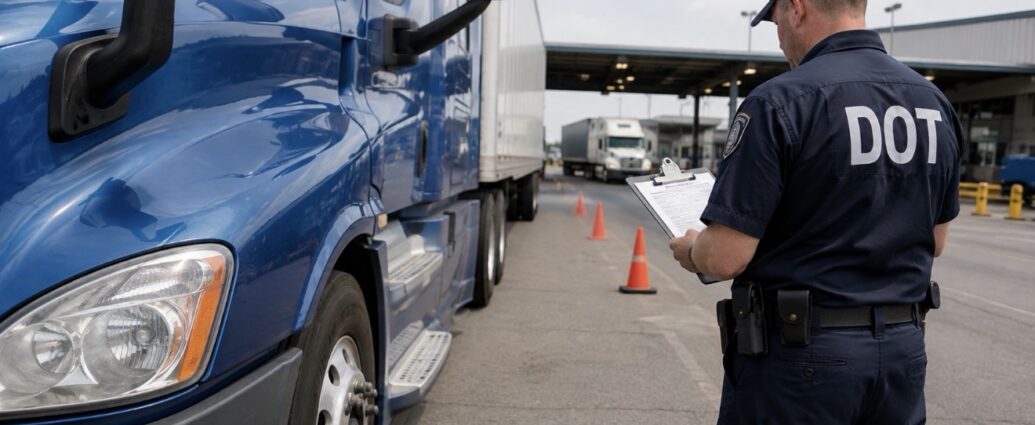
The federal government has launched one of its most aggressive crackdowns yet on commercial-driver training, immediately removing more than 110 truck-driving schools from the federal system and putting more than 160 additional schools on notice.
The move is aimed at a problem that reaches far beyond driving schools.
It strikes directly at the pipeline that supplies drivers to America’s trucking industry — the network responsible for moving food, fuel, retail goods, construction materials and nearly everything else businesses and consumers depend on.
The Department of Transportation said the 110 schools being removed from the Federal Motor Carrier Safety Administration’s Training Provider Registry were connected to more than 5,000 commercial drivers who later failed federal English-language proficiency requirements.
Those schools must immediately stop operating as federally recognized entry-level driver-training providers.
That means they can no longer provide the classroom instruction, behind-the-wheel training or certification required for new commercial drivers entering the profession.
And that is only the first part of the crackdown.
Federal investigators also conducted nearly 400 investigations across 40 states, uncovering serious violations at other training providers.
The problems included instructors who were not properly licensed, training facilities that did not have enough space for required maneuvers, missing testing records and even one provider that claimed its classroom was inside a school bus positioned in the back of a trailer.
Those investigations resulted in more than 160 proposed removals from the federal Training Provider Registry.
According to DOT, drivers certified by those providers were linked to 239 commercial-vehicle fatalities.
Why This Matters
Truck drivers cannot simply decide to drive an 80,000-pound tractor-trailer.
They need a commercial driver’s license, and new drivers generally must complete federally recognized entry-level training before they can qualify.
That makes driving schools one of the first gates into the trucking industry.
If the gate is weak, the entire system can be weak.
A school that improperly certifies drivers can potentially place people behind the wheel of extremely heavy commercial vehicles without the training or qualifications federal regulators expect.
That becomes a safety issue.
But it is also a business issue.
The trucking industry already operates with tight margins, high insurance costs, driver turnover and enormous pressure to keep freight moving.
Removing hundreds of training providers from the system could make it harder for some trucking companies to recruit drivers quickly.
Washington Is Going Much Further Than the Schools
The crackdown is not limited to training providers.
The Department of Homeland Security launched a synchronized enforcement sweep involving more than 200 driving schools across 23 states.
Federal investigators are examining allegations involving CDL fraud, unauthorized employment, identity-document fraud, financial crimes, money laundering and labor exploitation.
Officials are also investigating possible connections to human smuggling, drug trafficking and organized criminal networks.
That turns what might appear to be a licensing story into something much larger.
Federal authorities are asking whether parts of the commercial-driver system have been exploited by organized networks that help people improperly obtain licenses, jobs or documents.
The Justice Department has also created a multi-state task force involving federal prosecutors and law-enforcement agencies across Illinois, Indiana, Michigan and Ohio.
Its mission includes identifying fraudulent trucking operations, reducing highway fatalities and prosecuting criminal activity connected to commercial transportation.
The Driver Crackdown Is Already Huge
DOT says more than 28,000 commercial drivers have been taken off the road for failing English-language proficiency requirements since June 2025.
The department also says states have been forced to cancel more than 30,000 commercial licenses that were improperly issued to foreign drivers.
And federal regulators have already removed more than 8,000 unqualified training schools from the FMCSA registry during the past year and a half.
The scale shows that Washington does not view this as a handful of isolated bad schools.
It is treating it as a systemic problem.
Federal regulators are now launching a nationwide audit of third-party CDL skills testers as well.
Those are the people and organizations that actually test drivers before licenses are issued.
If regulators conclude a state is failing to properly oversee its CDL program, the consequences can become severe.
Federal highway funding can be withheld.
In extreme cases, a state’s CDL program could even be decertified, preventing it from issuing, renewing, transferring or upgrading commercial licenses until problems are corrected.
What It Means for Trucking Companies
For trucking companies, this creates both risk and responsibility.
Hiring a driver may increasingly require more than simply checking whether that person has a valid CDL.
Carriers may face growing pressure from regulators, insurers and customers to verify where drivers were trained, whether their documentation is legitimate and whether they meet federal qualification standards.
Companies that depend heavily on newly licensed drivers could also see their recruiting pipelines shrink if more training schools disappear.
That could tighten driver supply in certain regions.
And when driver supply becomes tighter, labor costs can rise.
Insurance companies may also respond.
If insurers become more concerned about poorly trained drivers or fraudulent CDL credentials, they may impose stricter underwriting requirements on trucking companies.
That could mean higher premiums or more detailed driver screening.
What It Means for the Economy
Trucking sits underneath almost every part of the U.S. economy.
Factories depend on trucks.
Supermarkets depend on trucks.
Construction companies depend on trucks.
Retailers, farms, ports and warehouses all depend on trucks.
If the federal government successfully removes unsafe or fraudulent operators, the long-term result could be a safer and more professional industry.
But in the short term, removing large numbers of schools and drivers could also reduce capacity in parts of the freight system.
That matters because fewer qualified drivers can mean higher transportation costs.
And higher freight costs eventually show up somewhere — in the price of groceries, building materials, manufactured goods or other products.
The government’s message is clear.
Washington is no longer treating commercial-driver fraud as a paperwork problem.
It is treating it as a public-safety, national-security and economic issue affecting one of the most important industries in America.
And the crackdown is only beginning.
JBizNews Desk | Washington
© JBizNews.com All Rights Reserved. Reproduction or distribution without written permission is prohibited.