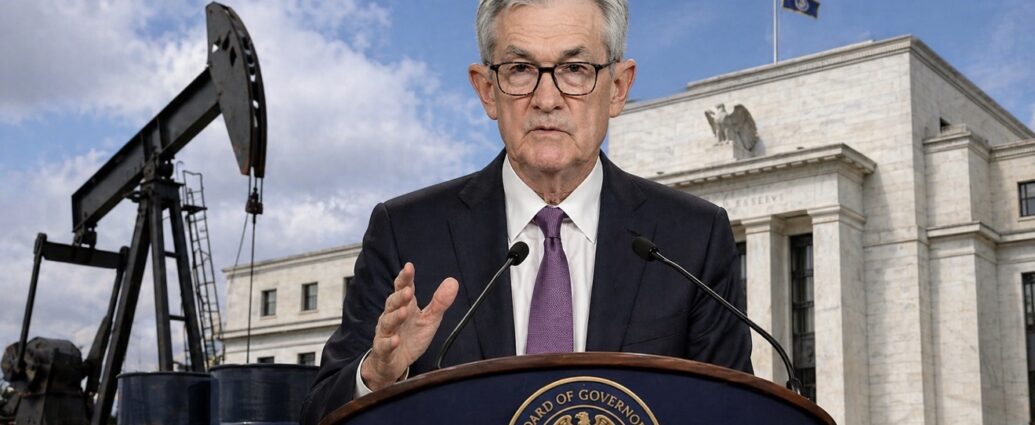
Washington — Federal Reserve policymakers convene this week in what may be Jerome Powell’s last meeting as Chair, with markets pricing in a near-certain hold on benchmark interest rates as elevated energy prices from the Iran conflict cloud the inflation outlook and complicate the path for future policy easing.0
The Federal Open Market Committee is widely expected to leave the target range for the federal funds rate unchanged at 3.50%–3.75% on Wednesday, extending the pause in place since December 2025. Isabelle Mateos y Lago, chief economist at BNP Paribas, highlighted the growth risks stemming from the Middle East standoff. “Energy shocks are amplifying uncertainty across the global economy, and the Fed will likely emphasize data dependence while acknowledging clear upside risks to inflation from sustained oil prices,” Mateos y Lago said.5
Kevin Warsh, President Trump’s nominee to succeed Powell, appears closer to confirmation after Senator Thom Tillis dropped his hold on the nomination. This development potentially sets the stage for a leadership transition as soon as mid-May. Sonal Desai, executive vice president for fixed income at Franklin Templeton, stressed the importance of maintaining Fed credibility during this period of transition. “Powell’s final acts will focus on anchoring inflation expectations; any dovish tilt in communications could be misinterpreted amid the current oil volatility and geopolitical tensions,” Desai cautioned.3
Oil prices have climbed sharply in recent sessions, with Brent crude trading above $107–$108 per barrel following disruptions and limited tanker traffic through the Strait of Hormuz. Stephen Schork, principal at The Schork Group, noted that sustained supply constraints could significantly complicate the Fed’s task. “Higher-for-longer energy costs risk re-anchoring inflation expectations at elevated levels, forcing policymakers to remain patient even as other parts of the economy show resilience,” Schork warned.10
The timing of this week’s decision is particularly notable as it coincides with the heaviest stretch of corporate earnings from major technology firms. More than $28 trillion in S&P 500 market capitalization — including reports from Meta Platforms, Microsoft, Alphabet, Amazon, and Apple — is set to report. Lori Calvasina, head of U.S. equity strategy at RBC Capital Markets, expects the central bank to carefully balance caution on growth with vigilance on price pressures. “Markets have proven resilient, but Powell will avoid signaling premature easing while the Iran situation and its impact on energy costs remain fluid,” Calvasina said.7
Broader economic implications from a steady policy stance extend directly to American households and businesses. Elevated borrowing costs for mortgages, credit cards, auto loans, and corporate investment could persist, potentially weighing on consumer spending and housing activity. Mark McCormick, head of equity strategy at BMO Capital Markets, views the week as pivotal for risk assets. “A steady Fed combined with strong results from the Magnificent Seven could reaffirm the soft-landing narrative, but oil remains the wildcard that could alter the trajectory for both inflation and growth expectations,” McCormick added.
Analysts note that Jerome Powell’s communications this week will be scrutinized not only for policy signals but also for their historical weight as potentially his final formal address in the role. His term as Chair officially ends on May 15, 2026, though he will continue serving on the Board of Governors. Paul Tudor Jones, founder of Tudor Investment Corp., has publicly highlighted the significance of leadership continuity at the Fed during turbulent times. “The transition from Powell to Warsh represents a critical juncture; markets will be listening for any hints on how the new guard might approach the balance between inflation control and economic support,” observers aligned with such views have noted in recent commentary.
The geopolitical backdrop adds another layer of complexity. With Brent crude up significantly year-to-date amid the Iran-related disruptions, economists warn of second-round effects on core inflation measures. Goldman Sachs economists have flagged that prolonged energy shocks could delay anticipated rate cuts into the second half of 2026 or later. This outlook aligns with CME FedWatch Tool data showing near-100% probability of no change this week and only modest easing priced in for later meetings.7
For businesses, steady rates mean continued elevated financing costs, which could influence capital expenditure decisions — particularly in interest-rate-sensitive sectors like real estate and technology infrastructure. Dan Ives, managing director at Wedbush Securities, remains constructive on the tech sector’s ability to weather the environment. “AI-driven productivity gains and strong balance sheets should help major companies navigate this period of policy caution,” Ives observed.
Everyday consumers are already feeling the pinch from higher gasoline prices, now averaging near $4.10 per gallon in many regions according to AAA data. This feeds directly into higher transportation and logistics costs, which ripple through to grocery bills and overall cost of living. Lori Calvasina of RBC emphasized that the Fed’s measured approach aims to avoid exacerbating these pressures through premature policy shifts.
As the FOMC prepares its statement and Jerome Powell takes the podium for what could be his swan song press conference, the focus will remain on data dependence and flexibility. Analysts broadly expect a measured, balanced tone that prioritizes continuity amid overlapping shocks from geopolitics, energy markets, and the corporate earnings cycle. The outcome will set the tone not only for the remainder of 2026 but also for the incoming leadership under Kevin Warsh.
JBizNews Staff | April 27, 2026