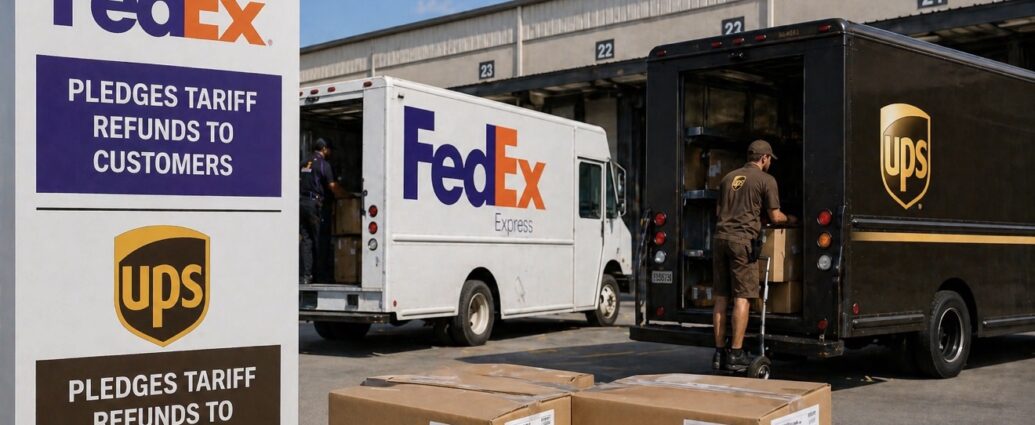
FedEx and UPS say they plan to return tariff-related refunds to customers if the U.S. government pays back duties tied to now-invalidated import levies, a step that could ripple through shipping bills and e-commerce costs for businesses and households. In statements reported by Reuters, Bloomberg and company materials, both parcel carriers signaled that any money recovered through the customs refund process would go back to the shippers that ultimately bore the charges, rather than stay on the companies’ books.
At UPS, Chief Executive Carol Tomé said on the company’s earnings presentation that the carrier is “working with Customs and Border Protection to apply for those refunds and will remit the money directly to our customers as soon as it arrives,” according to a company release. That commitment matters because UPS sits at the center of cross-border parcel flows for retailers, manufacturers and small businesses, and any refund program could affect pricing just as companies continue to navigate softer freight demand and pressure on consumer spending.
FedEx made a similar pledge. A company spokesperson told Fortune that “if refunds are issued to FedEx, we will issue refunds to the shippers and consumers who originally bore those charges,” underscoring that the company views itself as a conduit rather than the final beneficiary. The statement follows earlier legal action by FedEx challenging the tariff burden, and it positions the Memphis-based carrier to compete on service and trust at a time when logistics providers are trying to hold onto margin without alienating customers.
The refund issue traces back to a recent U.S. Supreme Court decision that struck down tariffs imposed under the International Emergency Economic Powers Act, overturning a key legal basis for the duties. While the exact scope of recoverable amounts still depends on customs processing and claim validation, the ruling opened the door for importers and intermediaries to seek reimbursement. Fortune reported that Commerce Secretary Scott Bessent voiced skepticism about whether consumers would ultimately benefit, saying, “I got a feeling the American people won’t see it,” a remark that sharpened attention on whether large companies would keep the proceeds or pass them through.
The mechanics now rest largely with U.S. Customs and Border Protection. CBP recently launched its Consolidated Administration and Processing of Entries, or CAPE, portal to centralize claims, and Deputy Commissioner Mark Morgan told Reuters that the system gives importers “a single point of entry for refund applications and accelerates processing.” CBP has said an initial wave of payouts could arrive within 60 to 90 days, a timeline that gives finance chiefs and supply-chain managers a near-term window to assess how much cash could flow back and how quickly it could reach customers.
Treasury officials also indicated they are preparing for a sizable administrative effort. MarketWatch reported that Treasury Undersecretary for Domestic Finance Neil Barr said, “We anticipate completing the first batch of refunds within the 60-90-day window outlined by CBP,” while adding that the department intends to monitor the flow of funds for transparency. That point matters for corporate customers because the value of a refund may depend not only on legal eligibility but also on recordkeeping, shipment documentation and whether carriers can match recovered duties to specific accounts.
For UPS, the accounting treatment and timing could become a closely watched issue in coming quarters. Bloomberg cited UPS Chief Financial Officer Brian Sutherland telling analysts that “our approach is collaborative; we are not pursuing litigation against the government,” and that the company expects to credit shippers after funds arrive. That language suggests UPS wants to avoid a prolonged courtroom fight and instead rely on the administrative process, a choice that may appeal to customers seeking certainty but could still leave open questions about timing if claims move more slowly than expected.
The broader economic backdrop helps explain why the issue has drawn so much attention. The Associated Press reported on consumer frustration with tariff charges attached to relatively small purchases, quoting one shopper who said, “It didn’t make sense to pay a $10 tariff on a $27 purchase.” Fortune, citing Federal Reserve data, said households absorbed roughly 90% of the levy burden, reinforcing the view that tariff costs often traveled through the supply chain to end buyers rather than staying with importers or carriers.
Small businesses, which often lack the pricing power of larger retailers, stand to feel the impact most directly if refunds arrive. Reuters quoted Seattle apparel shop owner Linda Cheng saying, “We’re counting on the rebate to keep our pricing competitive and protect margins,” a practical reminder that shipping surcharges and import duties can quickly erode profitability for merchants that depend on parcel networks for fulfillment. For those companies, even modest reimbursements could help offset inventory costs ahead of key seasonal selling periods.
Wall Street is also weighing the implications, though analysts appear careful not to treat the potential refunds as a clean earnings windfall. Bloomberg cited Morgan Stanley analyst Priya Patel saying, “The timing of these cash-back payments could add a meaningful boost to UPS’s Q3 top-line, especially as e-commerce volumes remain strong,” while also noting that FedEx could gain goodwill with business customers by honoring pass-through refunds. Even so, any benefit to reported revenue or customer retention will depend on when the government pays, how much each carrier recovers and whether the funds simply reverse prior charges rather than create new demand.
What comes next is less about legal theory than execution. If CBP and Treasury meet their stated 60-to-90-day target, shippers could begin seeing credits later this summer, giving retailers and importers a small but tangible cost release before year-end planning intensifies. If delays emerge, the episode could become another test of how quickly Washington can translate court rulings into real economic relief. For customers of FedEx and UPS, the key issue now is straightforward: whether the promised refunds move from corporate statements into actual account credits, and how much that changes shipping economics in the second half of the year.
JBizNews Desk