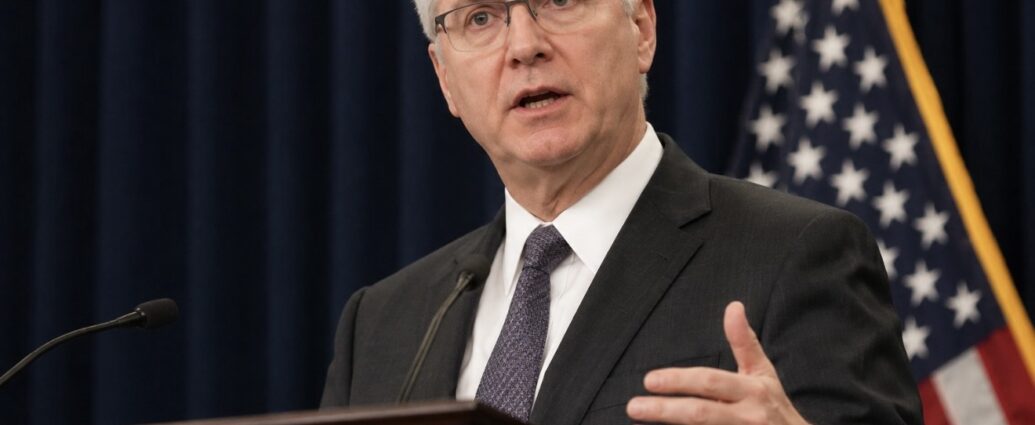
Federal Reserve Governor Christopher Waller said Thursday he could support leaving interest rates unchanged at the Fed’s September meeting if upcoming inflation data confirm that price pressures are finally moving lower.
That is an important shift.
Markets had moved sharply toward expecting another rate increase after higher oil prices and renewed inflation concerns rattled bonds and pushed Treasury yields higher.
Waller is now saying a September hike is not automatic.
His decision will depend heavily on the inflation data arriving before the Federal Open Market Committee meets on September 15 and 16.
What Waller Is Seeing
Waller acknowledged that inflation remains meaningfully above the Federal Reserve’s 2% target.
But he also said recent data are showing something policymakers have been waiting for:
Signs that inflation may finally be cooling again.
That distinction matters.
The Fed does not need inflation to already be at 2% before it stops raising rates.
It needs confidence that inflation is moving convincingly toward 2%.
If August inflation data continue that trend, Waller said maintaining the current federal-funds target range of 3.50% to 3.75% could be appropriate.
If inflation comes in hotter than expected, however, he remains prepared to support another rate increase.
Why Waller Matters
Waller is only one member of the Federal Reserve’s policy-setting committee.
But his comments matter because they show that policymakers are not united behind another hike.
Fed Chairman Kevin Warsh has taken a tougher tone on inflation, warning that the central bank must respond if price pressures remain too high.
Waller is emphasizing patience.
That debate will become increasingly important over the next two weeks.
The Fed is trying to determine whether the recent inflation pressure is becoming embedded throughout the economy or remains largely connected to temporary shocks such as energy prices and tariffs.
Oil Complicates Everything
The biggest new problem is energy.
Oil prices have jumped as conflict involving Iran has disrupted normal shipping through the Gulf.
Higher energy prices can quickly reach businesses and consumers through gasoline, diesel, aviation fuel, transportation and electricity costs.
The Fed cannot produce more oil.
Raising interest rates does not reopen a shipping lane.
But policymakers worry that if higher energy costs remain in place long enough, businesses will begin passing those expenses into broader prices.
That is when an energy shock can become general inflation.
Waller appears willing to wait for evidence that this is actually happening before voting for another rate increase.
The Labor Market Gives the Fed Room to Wait
The employment picture is also giving policymakers conflicting signals.
Layoffs remain relatively low.
Weekly unemployment claims released Thursday were just 206,000, suggesting companies are not broadly cutting workers.
But hiring has slowed substantially.
That creates what economists increasingly describe as a no-hire, no-fire economy.
Businesses are holding onto the workers they already have but are becoming more cautious about adding new ones.
For the Fed, that matters.
If policymakers raise rates too aggressively while hiring is already cooling, they risk weakening the labor market unnecessarily.
Why Friday’s Jobs Report Matters
The next major test arrives Friday with the August employment report.
Investors will be watching:
- How many jobs the economy created
- Whether unemployment increased
- How quickly wages are rising
- Whether previous months are revised
A surprisingly strong labor report combined with stubborn inflation could strengthen the case for another hike.
A weaker employment report combined with cooler inflation would make a pause much easier to justify.
Rates Are Already Restrictive
Waller also noted that interest rates are already restraining the economy.
The federal-funds rate currently stands at 3.50% to 3.75%.
That means the question facing policymakers is no longer whether monetary policy should be tight.
It already is.
The question is whether it needs to become even tighter.
Every additional quarter-point increase makes mortgages, business loans, credit cards and other financing more expensive.
That can slow investment and consumer spending.
What It Means for Businesses
For business owners, Waller’s comments reduce — but do not eliminate — the risk of another immediate jump in borrowing costs.
Companies financing equipment, inventory, real estate or expansion have been watching Treasury yields and bank lending rates move higher as markets anticipated another Fed increase.
If the central bank pauses in September, some of that pressure could stabilize.
If inflation comes in hot and the Fed hikes again, borrowing conditions would tighten further.
That makes the next inflation reports unusually important.
The Fed is no longer simply fighting inflation.
It is trying to decide whether the inflation problem is serious enough to justify putting additional pressure on an economy where hiring is already slowing.
Waller’s message Thursday was essentially:
Do not raise rates simply because markets expect it. Wait for the data to prove another increase is necessary.
For businesses and investors, that makes September’s Fed decision much less settled than it appeared only days ago.
JBizNews Desk | Washington
© JBizNews.com All Rights Reserved. Reproduction or distribution without written permission is prohibited.