By JBizNews Desk
If you run a company that imports anything from China, this story is about you.
On May 26, 2026, court filings revealed that the federal government has filed a formal $285.5 million claim against bankrupt auto parts maker First Brands Group, accusing the company of cheating on the tariffs it owed for parts brought in from China. The number includes the unpaid duties plus penalties. First Brands filed for Chapter 11 bankruptcy on September 28, 2025, and it already owes more than $11.8 billion it cannot pay back. Now the U.S. Treasury wants its cut.
Here is why this matters far beyond one bankrupt auto parts company.
First Brands is not an isolated case. It is the latest name on a fast-growing list, and the people fighting this trend say what we are seeing in the data is staggering.
The Number That Should Worry Every Importer
According to a recent New York Times investigation, the average value of goods packed into a 20-foot shipping container coming from China dropped nearly 40% between January 2025 and February 2026. Over that same stretch, container values from the rest of the world barely budged.
That is not a market story. That is a paperwork story. Companies have been writing down the declared value of their Chinese shipments to lower the tariffs they pay.
Ryan Petersen, chief executive of supply chain firm Flexport, told the New York Times: “We’re seeing just total, rampant fraud.”
When the CEO of one of the largest logistics companies in America says fraud is rampant, regulators listen. And they are.
Meet The Agency Hunting Your Shipping Paperwork
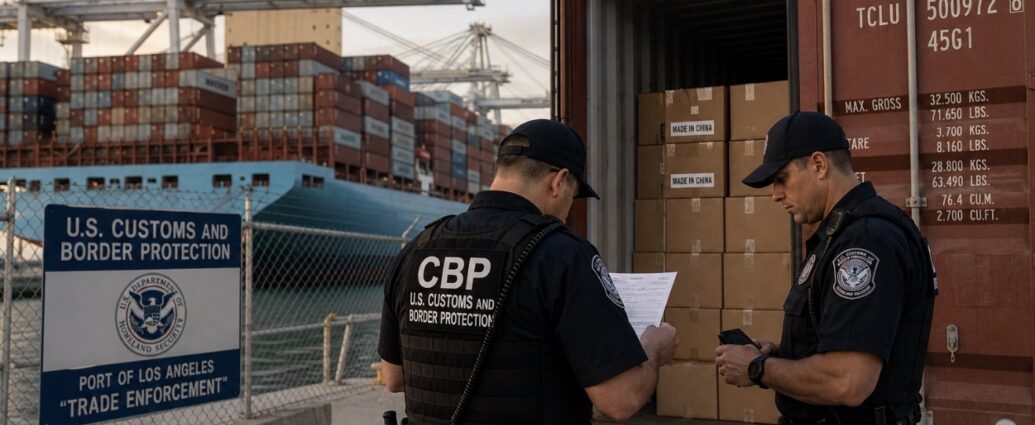
On August 29, 2025, the U.S. Department of Justice and the Department of Homeland Security launched a brand-new joint operation called the Trade Fraud Task Force. It brings together civil prosecutors, criminal prosecutors, Customs and Border Protection investigators, and Homeland Security Investigations agents under one roof. Its stated mission is to go after anyone who tries to “evade tariffs and other duties.”
In May 2025, the DOJ had already put trade fraud on its list of ten “high-impact” enforcement priorities. In fiscal 2025, the DOJ recovered a record $6.8 billion through False Claims Act settlements. Seventy-eight percent of that money came from whistleblower-driven cases.
That last number is the one you need to circle. Most of these cases are not coming from government audits. They are coming from inside the building.
The Roster Of Recent Settlements Keeps Growing
This is where the First Brands case stops looking lonely.
In December 2025, the DOJ announced a $54.4 million settlement with Ceratizit USA LLC over allegations the company misrepresented tungsten carbide products from China as Taiwanese to avoid tariffs. At the time, it was called the largest False Claims Act customs fraud settlement on record.
That record did not last long.
Two weeks ago, the DOJ settled with Perfectus Aluminum for $549.5 million — more than ten times larger than the previous record — also tied to Chinese imports.
In July 2025, Grosfillex Inc. settled for $4.9 million over evading anti-dumping duties on aluminum products from China. The whistleblower in that case, a former employee, walked away with nearly $1 million.
There were smaller ones too:
- King Kong Tools — $1.9 million
- Dallco Marketing — $2.5 million
- Homestar North America — $798,334
The whistleblowers collected hundreds of thousands of dollars in rewards.
That is the pattern. Same scheme. Same country of origin. Different companies. Growing penalties.
How The First Brands Case Started
The First Brands tariff case did not start with the government. It started with a whistleblower.
In March 2022, a company called Alder Wood LLC filed a sealed complaint in federal court in New York under the False Claims Act. Alder Wood alleged that First Brands imported brake parts from its own subsidiary in China without paying the right amount of tariffs.
The False Claims Act allows private parties to sue on behalf of the government when they believe a company is cheating taxpayers. If the government recovers money, the whistleblower gets a percentage.
The case stayed under seal for years while the DOJ investigated. It became public earlier this year. This week, the U.S. government formally joined it.
Mark Strauss, the attorney for Alder Wood, said this week that “the wrongdoing we alleged turns out to be the tip of the fraud iceberg.”
The Bigger Mess At First Brands
The tariff allegations were only part of the collapse.
About $2.3 billion of First Brands debt came from selling invoices to outside lenders through factoring arrangements.
Here is how factoring works in plain English. A company sells unpaid customer invoices to a lender at a discount in exchange for immediate cash. The lender then collects the payment later from the customer.
The lenders believed they were buying real invoices owed by real customers.
When First Brands filed for bankruptcy, only about $400 million of those invoices were considered legitimate, according to court filings from Leucadia Asset Management, a Jefferies-owned lender that bought roughly $885 million in invoices.
In April 2026, a court-appointed examiner found what the report called “widespread fraud” involving lenders including:
- Raistone
- Leucadia
- Evolution Credit Partners
- Katsumi Global
Some receivables were later resold to ING Belgium and Bank ABC.
First Brands founder Patrick James stepped down as CEO in October 2025.
Why This Is Happening Now
Tariff rates exploded higher in 2025.
Some imported goods were hit with rates as high as 73%, according to court filings. First Brands itself told the bankruptcy court tariffs added roughly $220 million in costs to the company.
When tariff rates triple, the incentive to manipulate customs paperwork rises with them.
A company facing a 10% or 25% tariff might decide the legal risk is not worth it. A company facing 73% tariffs starts making survival calculations.
That is what regulators believe is now happening across large parts of the importing system.
Who Could Be Next
Customs and Border Protection says the most commonly targeted categories include:
- Steel
- Aluminum
- Furniture
- Clothing
- Honey
- Shrimp
- Catfish
- Tools
The most common schemes are:
- Undervaluation — declaring imports as worth less than they really are
- Transshipment — routing Chinese goods through countries like Mexico, Vietnam, Malaysia, or the Philippines and relabeling them
The risks are massive.
The DOJ can seek:
- Triple damages
- Civil penalties
- Criminal charges
- Additional tariff penalties
And Customs inspects less than 1% of containers entering the United States, meaning whistleblowers are now doing much of the government’s discovery work.
The 120-Day Clock Companies May Not Know Exists
In May 2025, the DOJ Criminal Division introduced guaranteed declinations for companies that voluntarily disclose violations.
In March 2026, the department expanded that framework government-wide.
But there is a catch.
Once an internal whistleblower reports concerns inside a company, management has 120 days to self-disclose the issue to federal authorities or lose eligibility for a presumptive declination.
In plain English: the legal clock starts the moment an employee raises concerns internally.
The Bottom Line
The First Brands case is not an isolated bankruptcy story.
It is part of a growing federal crackdown that has now produced:
- An $11.8 billion bankruptcy
- A $549.5 million settlement
- A $54.4 million settlement
- A record $6.8 billion DOJ enforcement year
- A nearly 40% collapse in declared Chinese container values that regulators increasingly believe reflects fraud
If your company imports from China — directly or indirectly — regulators are no longer assuming paperwork errors are accidental.
They are increasingly assuming intent.
And they now have whistleblowers, data analytics, Customs investigators, Homeland Security agents, and the full DOJ Trade Fraud Task Force looking for it.
JBizNews Desk — Washington
© JBizNews.com All Rights Reserved. Reproduction or distribution without written permission is prohibited.