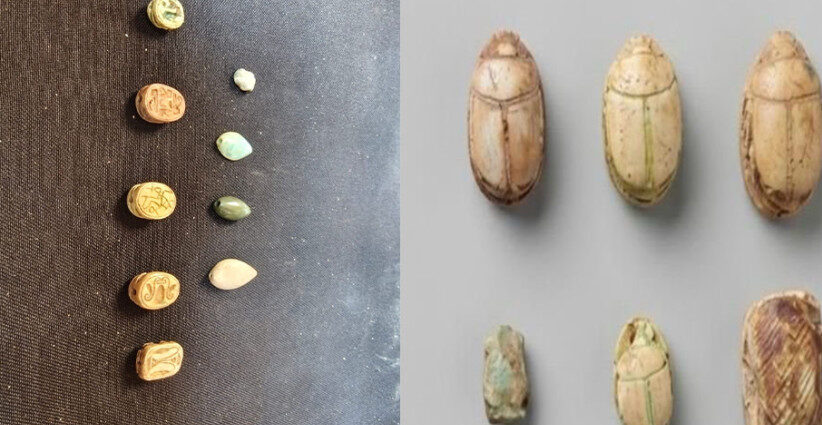
An almost-complete ancient Egyptian funerary set was recently discovered during archaeological excavations at the Panhesy Tomb within the ruins of the ancient city of Heliopolis, the Egyptian Tourism and Antiquities Ministry announced on Sunday.
Heliopolis, one of ancient Egypt’s oldest cities, sits today within the Ain Shams and El Matareya districts of northeastern Cairo.
In antiquity, it served as a primary religious center for the worship of Ra – indicated by the Al-Masalla obelisk of the Temple of Ra-Atum, originally erected by Pharaoh Senusret I of the 12th Dynasty.
The funerary set was found underneath a mud-brick burial containing human remains, according to Dr. Hisham El-Leithy, Secretary-General of Egypt’s Supreme Council of Antiquities.
It is the first near-complete set to ever be found in the area, according to the ministry.
Leithy added that a copper mirror, two alabaster kohl vessels fitted with lids and still containing kohl residue, as well as a third kohl vessel made of black obsidian, were also found beneath the burial.
The discovery further provides insight into the “daily life and funerary practices of the region’s inhabitants across successive historical periods,” said Egypt’s Tourism and Antiquities Minister Sherif Fathy.
Several faience artifacts found
Alongside the set and the adjoining cache, archaeologists unearthed two vessels made of pale blue faience. One of the vessels contained six symbolic scarabs bearing inscriptions, and two scarabs encased in what is believed to be gold.
Several faience amulets were also discovered, including a duck-shaped amulet and another in the form of the Atef crown of Osiris, which features the Hedjet (the white crown of Upper Egypt) and curly ostrich feathers set on each of its sides.
Two carnelian stones, a pinkish-red stone set in what is believed to be gold, and a blue-green stone were also found, along with five pairs of earrings (presumed to be made of gold).
Mohamed Abdel-Badie, Head of the Egyptian Antiquities Sector at Egypt’s Supreme Council of Antiquities, explained that these excavations follow the discovery of the remains of mud-brick and limestone funerary structures and two partial coffins.
One of the coffins, made of gilded plaster decorated with red inscriptions, is thought to have belonged to a military figure and contained a coin that is believed to date to the Roman period.
Limestone blocks bearing hieroglyphic inscriptions were also found, Badie added, further reinforcing the importance of studying the site’s chronological and civilizational sequence.
Over 30 mummified cats, ancient Egyptian tombs found in Luxor excavation
In mid-May, the ministry revealed that separate excavations at a necropolis on the Nile River’s west bank have uncovered a plethora of previously unrecorded tombs and ancient Egyptian artifacts.
The excavations have focused on the southeastern part of the tomb of Roy, an 18th Dynasty royal scribe, and his wife, which has been covered in debris from archaeological missions from over a century ago.
In the courtyard between the tomb of Roy and the nearby tomb of Baki, archaeologists have discovered a collection of 10 wooden coffins hidden within a burial shaft. All 10 were found to be in good condition, bearing a variety of scenes and texts.
A second coffin, dating to the Ramesside period (the 19th and 20th Dynasty periods), bears the name Padi-Amun (“he who Amun gave”), who was a priest in the Temple of Amun.
Buried, mummified animals, including over 30 mummified wild and domestic cats, were also discovered within layers of debris south of the tomb of Baki.
According to researchers, the burial likely dates to the Ptolemaic period, when animal mummies were offered as symbolic offerings for protection, before being buried in small pits upon completion of the religious ritual or celebration.