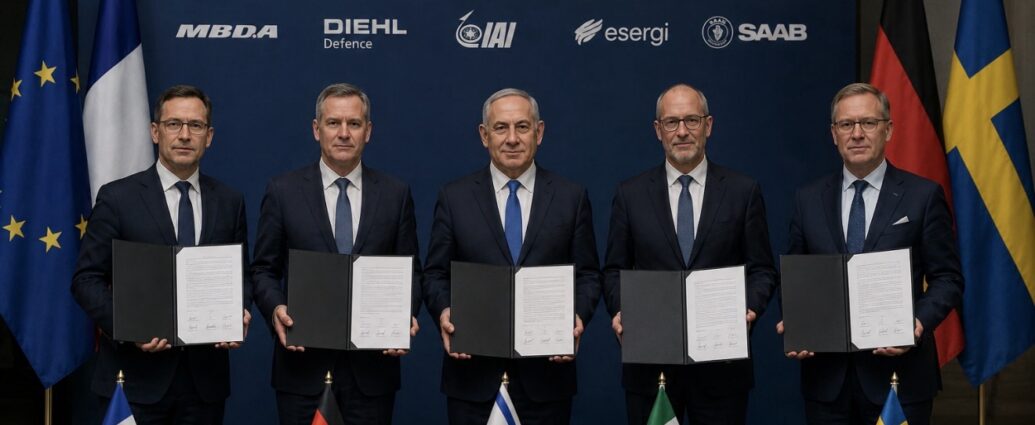
Five of Europe’s biggest defense companies have agreed to build the continent’s first homegrown system for shooting down long-range ballistic missiles in space, a direct response to the kind of weapons Russia has been firing at Ukraine. Airbus Defence and Space, Destinus, MBDA Deutschland, Safran Electronics & Defense, and Thales signed a Letter of Intent in Paris to establish the Bliksem EXO Consortium, the group announced this week. The signing took place at the inaugural meeting of a new anti-ballistic coalition on Monday, in the presence of Rob Jetten, Prime Minister of the Netherlands.
The system, called Bliksem EXO, is meant to detect, track and destroy medium- and intermediate-range ballistic missiles above the atmosphere by slamming an interceptor straight into them at high speed, without an explosive warhead — a technique known as hit-to-kill. The companies say it is aimed at threats including Russia’s Oreshnik-class missiles, which can carry separating and maneuvering re-entry vehicles that make them hard to stop.
Who does what
The consortium splits the work along each company’s strengths. Destinus serves as Consortium Lead and Prime, handling overall system integration and the Exo-atmospheric Kill Vehicle. MBDA Deutschland builds the interceptor booster, launcher and canister. Safran Electronics & Defense supplies the kill vehicle’s seeker and its guidance and navigation controls. Airbus Defence and Space provides command, control and battle management, and Thales delivers the radar and sensor chain, from early warning to fire control.
Mikhail Kokorich, Chief Executive Officer of Destinus, said Europe already has strong lower-layer defenses but still lacks its own upper-layer shield against medium- and intermediate-range missiles, a gap Bliksem EXO is designed to close. He said joint engineering will begin in August 2026, with a test of the kill vehicle in space planned for 2027. Thomas Gottschild, Managing Director of MBDA Deutschland, called the agreement an important step toward strengthening Europe’s collective defense.
The deal is a starting gun, not a signed contract. Under the Letter of Intent, the parties intend to reach a binding Consortium Agreement within three months, and the document creates no obligation to buy, supply or fund the system. The program is designed to plug into NATO’s Integrated Air and Missile Defence and to strengthen the European Sky Shield Initiative by filling its missing upper layer.
Why Europe is moving now
The push reflects a hard lesson from the war in Ukraine. Ten countries — Denmark, France, Germany, Italy, the Netherlands, Norway, Spain, Sweden, the United Kingdom and Ukraine — met in Paris to launch what they call the Integrated Anti-Ballistic Missile Coalition, an effort to build a cheaper alternative to the American Patriot system. The Patriot remains the workhorse against ballistic missiles, but its interceptors cost millions of dollars each and production cannot keep up with global demand.
Volodymyr Zelenskyy, Ukraine’s president, told reporters that Kyiv often runs short of the missiles needed to knock down ballistic targets, which is why it joined the effort. French President Emmanuel Macron framed the program as a way to protect Ukraine and build up Europe’s own defense industry. Notably absent were Poland, the Baltic states, Finland and the United States.
What it means for the business
For investors, the deal lands in the middle of the strongest run European defense stocks have seen in years. Companies from Rheinmetall to BAE Systems, Leonardo, Thales and Saab have piled up orders since Russia’s 2022 invasion, and McKinsey estimates European NATO core defense spending has doubled since 2019 and could reach roughly 800 billion euros by the end of the decade as members work toward NATO’s benchmark of 3.5% of GDP.
Of the five partners, three trade publicly: Airbus, Safran (SAF.PA) and Thales (HO.PA). MBDA is a joint venture, and Destinus is privately held, so the immediate market read runs through the listed names. Analysts have stayed constructive on Safran: Citi recently lifted its price target to 315 euros from 305 euros with a Neutral rating, while Jefferies analyst Chloe Lemarie raised her target to 330 euros from 310 euros and kept a Hold. Thales shares traded near 216 euros in late June, down in the mid-single digits for the year despite the broader defense rally.
The bigger prize is the pipeline. A working European interceptor would give governments a home-built option they do not have to buy from Washington, and the firms that build the radars, boosters and kill vehicles stand to book years of orders if the coalition turns intent into contracts. The first real test comes within three months, when the partners are due to sign a binding agreement.
JBizNews Desk | New York © JBizNews.com All Rights Reserved. Reproduction or distribution without written permission is prohibited.