By JBizNews Desk
June 3, 2026
Florida has become the first state in the nation to sue OpenAI, escalating the legal and political scrutiny surrounding artificial intelligence and how it is used by children.
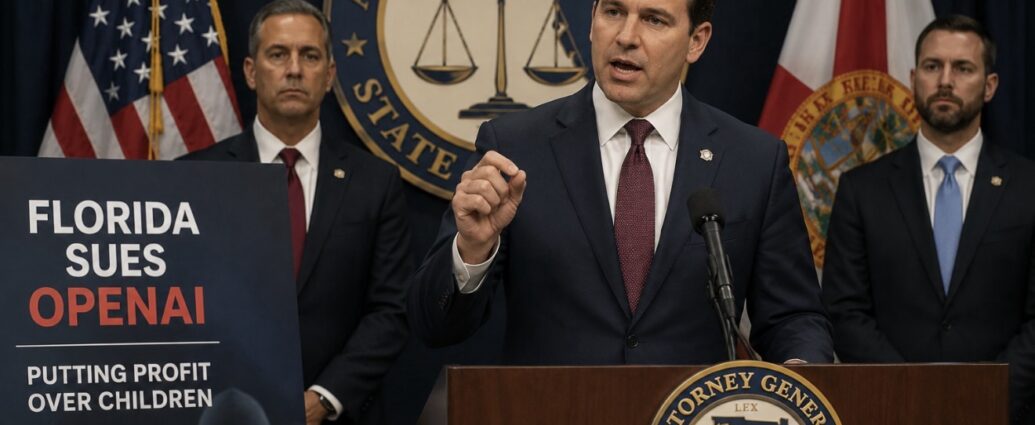
Florida Attorney General James Uthmeier announced Monday that the state had filed a civil lawsuit against OpenAI and its chief executive, Sam Altman, alleging that the company failed to adequately protect minors while marketing ChatGPT as a safe product. The lawsuit, filed in Florida state court, accuses the company of deceptive and unfair trade practices, negligence, and violations of product-liability laws.
At the center of the complaint is the state’s claim that OpenAI promoted ChatGPT as safe while allegedly downplaying or failing to address known risks associated with its use by young people.
“They have chosen profit over public safety,” Uthmeier said during a press conference announcing the lawsuit.
The attorney general said Florida intends to hold the company accountable and seek significant financial penalties.
Focus on Children
Much of the lawsuit centers on how minors access and use ChatGPT.
Florida argues that the free version of the chatbot lacks meaningful age-verification measures and does not provide sufficient safeguards to prevent children from accessing the platform.
The complaint further alleges that parental oversight tools are inadequate, claiming parents are limited in what they can monitor and review regarding their children’s interactions with the AI system.
The state also alleges that OpenAI collects information from minors without sufficient parental control and that the platform can encourage excessive reliance on AI among younger users.
Those allegations remain claims by the state and have not been proven in court.
Sam Altman Named Personally
In an unusual move, Florida also named Sam Altman individually as a defendant.
Uthmeier told reporters that Altman played a direct role in decisions surrounding product development and deployment and therefore should be held personally accountable if the allegations are proven.
The lawsuit seeks damages that state officials say could potentially reach into the billions of dollars, along with court-ordered changes to how OpenAI handles younger users.
Legal experts note that attempts to impose personal liability on technology executives are relatively uncommon and often become a major point of dispute during litigation.
Part of a Larger Investigation
The civil lawsuit follows a broader investigation launched by the attorney general’s office in April.
That inquiry examined whether OpenAI’s technology may have played a role in certain criminal cases in Florida after investigators reported that individuals involved in violent incidents had interacted with ChatGPT before those events.
The lawsuit references those broader concerns as part of the state’s argument that stronger safeguards are needed around advanced AI systems.
OpenAI’s Position
OpenAI did not immediately respond to requests for comment following the filing.
The company has previously stated that its systems are designed to reject requests that could facilitate violence or criminal activity and has emphasized that safety remains a central focus of development.
OpenAI has also said it works with law enforcement when conversations indicate an imminent and credible threat of harm and employs specialized review teams to assess sensitive situations.
Major Stakes for the AI Industry
The financial and regulatory implications extend far beyond OpenAI.
The company is one of the world’s most valuable private technology firms, and a significant damages award or court-ordered changes could affect both its business model and future product development.
The lawsuit also signals a broader shift in how governments may approach artificial intelligence regulation.
Until now, much of the debate surrounding AI oversight has occurred in Congress, federal agencies, and state legislatures. Florida’s lawsuit represents one of the first major attempts to use the court system to impose accountability on AI developers.
If Florida succeeds—or reaches a substantial settlement—other states could follow with similar legal strategies.
A Potential Roadmap for Other States
Attorneys general across the country have increasingly focused on issues involving artificial intelligence, particularly where children and consumer protection are concerned.
A successful case in Florida could provide a blueprint for future lawsuits targeting age verification, parental controls, content moderation, and data collection practices.
For AI companies, that could mean increased pressure to build stronger safeguards, verification systems, and compliance frameworks—changes that often require significant investment and can slow product rollouts.
Industry groups have warned that a patchwork of state-by-state regulations and lawsuits could create substantial compliance burdens for technology companies operating nationwide.
Consumer advocates argue that legal action is necessary because AI technology has advanced far faster than the rules governing it.
The Bottom Line
The allegations against OpenAI remain unproven, and the company will have an opportunity to challenge the claims in court.
But the lawsuit marks a significant milestone in the evolution of AI regulation.
After years in which artificial-intelligence technology expanded faster than governments could respond, Florida is now asking a court to decide whether companies that build these systems—and the executives who run them—can be held responsible when those tools allegedly cause harm to children.
The outcome could influence not only OpenAI, but the future legal framework governing the entire AI industry.
Tallahassee, Fla. — JBizNews Desk
© JBizNews.com All Rights Reserved. Reproduction or distribution without written permission is prohibited.