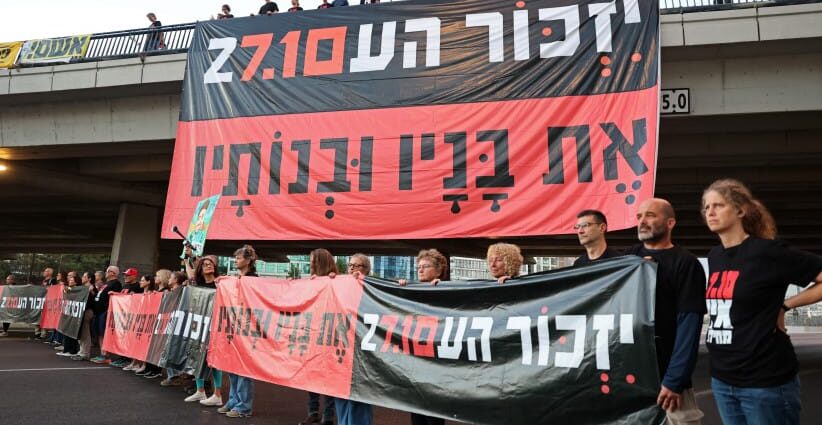
Deganit Bar Hay, an Israeli survivor of the Hamas-led October 7 massacre, cannot barbecue because the smell of burnt flesh is still a trigger three years later, she told the Associated Press. Let that horrific thought sink in for a moment.
Hundreds of thousands of survivors of Hamas’s rampage of murder, maiming, rape, torture, kidnapping, burning, and destruction share her enduring trauma.
In Israel, three years afterward, one in five Israelis are still “struggling to function” due to mental health disabilities, a new study found.
But for the leading wire service, Deganit’s ongoing trauma is merely a footnote to what the news agency considers the real story: that is, the “tragedy in Gaza.”
On the eve of October 7, 2026, the third anniversary of the deadliest day for Jews since the Holocaust, Deganit’s heartbreaking pain is buried in the seventh paragraph. The article’s focus, as the headline puts it, is “Much of the world sees tragedy in Gaza. Many Israelis, scarred by October 7, see only a threat.”
Deganit’s trauma serves as a mere vehicle to probe what the news agency sees as the real story on the anniversary of this horrific massacre of Israelis: “tragedy in Gaza.”
Thus, as Israelis gathered to mark the Palestinian mass murder of their own people in their homes and at a music festival, the AP perversely highlights Palestinian victimhood.
Even more perversely, on the anniversary of Hamas’s unprecedented slaughter of Israeli civilians, the AP faults Israeli victims for not seeing beyond their own self-absorbing pain to share concern for Palestinian hardships.
“There is little discussion of Palestinian civilians,” a subheading complains.
Indeed, in the opening paragraphs describing Israelis peering through binoculars towards “the shattered Gaza town of Beit Hanun,” AP falsely frames the scene as Israelis exhibiting cruel callousness towards Palestinian civilians.
“The lookout is a rare place where they can confront the Palestinian territory firsthand, and some celebrate its devastation,” AP’s Cara Anna opines, completely erasing Hamas from the equation.
She then cites one onlooker quoted in an Israeli documentary: “Wow, destroyed beautifully.”
In her fallacious telling, Israelis rejoice in the pain of civilians, not in the destruction of the terror infrastructure that enabled the unspeakable horrors their own communities suffered on October 7 and still torment to this day.
The news agency’s unfortunate photo choice reinforces the distorted narrative in which ghoulish Israelis supposedly rejoice in the suffering of neighboring civilians.
Of the five photos and one video illustrating the October 7 story, the first image viewers encounter is not of Israelis mourning their dead or visiting their still savaged homes, but of Israelis peering through the binoculars towards the Gaza Strip.
“Three years on, a visit to the communities attacked that day made clear: it’s too soon for many residents to see the Palestinians next door as anything other than a threat,” AP reports, implying that their fears are unfounded and unjustified.
AP’s double standards
Alleging that the “vast majority of [Gaza’s] 2 million residents live in rat-infested camps or among the debris,” AP charged: “But empathy for them is still unthinkable for many in Israel, with memories raw.”
Under what moral or journalistic compass does a leading news outlet mark the anniversary of a massacre by highlighting the victims’ ostensible failure to empathize with the plight of the other side?
At the time when Israelis commemorate their dead, and their living dead – those who have been completely unable to pick up the pieces of the wreckage of their lives in the wake of the trauma, loss, devastation, and physical injuries – why in the world would their thoughts be turned to their brutalizers’ population?
Is there any precedent in human history or psychology in which the victims spend the anniversary of the horrific day in which their lives and communities were destroyed pondering the ensuing hardships of the side responsible for the unspeakable horrors they endured?
Last March, when AP covered the fourth anniversary of the Russian massacre of Ukrainians in Bucha near Kyiv, its reporters did not question the victims’ failure to identify with Russian suffering endured due to the war they themselves started by invading Ukraine.
On the contrary, the story rightly noted the atrocities which Russian perpetrators inflicted on their Ukrainian victims, including the Bucha slaughter of at least 400: “Authorities say that many of the victims were gunned down in the street. Some had their hands tied behind their backs, and others showed signs of torture or rape.”
Many Israeli victims – shot or burned – had their hands tied behind their backs. Some were tied together, parents and children. Sometimes naked. They were tortured and raped.
And yet, in its October 7 anniversary story, AP didn’t note the bodies found with their hands tied behind their backs or those that showed signs of torture or rape.
Instead, it laments that Israelis show signs of insensitivity towards Palestinian suffering.
“Many Israelis are still turned inward,” said Anna, an editor on AP’s Global Desk who has reported from Ukraine.
“Empathy is biased and parochial; it focuses you on certain people at the expense of others; and it is innumerate, so it distorts our moral and policy decisions in ways that cause suffering instead of relieving it,” psychology professor Paul Bloom wrote in Against Empathy: The Case for Rational Compassion.
It turns out that empathy also distorts journalistic decisions. In AP’s entrenched empathy bias, even October 7 is a moment to mark Palestinian suffering.
According to this orthodoxy, not even the still-suffering victims of October 7 are exempt from bowing their heads at the immutable altar of Palestinian victimhood.
The writer is a director of research and media analysis and director of the Israel office for CAMERA (Committee for Accuracy in Middle East Reporting and Analysis), the leading organization exposing and countering anti-Israel narratives in the media, online, and in schools. Learn more at CAMERA.org and on social media @CAMERA4Truth.