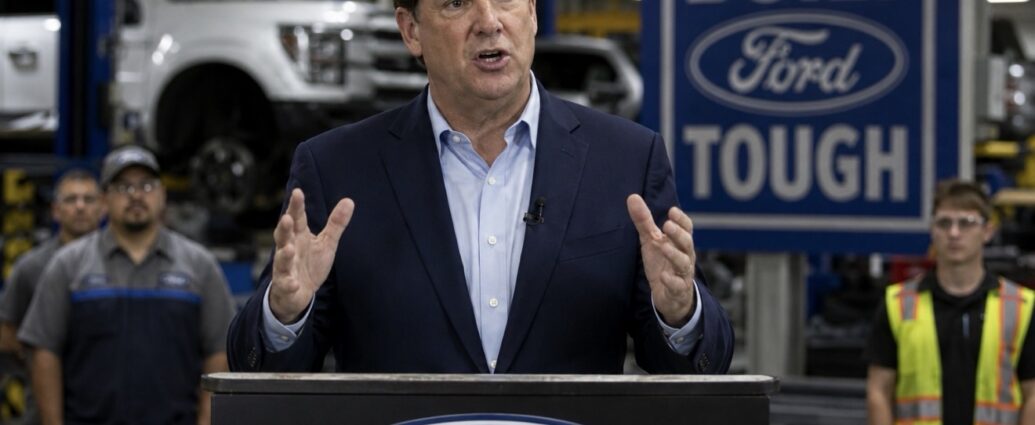
Ford Motor Company Chief Executive Jim Farley said Wednesday that the United States is sliding into what he called a “huge crisis” in the skilled trades, arguing in a CNN interview that the country has neglected the mechanics, electricians and factory workers it depends on while pouring its attention into artificial intelligence.
Farley pointed to his own industry to make the case. He said there are roughly 400,000 open jobs for automotive technicians, positions paying from about $50,000 for entry-level workers to as much as $150,000 for experienced professionals. Those jobs remain difficult to fill even as vehicles become increasingly sophisticated and wages continue to rise.
The shortage extends well beyond automobile repair.
Farley said the nation lacks enough plumbers, electricians and skilled manufacturing workers, with few young people entering trades that traditionally passed from one generation to the next. He has spent the past year describing these occupations as the “essential economy”—the workers who build, maintain and repair the infrastructure Americans rely on every day.
Citing the Aspen Institute, Farley said the essential economy contributes roughly $12 trillion to U.S. gross domestic product. He estimates America is currently short approximately 600,000 manufacturing workers, 500,000 construction workers, in addition to the 400,000 automotive technicians already needed.
What makes the warning particularly striking is its timing.
Farley has become one of corporate America’s most outspoken executives warning that artificial intelligence could eliminate large numbers of white-collar office jobs over the coming decade, particularly entry-level administrative and programming positions that many young workers have historically used to launch their careers.
At the same time, however, the AI revolution is creating an enormous demand for the very skilled trades the country is struggling to supply.
According to Goldman Sachs Research analysts Hongcen Wei, Daan Struyven and Samantha Dart, U.S. data-center electricity demand is expected to climb from 31 gigawatts in 2025 to 41 gigawatts in 2026, before reaching 66 gigawatts in 2027—nearly doubling within two years.
Those same analysts warned that labor shortages and supply-chain constraints remain the biggest obstacles preventing projects from staying on schedule.
After accounting for those risks, Goldman estimates only about 60% of planned data-center capacity scheduled for next year will actually become operational on time, falling to roughly 50% over a two-year period.
The shortage has already been documented across the construction industry.
The Information Technology and Innovation Foundation reported in November 2025 that the United States was short approximately 439,000 construction workers, most in highly skilled positions such as electricians and pipefitters, while more than 400 data centers were simultaneously under development nationwide.
The Bureau of Labor Statistics projects approximately 80,000 electrician job openings annually over the next decade, while roughly 20,000 union electricians retire every year, leaving the workforce unable to replenish itself fast enough.
Electricians sit at the center of the challenge.
The International Brotherhood of Electrical Workers (IBEW) estimates electrical systems account for between 45% and 70% of the total cost of constructing a modern data center. That highly specialized work cannot easily be accelerated or handed to inexperienced workers.
The financial stakes continue to grow.
McKinsey & Company estimates cumulative worldwide investment in data centers could reach $6.7 trillion by 2030, while global AI-related capital expenditures are projected to exceed $750 billion during 2026 alone.
The shortage is already delaying projects.
Oracle, which is building data-center capacity for OpenAI, pushed portions of its construction schedule from 2027 into 2028, with labor shortages cited as one contributing factor, according to Bloomberg. Oracle disputes that characterization and says its projects remain on schedule.
Meanwhile, Google committed $15 million to the Electrical Training Alliance to expand the pipeline of qualified electricians, reflecting how seriously major technology companies now view workforce availability.
Farley also challenged decades of conventional career advice.
He argued that American families have convinced their children that a traditional four-year college degree represents the only path to a successful career, dismissing that assumption as “total bologna.”
Many parents, he said, continue steering children toward software engineering positions paying around $170,000 annually while overlooking skilled HVAC technicians earning roughly $97,000 in careers that are significantly more difficult to automate or outsource.
Ford has invested directly in changing that perception.
The company funds technician scholarship programs through its nationwide dealer network and has established training centers designed to prepare future mechanics and skilled workers. Farley has also pointed to his own family, noting his son spent last summer working as a fabricator in North Carolina instead of taking additional college classes.
For households, the consequences are becoming increasingly visible.
When there are too few skilled tradespeople, vehicle repairs take longer, home repairs become more expensive, construction slows, and housing costs remain elevated because projects cannot be completed quickly enough.
Electricity bills may also feel the impact.
As AI data centers consume a growing share of the nation’s power grid, their contribution to peak summer electricity demand is projected to increase from roughly 4.1% in 2025 to approximately 8.5% by 2027, placing additional upward pressure on electricity prices in many regions.
The picture that emerges is one of the central paradoxes of the AI economy.
While technology companies continue investing hundreds of billions of dollars into artificial intelligence, one of the industry’s greatest constraints is neither capital nor computing power—it is a shortage of skilled human workers.
The jobs exist.
The wages are competitive.
And as the chief executive of one of America’s largest manufacturers continues to warn, the country is running short of the people willing—and trained—to do them.
JBizNews Desk | Dearborn, Michigan
© JBizNews.com All Rights Reserved. Reproduction or distribution without written permission is prohibited.