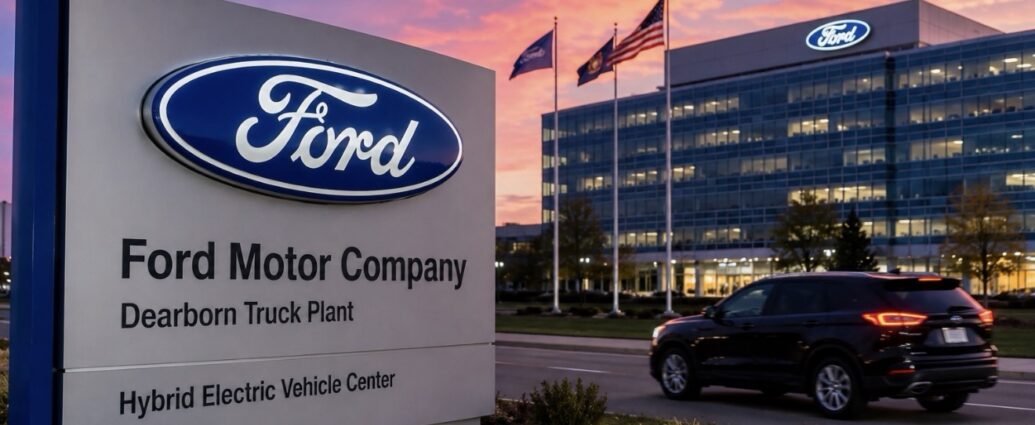
Shares of Ford Motor Company surged 13% Wednesday, marking the automaker’s biggest one-day gain since March 2020, after analysts signaled the company could soon secure major battery-storage agreements tied to the artificial-intelligence data center boom. The rally pushed Ford shares as high as $13.56 intraday and erased much of the skepticism that has surrounded the company’s electric-vehicle strategy since its massive EV writedown last year.
The catalyst came from a research note published late Tuesday by Morgan Stanley analyst Andrew Percoco, who told clients there is a “fairly high likelihood” Ford signs energy-storage system supply agreements with large commercial customers — including hyperscale data center operators — within the next several months. According to Bloomberg, the note immediately triggered a sharp reassessment across Wall Street of Ford’s emerging energy-storage business.
Percoco maintained an Equal-weight rating and a $14 price target but estimated Ford Energy could eventually be worth roughly $10 billion as a standalone operation. He projected the division could generate between $500 million and $600 million in run-rate earnings before interest and taxes once production capacity reaches 20 gigawatt-hours, potentially turning profitable by 2028.
The thesis centers on Ford’s partnership with China’s Contemporary Amperex Technology Co. (CATL), the world’s largest battery manufacturer. Percoco described the relationship as an “underappreciated strategic competitive advantage” because it gives Ford access to CATL’s advanced lithium iron phosphate battery chemistry while manufacturing the batteries domestically in a structure that still qualifies for U.S. tax incentives.
That combination positions Ford as one of the few American manufacturers potentially capable of delivering large-scale, U.S.-compliant battery-storage systems to utilities and hyperscale data center operators at a moment when electricity demand tied to artificial intelligence infrastructure is exploding.
The hyperscaler angle is what transformed the analyst note into a market-moving event. Companies including Microsoft, Amazon Web Services, Alphabet’s Google, Meta Platforms, Oracle, and Apple are collectively expected to spend nearly $700 billion in 2026 building artificial-intelligence infrastructure, according to industry projections. Massive AI training clusters and cloud-computing campuses require not only enormous amounts of power, but increasingly stable and dispatchable backup energy systems — making large-scale battery storage one of the most constrained supply chains in technology infrastructure today.
Demand for grid-scale battery systems has already surged globally as utilities and data center operators race to secure capacity. Analysts say companies capable of supplying compliant domestic battery infrastructure stand to benefit from one of the fastest-growing segments of the AI economy.
Ford’s sudden emergence in that conversation represents a dramatic shift in investor perception. Just months ago, Wall Street viewed the automaker primarily through the lens of slowing EV demand and heavy electric-vehicle losses. The company wrote down roughly $20 billion tied to its Ford Model e EV division late last year, fueling concerns about long-term profitability.
Sentiment began shifting after Ford’s first-quarter 2026 earnings report exceeded expectations across multiple categories. The company reported revenue of $43.3 billion, adjusted earnings per share of $0.66, and net income of $2.55 billion while also raising full-year adjusted EBIT guidance. Management cited stronger cost controls, resilient demand for combustion-engine trucks, and expanding commercial revenue through Ford Pro.
Chief Executive Officer Jim Farley has increasingly framed Ford as a diversified industrial and technology platform rather than simply a traditional automaker. The company currently organizes operations into Ford Blue for gas and hybrid vehicles, Ford Model e for electric vehicles and software, and Ford Pro for commercial operations. The emerging energy-storage business effectively creates a fourth pillar — one tied directly to utilities, AI infrastructure, and commercial power systems rather than consumer vehicle sales.
Farley told investors during Ford’s latest earnings call that the company is entering “one of the most intensive product, software, and physical services rollouts in our history.” Ford’s board also maintained its quarterly dividend at $0.15 per share, payable June 1.
For investors, the strategic significance goes beyond Wednesday’s stock rally. If Ford successfully monetizes battery manufacturing capacity through hyperscaler agreements, it could reduce dependence on consumer EV demand at a time when the broader automotive industry faces rising financing costs, elevated interest rates, and economic uncertainty tied partly to the Iran conflict and higher energy prices.
It also highlights a broader structural shift underway in the American economy: legacy manufacturers are increasingly becoming suppliers to the AI infrastructure buildout itself, not merely users of cloud technology.
Still, analysts cautioned that much of Wednesday’s rally was driven by expectations rather than signed contracts. Percoco’s report referenced a “high probability” of agreements within the next few months but did not identify specific counterparties. Industry speculation has centered on potential deals involving Microsoft, Meta, Oracle, or other major cloud operators.
If Ford secures a high-profile hyperscaler customer, analysts believe the stock could move materially higher. If negotiations drag into 2027 or fail to materialize, Wednesday’s gains could reverse quickly. Morgan Stanley’s $14 target actually sits below Ford’s intraday high Wednesday, suggesting the bank itself sees limited immediate upside absent formal contract announcements.
Competition remains fierce. Tesla continues dominating the U.S. utility-scale battery market through its Megapack business, while General Motors, Fluence, NextEra Energy Resources, Stem, and several Chinese firms are all competing aggressively for large-scale energy-storage contracts tied to AI infrastructure expansion.
But for now, Wall Street appears increasingly willing to believe Ford may have found a credible new growth engine — one tied not to the next generation of cars, but to the enormous power demands of artificial intelligence itself.
JBizNews Desk
© JBizNews.com. All rights reserved. This article is original reporting by JBizNews Desk. Unauthorized reproduction or redistribution is strictly prohibited.