A Skunkworks Unit of 650 Engineers Is Scrapping a Century of Auto Manufacturing Tradition — And Betting the Company’s Electric Future on It
By JBizNews Desk | Dearborn, Mich. — May 5, 2026
Deep inside a nondescript building in Long Beach, California, a team of engineers that Ford Motor Company has kept largely out of public view for the past four years has been quietly dismantling one of the most entrenched assumptions in American manufacturing: that building a car requires a traditional moving assembly line.
The result is now coming into focus. Ford is targeting a 2027 launch for a midsize electric pickup starting at roughly $30,000 — a price point that would bring an American-made EV truck into true mass-market territory and position the company directly against low-cost Chinese competitors reshaping the global auto industry.
Getting there required tearing up the playbook.
At the center of the effort is a skunkworks unit led by Alan Clarke, a former Tesla engineer now serving as Ford’s vice president of Advanced Development. The group — roughly 650 engineers split between Long Beach and Palo Alto — was assembled beginning in 2021 with talent drawn from Tesla, Rivian, and Lucid, and has operated with unusual independence inside the company.
The structure of Ford itself has shifted around them. CEO Jim Farley recently dissolved the broader Model e division, stripping layers of bureaucracy while keeping Clarke’s team intact — a move widely seen inside the company as confirmation that this program is central to Ford’s long-term EV strategy. Farley has called the initiative a “Model T moment,” invoking the company’s original breakthrough in mass production.
The core innovation is not just the vehicle — it’s how the vehicle is built.
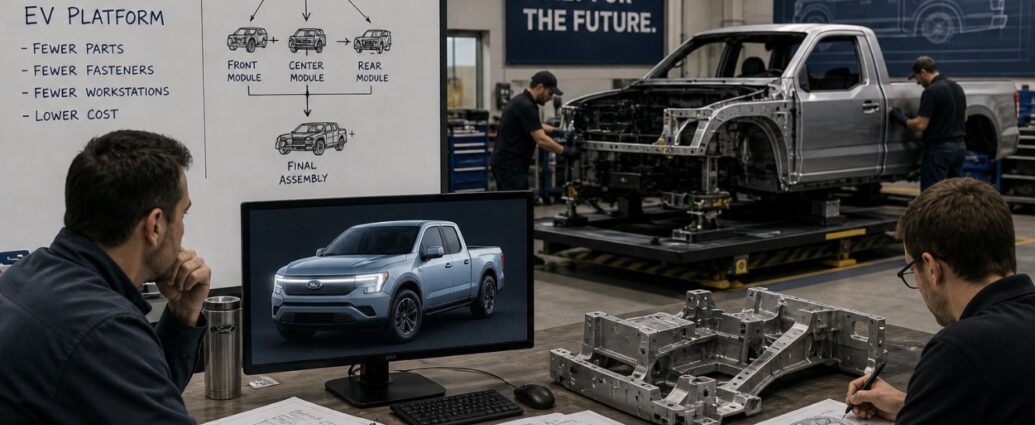
Ford has replaced the traditional linear assembly line with what it calls an “assembly tree,” a branching system where major sections of the vehicle — front, rear, and center — are constructed simultaneously on parallel sub-lines before being merged at final assembly. The approach fundamentally rethinks workflow inside a factory.
The efficiencies are significant. The new platform reduces parts by roughly 20%, cuts fasteners by 25%, and lowers the number of workstations by about 40%. Wiring has been shortened by more than 4,000 feet and reduced in weight by over 20 pounds compared with earlier EV models, directly lowering cost and complexity.
Clarke’s team also introduced an internal “bounty” system, rewarding engineers for identifying incremental improvements — a concept borrowed from Formula 1 racing, where marginal gains compound into meaningful performance advantages.
The production impact could be substantial. Ford expects the new system to enable vehicle assembly up to 40% faster than current processes, with sustained production speeds running about 15% higher once fully operational.
“The goal is to build EVs that are not just compelling, but cost-competitive with gas vehicles,” Alan Clarke has said in internal briefings, framing affordability as the defining challenge of the next phase of electrification.
The first product to emerge from this system will be a midsize pickup roughly the size of a Ford Maverick, but with interior space closer to a Ranger. The vehicle is expected to deliver at least 300 miles of range and a starting price below $30,000.
Performance remains a focus. Jim Farley has described the truck as being “as quick as a Mustang EcoBoost,” suggesting a 0-to-60 time under five seconds, while offering more passenger volume than a Toyota RAV4 along with traditional pickup utility — including a full bed, smart storage features, and a front trunk.
Under the hood, the vehicle will use lithium iron phosphate (LFP) batteries assembled in the United States — a lower-cost chemistry increasingly favored for mass-market EVs. It will also incorporate large aluminum unicastings, a manufacturing technique pioneered by Tesla that replaces dozens of smaller parts with single cast structures, further reducing cost and assembly time. Aerodynamic improvements are expected to deliver roughly 15% greater efficiency than current pickup designs.
To bring the vehicle to market, Ford is investing nearly $2 billion to overhaul its Louisville Assembly Plant in Kentucky. The upgrade includes a 52,000-square-foot expansion, major digital infrastructure improvements, and a reconfiguration of production lines to accommodate the new system.
The project is expected to preserve approximately 2,200 existing jobs while contributing to a broader total of nearly 4,000 jobs tied to the initiative. Rather than layoffs, Ford plans to reassign workers or offer buyouts as it transitions operations.
The stakes are high.
Ford’s EV division has faced mounting pressure, with sales declining in April 2026 and the company rolling out aggressive incentives, including employee pricing and free home chargers, to stimulate demand. At the same time, the company expects to absorb roughly $3 billion in tariffs this year, adding further strain to margins.
Globally, competition is intensifying. Chinese automaker BYD continues to scale sub-$30,000 EVs at speed, Tesla is focused on aggressive cost reduction, and Rivian is preparing its own push into more affordable segments.
Ford’s bet is that manufacturing — not just design or battery chemistry — is the key to closing the gap.
For more than a century, the moving assembly line introduced by Henry Ford in 1913 has defined industrial production. Clarke’s team is arguing that the same system is now a constraint — one that has kept electric vehicles too expensive for mainstream buyers.
If the Long Beach experiment succeeds, it won’t just reshape Ford. It could force a global rethink of how cars are built.
That test begins in 2027, when the first trucks roll off the redesigned Louisville line — and the industry sees whether a century-old model has finally met its replacement.
JBizNews Desk
© JBizNews.com. All rights reserved.