Former attorney-general Avichai Mandelblit testified Sunday that investigators carried out serious actions in the cases against Prime Minister Benjamin Netanyahu without his approval. He said he had wanted the main investigative steps reviewed, but had not expected to approve every police action.
“There were things I did not approve, including serious things,” Mandelblit told the Jerusalem District Court.
Mandelblit, who approved investigations into Netanyahu and later decided to indict him in Cases 1000, 2000 and 4000, was called by the defense. Netanyahu’s lawyers argue investigators exceeded the scope of Mandelblit’s approvals and that some actions began without the consent required by law. The prosecution says he authorized the investigations, including orally, and that the defense is mischaracterizing those approvals.
The testimony is expected to continue Monday. The defense has requested five further days, from October 18 to 22.
The central dispute is what Mandelblit approved and how those decisions were recorded.
Basic Law requires A-G consent for investigation against prime minister
Under Basic Law: The Government, an investigation of a sitting prime minister requires the attorney-general’s consent. The prosecution relies on Justice Ministry meeting records and a memorandum from Mandelblit to show that he approved opening the investigations.
The defense says the records do not establish the required approvals or show that police stayed within their scope. In 2021, the judges rejected a defense request to dismiss the indictment on this ground, but criticized the lack of separate written authorizations.
Mandelblit said he closely supervised the investigations because they involved a sitting prime minister, but was not informed of every police action. He wanted the main steps reviewed because of the case’s sensitivity and the need to balance gathering evidence with protecting the office and dignity of the prime minister. Police, he said, can be “like runaway horses” in pursuing suspicions. But the law did not require him to approve every action, and he said he had not tried to manage the police team.
Defense attorney Amit Hadad cited testimony from former senior investigator Koresh Barnur, who said every action in the case had been approved by the attorney-general. Mandelblit said that was inaccurate and agreed that some actions he had not approved were serious.
One example was a wiretap targeting Natan Eshel, a close Netanyahu associate. Mandelblit said the surveillance should have been brought to him because it was sensitive. When he learned of it, he demanded it stop unless investigators had information connecting Eshel personally to an offense. He said he told investigators to consult him in advance about similar steps.
Mandelblit also addressed a controversial police tactic involving Nir Hefetz, a former Netanyahu aide who became a state witness. Investigators arranged a chance encounter between Hefetz and a woman close to him while he was in custody, intending for him to learn that police knew personal details about him. Mandelblit said he had not known about the tactic beforehand and called it “improper and wrong.”
He said he considered whether to investigate the conduct immediately, but decided against questioning the officers and witnesses while the case was underway, fearing that bringing them together could affect the proceedings. Instead, he told his staff to examine documents related to the incident. He said he did not know that prosecutor Yehudit Tirosh had attended a meeting where the tactic was discussed and would have expected to be told.
Hadad also asked what Mandelblit knew about pressure on state witnesses. Mandelblit said he had not been in the interrogation rooms and did not know what pressure investigators had put on Hefetz. Hadad raised claims that investigators tried to get Or Elovitch, the son of Shaul Elovitch, Netanyahu’s co-defendant in Case 4000, to persuade his father to replace his lawyer. Mandelblit said it was unacceptable for an investigator to tell a suspect to change lawyers.
Mandelblit said investigators had to seek his consent to open an inquiry into a suspicion involving the prime minister, and return to him if a new suspicion emerged. An investigation, he said, had to be based on a specific suspicion, not a personal impression of the prime minister.
On Case 1000, the illegal gifts affair, Mandelblit rejected Hadad’s claim that he had not authorized investigators to look into cigars and champagne. He said he had approved examining whether Netanyahu received benefits from businesspeople, including wealthy figures abroad. Asked about businessman Arnon Milchan, Mandelblit said he did not remember refusing to investigate gifts from him. He said the wording investigators used when cautioning Milchan as a suspect went beyond what he had approved.
Mandelblit denied knowing investigators had acted without his approval
On Case 4000, the Bezeq-Walla case, Mandelblit said he had approved examining whether actions by then-Communications Ministry director-general Shlomo Filber were connected to Netanyahu. He denied knowing that investigators had taken steps in the case without his approval. The defense challenged whether the meeting records supported his account.
Mandelblit also rejected the suggestion that Case 4000 had been essential to his decision to indict Netanyahu. He said each of the three cases independently justified an indictment and that he viewed them as connected in reflecting a pattern of conduct. He acknowledged that he may earlier have hoped the inquiries would not produce evidence warranting charges, but said he had to approve examining a suspicion once it arose.
The trial, which began in May 2020, combines three cases. In Case 1000, prosecutors allege that Netanyahu and his family received gifts from wealthy businessmen. Case 2000 concerns recorded conversations between Netanyahu and Yediot Aharonot publisher Arnon Mozes about a possible exchange of more favorable coverage for Netanyahu for steps to curb rival Israel Hayom.
In Case 4000, prosecutors allege that Netanyahu advanced regulatory measures benefiting Bezeq in exchange for favorable coverage on the Walla news site. Netanyahu denies wrongdoing. He faces charges of fraud and breach of trust in Cases 1000 and 2000, and bribery, fraud and breach of trust in Case 4000.
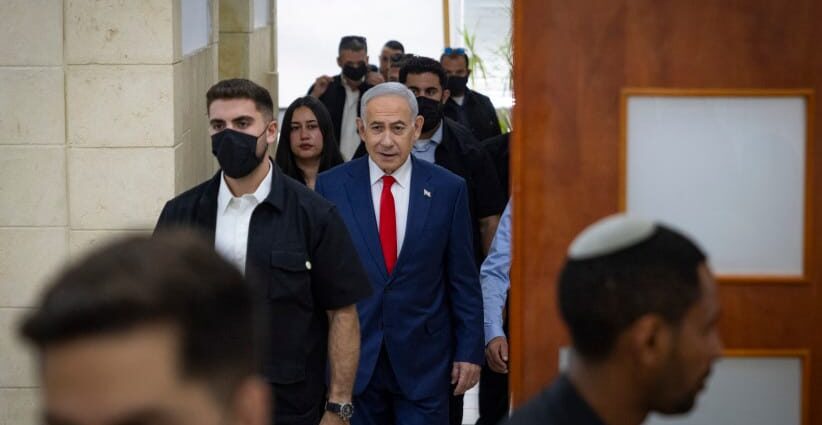
Netanyahu arrived after the testimony began and said, “The truth is coming to light.” He left before the afternoon session resumed, and Mandelblit continued testifying in his absence.
Foreign Minister Gideon Sa’ar, Knesset Speaker Amir Ohana, former Israel Bar Association head Efi Nave and MK Tali Gotliv also attended. Gotliv, who recently moved from Likud to Otzma Yehudit, shouted at Mandelblit as he entered the courtroom.
At the hearing’s opening, Mandelblit complained that a journalist had confronted him outside court and made claims he could not answer. Kan 11 journalist Ayala Hasson denied his account and said she had approached him politely.
Prosecutor Yehonatan Tadmor called testimony by a former attorney-general “exceptional,” warning that questioning a prosecutor could become a means of personal attack or expose internal discussions. The prosecution had not opposed Mandelblit’s testimony because of the unusual circumstances and the dispute over whether he authorized the investigation, Tadmor said.
Justice Minister Yariv Levin called Mandelblit’s appearance “disgraceful” and said it showed that the case against Netanyahu had been fabricated. He called for the trial to be canceled before the election and for a commission of inquiry into law-enforcement officials.
Yonah Jeremy Bob contributed to this report.