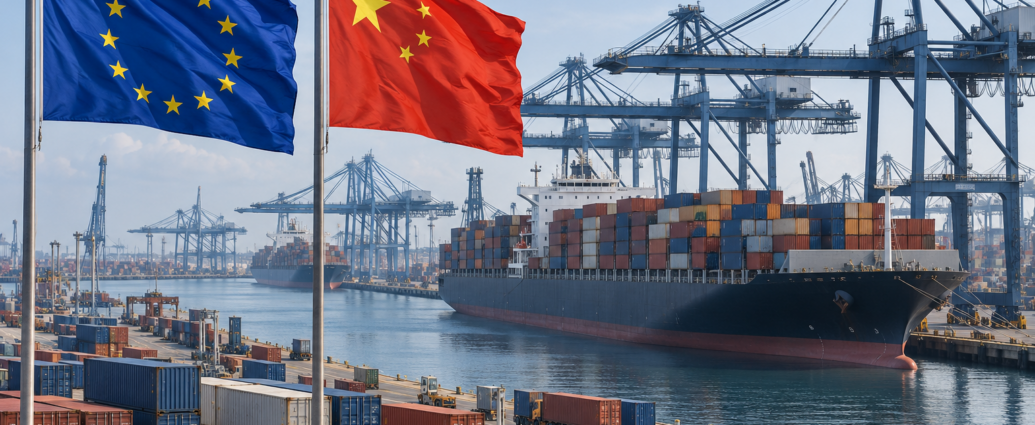
Europe is buying more than $1 billion a day more from China than it sells there, and France and Germany now want the European Union to be ready to use its most powerful trade weapon to fix it. A joint letter from the two countries calls for a sweeping rethink of how the bloc deals with China, including making it easier to use a never-before-tried tool that Europeans call the “trade bazooka.”
The bazooka’s formal name is the Anti-Coercion Instrument. In plain terms, it lets Europe block or restrict trade and investment from a country that is found to be pressuring European governments or companies. It has never been used.
The pressure is building on the same day Europe’s top trade official sits down in Beijing. Maroš Šefčovič, the European Commission’s trade chief, arrives in China on Thursday for two days of talks with Chinese Commerce Minister Wang Wentao. His goal is to shrink Europe’s trade gap with China, which stands at 360 billion euros, or about $410 billion. Earlier this year, Šefčovič gave Beijing until October to show real progress.
The imbalance is growing, not shrinking. Chinese exports to Europe rose 15.3% in the first eight months of this year, according to China’s customs agency, while China’s purchases from Europe rose just 6.2%. That means China’s sales into Europe are growing about two and a half times as fast as Europe’s sales into China.
America is a big part of why this is happening now. After the United States raised tariffs on Chinese goods, China redirected many of its exports to Europe and other markets. Chinese factories that lost American customers went looking for new ones, and Europe’s open market was the biggest target. Meanwhile, trade between Washington and Beijing appears relatively stable following the summit between President Trump and Chinese President Xi Jinping in Washington, which has shifted the spotlight to the fight between China and Europe.
European leaders are describing the problem in American terms. European Commission President Ursula von der Leyen has called it another “China shock,” comparing it to the early 2000s, when a flood of cheap Chinese imports wiped out hundreds of thousands of factory jobs across America’s heartland. A Brussels research group has even urged Europe to create its own trade investigation office modeled on Section 301 of the U.S. Trade Act, the law Washington has used to target unfair foreign trade practices.
The damage in Europe is already visible. China’s heavy government subsidies let its companies undercut European prices on steel, cars, batteries, solar panels, chemicals and machinery. German carmakers are seeing sales collapse inside China while Chinese automakers prepare to grab market share in Europe with cheaper vehicles. Volkswagen has already carried out mass layoffs.
European lawmakers made their mood clear this week. The European Parliament voted 454 to 86, more than 5 to 1, on Wednesday for a resolution demanding fair, two-way trade and a proportionate response if China keeps its own markets closed. Belgian lawmaker Hilde Vautmans, who led the measure, said Europe has economic power and it is time to use it.
Europe has already taken smaller steps, including limits on Chinese steel and on the flood of small e-commerce parcels. A French government planning office went further in February, calling for 30% tariffs on many Chinese goods.
Not everyone in Europe is on board. Spain has taken a softer line toward Beijing, with Prime Minister Pedro Sánchez visiting China four times in three years, which makes a united European crackdown harder to deliver.
China is signaling it will not back down. Its Commerce Ministry warned France and Germany against pushing Europe toward protectionism, saying cutting off supply chains only hurts everyone. Last weekend, just before Šefčovič’s visit, Beijing opened an anti-dumping investigation into a European chemical used in dyes and medicines, following through on an earlier warning that it would retaliate against tougher European trade measures.
For American businesses, the outcome matters in two directions. If Europe slams its doors, Chinese goods blocked from both America and Europe will push harder into other markets where U.S. companies compete. If Europe’s talks succeed, a fairer playing field there could open more room for American exporters selling into the world’s biggest trading relationship with the United States.
JBizNews Desk | Brussels
© JBizNews.com All Rights Reserved. Reproduction or distribution without written permission is prohibited.