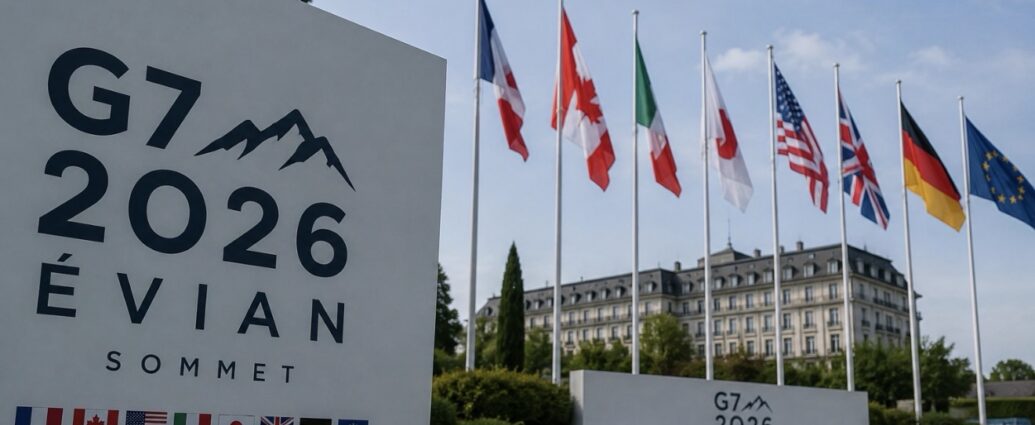
ÉVIAN-LES-BAINS, France — The annual G7 Summit opens Monday in Évian-les-Bains, France, running June 15–17, a day later than the June 14–16 dates originally announced.
French President Emmanuel Macron’s office, which holds the 2026 G7 presidency, said the change followed “consultations with G7 partners.” A senior White House official described it more directly, saying other leaders “kindly shifted dates to accommodate the U.S. President’s schedule.”
That president, Donald Trump, turns 80 years old on Saturday and is spending the day hosting a UFC event at the White House.
France never officially linked the schedule change to the event, and Macron’s office declined to do so. However, officials familiar with the planning said the original summit opening fell on Trump’s birthday, June 14, the same day he had long planned to host the mixed-martial-arts event on the South Lawn. Rather than compete with it, Paris pushed the summit back by one day.
Trump is now expected to depart for France late Sunday following the event and arrive in time for Monday’s opening session.
The scheduling adjustment reflects broader tensions facing the group.
The United States, France, Germany, Italy, Japan, the United Kingdom, Canada, and the European Union are gathering at one of the most challenging moments for the alliance in recent years. Trade disputes, Middle East instability, and growing disagreements over artificial intelligence policy dominate the agenda.
The most immediate concern remains the closure of the Strait of Hormuz.
Following fighting involving the United States, Israel, and Iran earlier this year, Tehran shut the strategic shipping lane through which a significant portion of the world’s oil supply normally passes. The disruption has contributed to higher fuel prices, supply-chain challenges, increased shipping and fertilizer costs, and renewed inflation concerns across global markets.
Several European leaders continue to express frustration over the handling of the conflict and are expected to raise those concerns during summit discussions.
Trade remains another major flashpoint.
Trump has maintained tariffs on a range of European imports, creating friction with key allies. Canadian Prime Minister Mark Carney, who hosted last year’s summit, recently described the current environment as a period of global economic disruption rather than a routine transition, reflecting growing divisions within the group.
Artificial intelligence could produce some of the summit’s most significant debates.
European leaders have pushed for stronger oversight of major AI companies, including scrutiny of their growing energy consumption. The Trump administration has generally favored a lighter regulatory approach.
In a sign of AI’s increasing geopolitical importance, Macron invited OpenAI CEO Sam Altman to participate in portions of the summit. Executives from Anthropic and Google are also expected to attend select discussions.
Several high-profile meetings are planned on the sidelines.
Trump is expected to meet with Ukrainian President Volodymyr Zelensky and continue discussions aimed at securing a broader agreement to end the Iran conflict and restore stability to global energy markets. U.S. officials also indicated that securing reliable supplies of critical minerals used in advanced technology, defense systems, and semiconductor manufacturing remains a top priority.
For Macron, the summit represents a test of whether the G7 can still serve as an effective forum for addressing major global challenges.
The European Union will be represented by European Commission President Ursula von der Leyen and European Council President António Costa, while Japanese Prime Minister Sanae Takaichi will attend her first summit as a national leader. France has also invited several non-member nations, including India and Brazil, to participate in portions of the discussions.
The delayed start may have solved a scheduling conflict, but it does not resolve the deeper divisions facing the group.
Trump has previously left G7 gatherings early, and whether leaders can reach meaningful agreements on energy, trade, and artificial intelligence before the summit concludes may help determine the direction of the global economy through the remainder of the summer.
Washington — JBizNews Desk
© JBizNews.com. All Rights Reserved. Reproduction or distribution without written permission is prohibited.