JBizNews Desk| Sunday, May 10, 2026 | 11:42 AM ET
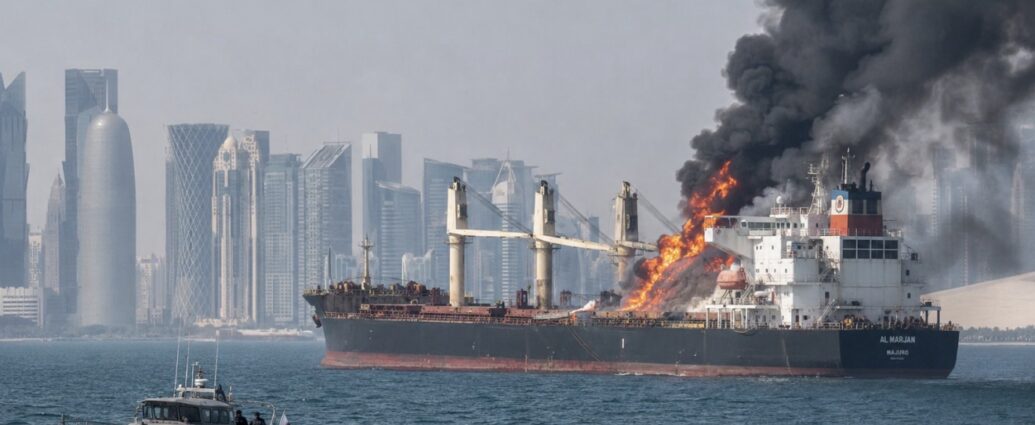
Early Sunday morning, Qatar’s Defense Ministry confirmed that a drone struck a commercial cargo vessel in Qatari territorial waters, setting off a fire that was later extinguished without casualties. The ship, traveling from Abu Dhabi to Mesaieed Port, continued its route after the incident. The United Kingdom Maritime Trade Operations Centre said the strike occurred roughly 23 nautical miles northeast of Doha. No group immediately claimed responsibility, but the attack marked the latest escalation threatening the fragile ceasefire that has rattled global energy markets for more than a month, pushing Brent crude near $101 a barrel, lifting U.S. gasoline prices sharply higher, and driving consumer confidence to fresh lows.
The strike unfolded alongside a broader wave of regional security incidents. Kuwait’s Defense Ministry, through spokesman Brig. Gen. Saud Abdulaziz Al Otaibi, said hostile drones entered Kuwaiti airspace early Sunday and that military forces responded under established defense procedures, though officials stopped short of identifying the drones’ origin. The UAE’s Defense Ministry separately announced that Emirati forces intercepted and destroyed two drones it directly attributed to Iran. The near-simultaneous alerts across Qatar, Kuwait, and the United Arab Emirates underscored how exposed Gulf commercial infrastructure remains despite the ceasefire formally brokered on April 8.
Even as military tensions intensified, diplomatic negotiations appeared to move forward. Iran’s state-run news agency IRNA reported Sunday that Tehran had delivered its formal response to a U.S. peace proposal through mediator Pakistan. A Pakistani diplomatic source later confirmed to Al Jazeera Arabic that the response had been transmitted to Washington. According to Reuters, Iran’s message focused primarily on ending hostilities and stabilizing maritime security in the Persian Gulf and the Strait of Hormuz. Iran’s semi-official ISNA news agency reported that restoring freedom of navigation in the region had become a central element of Tehran’s negotiating position.
The U.S. framework under discussion — a 14-point proposal delivered earlier this week through Pakistani intermediaries — would reopen the Strait of Hormuz and formally end the conflict before addressing more politically sensitive disputes surrounding Iran’s nuclear program. Under the proposed terms, Iran would suspend uranium enrichment for at least 12 years and surrender approximately 970 pounds of uranium enriched to 60% purity, material considered only a short technical step from weapons-grade levels. In exchange, the United States would gradually ease sanctions and release billions of dollars in frozen Iranian assets.
Despite the Iranian reports, U.S. Ambassador to the United Nations Michael Waltz said Sunday that Washington had not yet formally received Tehran’s response, adding that negotiations remain complicated by internal divisions inside Iran’s leadership structure.
Separately, the naval branch of Iran’s Revolutionary Guard Corps warned that any additional attacks on Iranian oil tankers or commercial vessels would trigger direct retaliation against U.S. military bases and allied ships operating in the region. The warning followed U.S. strikes earlier this week on two Iranian tankers — M/T Sea Star III and M/T Sevda — which American officials said attempted to breach the naval blockade surrounding Iranian ports.
For global energy markets, the implications remain enormous. The International Energy Agency warned the conflict is removing roughly 14 million barrels per day from global oil supply, potentially representing the largest disruption in modern energy market history. Although Brent crude settled Friday at $101.29 per barrel, down more than 6% on the week as traders priced in ceasefire optimism, several analysts cautioned that the decline may underestimate the longer-term supply risks.
Analysts at ANZ Research said in a note Sunday that oil volatility is likely to persist as long as uncertainty surrounding the proposed peace agreement remains unresolved. Matt Smith, lead oil analyst at Kpler, said traders remain surprised that oil prices have not climbed substantially higher given the scale of shipping disruptions and lost exports.
That uncertainty was reinforced by comments from Saudi Aramco CEO Amin Nasser, who said Sunday that even if shipping traffic resumes immediately through the Strait of Hormuz, global oil markets would still require several months to rebalance. If disruptions continue beyond the next few weeks, he warned, normalization may not occur until 2027. Saudi Aramco also reported a 26% jump in first-quarter profit, driven largely by war-related fuel price increases and rerouted exports through alternative Red Sea infrastructure.
Meanwhile, Goldman Sachs warned that inventories of refined products — including jet fuel, naphtha, and liquefied petroleum gas — are being depleted at an accelerating pace, increasing the risk of shortages in countries including India, Thailand, Taiwan, and South Africa.
June Goh, senior oil market analyst at Sparta Commodities, said traders are increasingly pricing in the possibility of additional damage to Gulf energy infrastructure and a prolonged closure of the Strait of Hormuz beyond the timeline outlined publicly by the Trump administration. She added that rapidly declining OECD inventory levels could eventually trigger a much sharper upward move in oil prices.
Diplomatic pressure intensified simultaneously. Qatari Prime Minister Sheikh Mohammed bin Abdulrahman Al Thani warned Iranian Foreign Minister Abbas Araqchi that using the Strait of Hormuz as geopolitical leverage would only deepen the crisis and further destabilize global markets, according to Qatar’s foreign ministry. On Saturday, U.S. Secretary of State Marco Rubio and special envoy Steve Witkoff met with the Qatari leader in Miami to coordinate diplomatic efforts surrounding the negotiations.
At the same time, Pakistani Prime Minister Shehbaz Sharif spoke Sunday with his Qatari counterpart to review the mediation process, describing the relationship between the two nations as rooted in “brotherly bonds” while reaffirming Pakistan’s role in advancing ceasefire negotiations.
Despite the diplomatic momentum, commercial traffic through the Strait of Hormuz remains severely disrupted. According to shipping data from Kpler, only a limited number of vessels crossed the waterway in recent days. The International Energy Agency estimates as many as 20,000 seafarers remain stranded aboard vessels inside or near the strait — a situation the International Maritime Organization described as unprecedented in the modern shipping era.
President Donald Trump has continued warning that the United States could resume full-scale military strikes if Iran refuses to reopen the waterway and scale back its nuclear activities. At the same time, Iran’s parliament is drafting legislation that would formalize Tehran’s control measures over the strait, including restrictions targeting vessels linked to hostile nations.
With President Trump expected to travel to China later this week — and Beijing pushing urgently for an end to a conflict that has fueled a global energy crisis — the diplomatic response now moving through Islamabad carries consequences far beyond the Gulf. Whether Sunday’s drone activity hardens negotiating positions or accelerates pressure for a broader settlement is now the central question confronting governments, traders, and consumers worldwide.
JBizNews Desk
© JBizNews.com. All rights reserved.