By JBizNews Desk
May 10, 2026
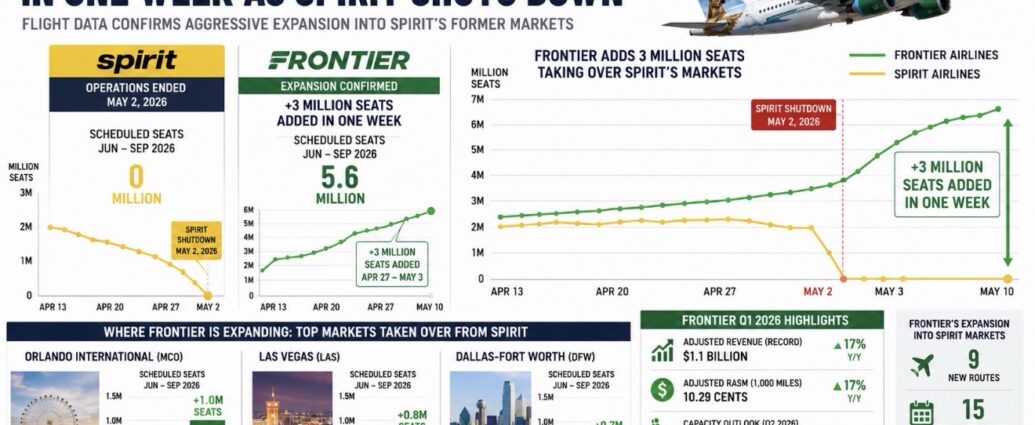
Frontier Group Holdings told investors in its official first-quarter 2026 earnings report filed May 5 that the collapse of Spirit Airlines had “meaningfully” altered the competitive landscape for ultra-low-cost carriers, as the company rapidly expanded capacity across former Spirit strongholds including Orlando, Las Vegas, Dallas-Fort Worth, Fort Lauderdale, and Detroit. Days later, newly published Cirium flight-tracking data confirmed the scale of that expansion, showing Frontier Airlines added approximately 3 million seats in a single week to scheduled flying between June and September — one of the fastest domestic capacity redeployments seen in the U.S. airline industry since the pandemic recovery period.
The move follows the shutdown of Spirit Airlines on May 2 after the carrier failed to secure emergency financing, abruptly leaving major gaps across some of America’s busiest leisure and budget-travel corridors. The collapse immediately triggered a scramble among airlines to capture displaced passengers, airport slots, and route opportunities previously dominated by Spirit’s ultra-low-cost network.
According to the Cirium data analyzed Sunday, Frontier moved fastest.
Jimmy Dempsey, President and Chief Executive Officer of Frontier Group Holdings, signaled the strategy directly during the company’s May 5 earnings call with analysts and investors.
“Spirit’s exit meaningfully alters the supply landscape,” Dempsey said. “We positioned ourselves over the last six to nine months on launching routes that we thought would be opportunities that come as they reduce their capacity and with the possibility that they would cease operations.”
Dempsey added that Frontier overlaps with Spirit on more than 100 routes, more than any other U.S. carrier, giving the airline a uniquely positioned opportunity to absorb displaced traffic at scale.
The company confirmed it is launching 9 new routes and adding 15 daily departures across 18 former Spirit markets, focusing heavily on airports where Spirit previously maintained some of its largest operational footprints, including Orlando International Airport, Harry Reid International Airport in Las Vegas, and Dallas-Fort Worth International Airport.
The expansion is already feeding directly into revenue expectations.
Robert Schroeter, Chief Commercial Officer of Frontier Airlines, told investors that Spirit’s collapse is expected to lift revenue per available seat mile, or RASM, by approximately 3% to 5%, with roughly two percentage points already embedded into second-quarter guidance because a large portion of bookings are already secured.
Dempsey suggested the eventual benefit could exceed even that range if pricing stabilizes and customer retention remains strong.
The company’s first-quarter earnings report reflected a business already showing stronger unit revenue trends even before the full impact of Spirit’s shutdown is realized.
According to the filing, Frontier Group Holdings generated adjusted quarterly revenue of nearly $1.1 billion, an all-time company record, despite operating approximately 1% lower capacity than a year earlier. Adjusted RASM, normalized for stage length, rose 17% year over year to 10.29 cents, landing at the high end of company guidance.
The airline reported a net loss of $272 million, or $1.18 per share, though the results were heavily impacted by several major non-recurring charges, including a $139 million expense tied to the early termination of leases on 24 Airbus A320neo aircraft and a separate $73 million charge related to a court ruling involving Transportation Security Administration fee remittances.
Excluding those items, adjusted net loss narrowed to $68 million, or $0.30 per share, outperforming company expectations.
Mark Mitchell, Chief Financial Officer of Frontier Group Holdings, said the airline ended the quarter with approximately $974 million in liquidity and reduced full-year 2026 capital expenditure guidance by $30 million. The company also reaffirmed plans to defer deliveries of 69 Airbus aircraft, helping reduce future pre-delivery deposit obligations by an estimated $170 million to $210 million.
Fuel costs, however, remain one of the airline’s largest pressures.
Frontier disclosed that average fuel prices climbed to $2.88 per gallon during the quarter, up from $2.55 a year earlier, pushing total fuel expense to approximately $268 million.
Even so, the airline continues to emphasize its fuel-efficiency advantage as a core competitive differentiator.
Frontier operates a fleet of 183 Airbus single-aisle aircraft, all financed through operating leases, and says it generates approximately 106 available seat miles per gallon, which the company claims is more than 40% better fuel efficiency than other major U.S. carriers.
The airline now projects second-quarter capacity growth of 6% to 8% year over year, reflecting both organic expansion and the rapid absorption of former Spirit demand.
For the broader airline industry, the speed of Frontier’s move highlights the highly opportunistic nature of the ultra-low-cost business model. When financially weaker carriers retreat or collapse, competitors with overlapping route structures and lower operating costs often move immediately to capture airport access, aircraft utilization, and price-sensitive travelers before larger network airlines respond.
Legacy carriers including American Airlines, Delta Air Lines, and United Airlines have historically expanded more cautiously in these situations, prioritizing pricing discipline, loyalty-program economics, and premium cabin profitability over rapid low-fare growth.
The larger question for investors now is whether Frontier can convert Spirit’s collapse into durable long-term market share gains rather than a temporary influx of bargain-hunting travelers.
Much will depend on load factors, ancillary revenue performance, competitive pricing responses, and whether rival carriers eventually move aggressively into the same markets once fares begin stabilizing.
For now, the latest Cirium data suggests Frontier Airlines has no intention of waiting for competitors to react.
JBizNews Desk