By JBizNews Desk | May 10, 2026
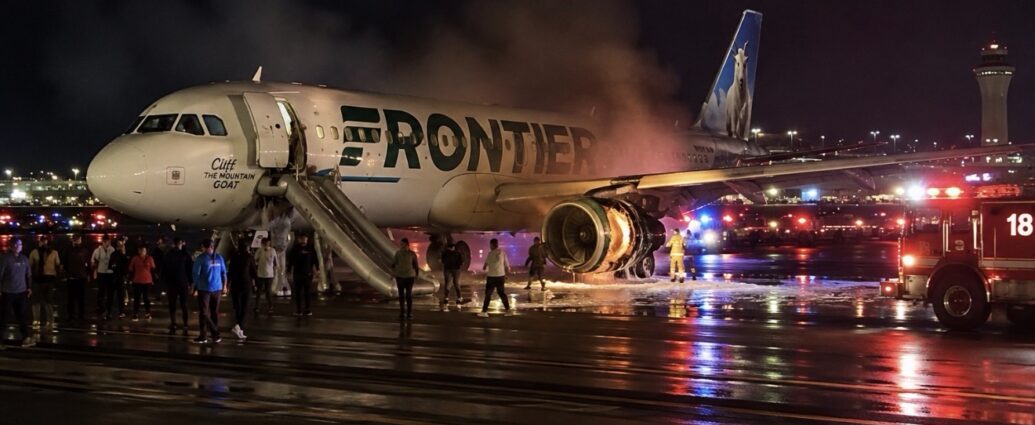
Frontier Airlines confirmed Saturday that Flight 4345, an Airbus A321 departing Denver International Airport for Los Angeles, struck and killed a pedestrian during takeoff late Friday night, triggering an engine fire, a smoke-filled cabin and an emergency evacuation that has now become the focus of a widening federal investigation into airport perimeter security and aviation safety preparedness.
According to a statement from Denver International Airport, the incident occurred at approximately 11:19 p.m. local time on Runway 17L after an individual who was not believed to be an airport employee deliberately breached the airport’s perimeter fence and entered the active runway environment.
The individual was struck by the aircraft during takeoff and was at least partially consumed by one of the engines, according to an official familiar with the incident, sparking a brief engine fire that firefighters later extinguished.
Transportation Secretary Sean Duffy said Saturday that the individual had “deliberately” scaled the perimeter fence before entering the runway area.
“No one should EVER trespass on an airport,” Duffy said.
The National Transportation Safety Board has been notified, while the investigation is being led by local law enforcement with support from the Federal Aviation Administration and the Transportation Security Administration.
Runway 17L remained closed Saturday as investigators examined the scene.
Inside the aircraft, passengers described scenes of immediate panic as smoke rapidly filled portions of the cabin following the engine fire.
Frontier said all 224 passengers and 7 crew members were safely evacuated after flight attendants initiated an emergency evacuation onto the tarmac using inflatable slides. Twelve passengers reported minor injuries and five passengers were transported to local hospitals for evaluation.
“As we were lifting off the engine exploded. There was so much smoke we couldn’t even see one foot in front of us,” passenger Jacob Athens told reporters.
Another passenger, Brandon Dee, described passengers struggling to breathe as panic spread through the aircraft cabin.
“Everyone’s having struggle — we’re struggling breathing. We are like panicking,” Dee said.
Passengers were later bused back to the terminal, while Frontier offered replacement flights and refunds.
While the immediate focus remains on the fatality and emergency response, the incident is rapidly evolving into a broader aviation-security and business story with implications extending far beyond Denver.
For Frontier Airlines, the event arrives during one of the most financially difficult operating environments low-cost carriers have faced in years.
According to Department of Transportation data, airline fuel costs have surged approximately 56% since the escalation of the Iran conflict disrupted global energy markets earlier this year, pressuring airlines already operating under thin margins and rising labor costs.
Budget carriers like Frontier remain particularly vulnerable because their business models rely heavily on maintaining high aircraft utilization rates, aggressive scheduling efficiency and lower operating cushions than larger legacy airlines.
The grounding of an Airbus A321 — one of the core workhorses of Frontier’s fleet — alongside the temporary closure of a major runway at one of America’s busiest airports introduces both operational disruption and reputational risk at a sensitive time for the airline industry.
Airline analysts note that even isolated incidents involving emergency evacuations, federal investigations and aircraft damage can trigger cascading scheduling delays, maintenance reviews, insurance complications and increased regulatory scrutiny.
The broader policy question emerging from the incident centers on airport perimeter security — an area aviation experts have warned for years remains underfunded relative to passenger-screening systems implemented after September 11.
Denver International Airport is among the busiest airports in the United States by passenger traffic, handling tens of millions of travelers annually across a massive physical footprint that includes miles of fencing, restricted-access roads and open tarmac.
Airport officials said Saturday morning that security personnel were inspecting the eastern perimeter fence for vulnerabilities. Denver Airport later stated the fence itself appeared intact, suggesting the individual climbed over rather than breached through it.
But investigators are now examining the roughly two-minute window between the perimeter breach and the collision with the aircraft — a response gap likely to become central to both the federal investigation and broader industry discussions about airport security modernization.
Aviation-security specialists have long argued that perimeter defense systems at many U.S. airports have lagged behind checkpoint screening investments because post-September 11 security spending focused overwhelmingly on passenger and baggage inspection rather than airfield intrusion detection.
That imbalance may now face renewed scrutiny.
Industry analysts say a fatal perimeter breach at a major international airport resulting in an engine fire and emergency evacuation is precisely the type of incident that can trigger congressional hearings, FAA reviews and potentially expensive new security mandates.
Potential upgrades could include expanded thermal imaging systems, AI-powered perimeter monitoring, enhanced motion-detection technology, drone surveillance systems and increased airport-security staffing — measures likely carrying significant financial implications for airports already managing rising infrastructure and operational costs.
Airport consultants and infrastructure analysts estimate a nationwide perimeter-security modernization effort across major U.S. airports could ultimately cost between $8 billion and $20 billion or more over several years, depending on how aggressively regulators move after the investigation.
Large aviation hubs including Denver, JFK, Atlanta, LAX, Chicago O’Hare and Dallas-Fort Worth could individually face upgrade costs ranging from roughly $150 million to more than $500 million per airport if federal regulators mandate comprehensive airfield intrusion-detection systems.
For travelers, those costs would likely filter gradually into higher airline operating fees, airport surcharges and ultimately ticket prices.
Airports typically pass major infrastructure expenses through to airlines via landing fees, gate costs and operational assessments — expenses carriers frequently offset through higher fares or reduced service on marginal routes.
Analysts say low-cost carriers like Frontier could face disproportionate pressure because their pricing models leave less room to absorb additional operating costs compared with larger legacy competitors.
At the same time, Wall Street analysts note that a large-scale airport-security modernization cycle could create a major infrastructure and technology spending boom across the aviation sector.
Companies tied to AI surveillance, thermal imaging, airport infrastructure, security technology, telecommunications systems and defense contracting could emerge among the largest beneficiaries if Washington moves toward a federally backed security-upgrade initiative.
Industry economists estimate a nationwide airport-security overhaul could support between 40,000 and 100,000 jobs across construction, engineering, software development, systems integration, airport operations and security staffing over the coming years.
For investors and airline operators, the incident also underscores how aviation risks increasingly extend beyond traditional mechanical failures or weather disruptions.
The post-pandemic recovery brought surging passenger volumes, tighter scheduling and heavier pressure on airport infrastructure at the same time geopolitical instability, staffing shortages and rising operating costs strained the broader aviation system.
Frontier said Saturday it was “deeply saddened” by the incident and is cooperating fully with investigators.
The NTSB investigation is expected to examine not only the sequence of physical events leading to the collision, but also the adequacy of perimeter-security protocols, surveillance systems and emergency response procedures.
If investigators conclude broader systemic vulnerabilities exist, the consequences could extend well beyond Denver.
For the 231 people aboard Flight 4345 Friday night, the story remains one of survival — and of pilots and cabin crew who acted quickly enough to prevent a far larger catastrophe.
For the aviation industry and the regulators overseeing it, the harder questions are only beginning.
JBizNews Desk