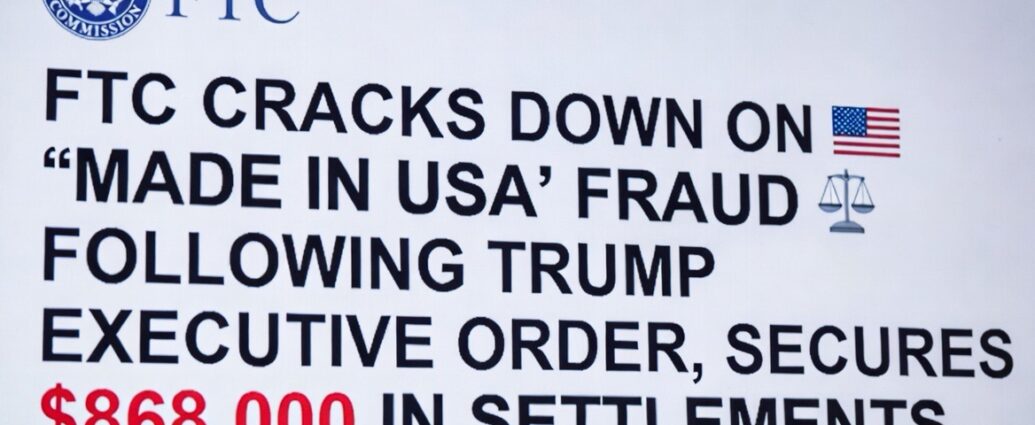
Washington, D.C. — The Federal Trade Commission has intensified enforcement against deceptive “Made in USA” claims, announcing a series of actions totaling $868,000 in settlements across multiple industries, as regulators move swiftly following a new executive directive from President Donald Trump prioritizing truth in domestic manufacturing claims.
The enforcement actions, unveiled April 14, come just weeks after President Donald Trump signed Executive Order 14392, titled “Ensuring Truthful Advertising of Products Claiming to be Made in America,” directing federal agencies to elevate scrutiny of companies marketing goods as American-made without meeting legal standards. “Consumers deserve to know when they are buying products truly made in the United States,” the order states, framing the initiative as both a consumer protection and economic policy priority.
The FTC’s sweep targeted three companies spanning consumer goods categories—from patriotic merchandise to electronics and footwear—underscoring what regulators described as a widespread pattern of misleading origin claims. “Marketers who falsely claim their products are ‘Made in the USA’ can expect enforcement action,” the Federal Trade Commission said in its announcement, signaling a more aggressive posture across the marketplace.
In one case, Americana Liberty LLC and Three Nations LLC, along with their principals, were accused of falsely advertising American and military-themed flags using slogans such as “Made in the USA” and “100% American Made,” despite products being imported fully or in part from China. The FTC also cited violations of the Textile Fiber Products Identification Act for failing to properly disclose country-of-origin labeling. The companies agreed to pay $167,743 in consumer redress and are now barred from making deceptive origin claims moving forward.
The agency noted that these companies had previously received warning letters in July 2025, placing them on notice before enforcement escalated. “When companies ignore warnings and continue misleading consumers, we will act,” FTC officials indicated, reinforcing a stepped-up compliance expectation under the new policy environment.
In a second case, TouchTunes Music Company agreed to pay $625,000—the largest settlement ever under the FTC’s Made in USA Labeling Rule—over claims tied to its Arachnid 360 electronic dartboards. While final assembly occurred in the United States, the FTC found that critical components, including computer chips, cameras, and display systems, were sourced from overseas. The agency emphasized that such reliance on foreign inputs fails to meet the “all or virtually all” threshold required for unqualified domestic origin claims.
“Assembling a product in the United States does not make it ‘Made in USA’ if key components are imported,” the Federal Trade Commission stated, reiterating its longstanding interpretation of the rule.
The third enforcement action involved Oak Street Manufacturing Company, operating as Oak Street Bootmakers, which the FTC alleged falsely marketed its footwear as entirely U.S.-made. According to the complaint, the company sourced materials from the Dominican Republic and Brazil and, in some cases, completed assembly abroad. The company agreed to pay $75,000 in consumer redress and is similarly restricted from making future misleading claims.
The regulatory backdrop for these actions has been tightening. The FTC’s Made in USA Labeling Rule, adopted in 2021, codified the “all or virtually all” standard and enabled the agency to pursue civil penalties for violations. Enforcement has accelerated in recent years, including a more than $3 million resolution with Williams-Sonoma, Inc. in 2024 over prior violations.
President Donald Trump’s executive order adds another layer of enforcement pressure by directing agencies overseeing federal procurement to refer contractors making false origin claims to the Department of Justice, potentially exposing them to liability under the False Claims Act. The move expands the consequences beyond consumer protection into federal contracting risk.
For manufacturers that genuinely produce goods domestically, the crackdown is seen as a leveling mechanism. Philip K. Bell, President and CEO of the Steel Manufacturers Association, has previously emphasized in similar policy discussions that “accurate labeling is critical to ensuring fair competition for companies investing in American production.”
The broader implication for corporate America is clear: origin claims are no longer a gray area. Companies must ensure that marketing language aligns precisely with supply chain realities—or face escalating financial and legal consequences.
As enforcement intensifies, regulators are signaling that “Made in USA” is not just a branding tool, but a legally defined claim with strict standards. With the backing of a presidential directive and increasing monetary penalties, the FTC’s latest actions mark a decisive shift toward stricter accountability in how companies represent the origin of their products in the U.S. marketplace.
JBizNews Desk