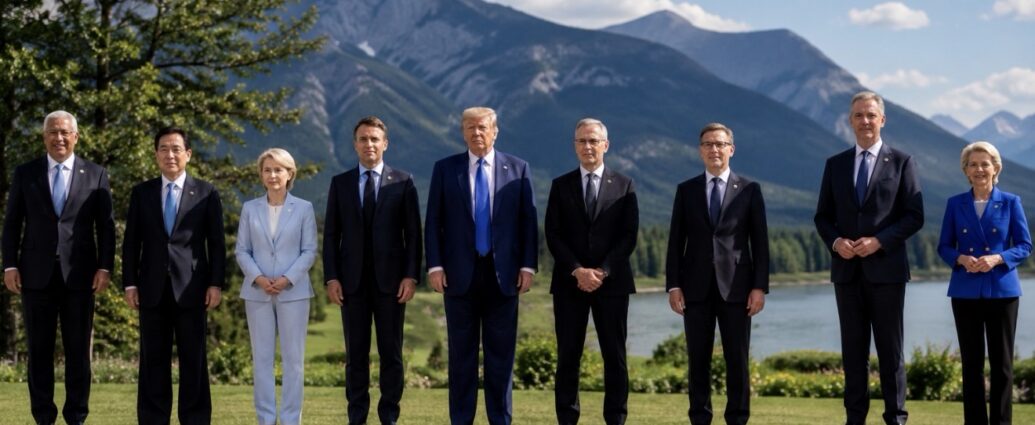
The leaders of the Group of Seven gathered in Évian, France, this week wanting to show the world a united front on artificial intelligence. Instead, their push is running into two hard walls: the United States’ insistence on protecting its own technology lead, and China’s tight grip on the raw materials that AI depends on.
The summit, hosted by French President Emmanuel Macron and running through Wednesday, has put AI near the top of the agenda alongside the wars in Ukraine and the Middle East. Macron has courted the technology world to make his case, even inviting OpenAI chief executive Sam Altman to attend. But the deeper the leaders dig, the clearer it becomes that “G7 cooperation” on AI is complicated by how lopsided the field really is.
Consider the numbers. In 2025, roughly 79% of newly funded AI companies across the G7 were based in the United States, according to the Atlantic Council. France, the host, accounted for about 3.4%. When one member so thoroughly dominates an industry, agreeing on shared rules becomes a negotiation over advantage, not just principle.
That is the first wall. Washington has made clear it opposes binding multilateral agreements on AI that could dull its edge. Instead of signing onto shared governance, the United States is promoting what officials call the “American AI technology stack” — a push to export U.S. hardware and software, often backed by financing from the Commerce Department, so other countries build on American systems rather than Chinese ones. Add in U.S. export controls that restrict the sale of the most advanced AI chips abroad, and the message to allies is less “let’s write rules together” and more “build on our platform.” References to AI governance in this year’s summit language are expected to be watered down as a result.
The second wall is China, and it may be harder to climb. Artificial intelligence is not just software. It runs on physical hardware — chips, servers, data centers — and that hardware depends on rare earth elements and other critical minerals. China controls an estimated 80% to 90% of the global supply of those materials, and it has spent the past year tightening export controls on them. A suspension of some of the toughest restrictions is set to expire on November 10, less than five months away, and if it lapses, a wide swath of the world’s electronics supply chain would again need Chinese approval to operate.
The stakes are enormous. The International Energy Agency, in a report prepared for France’s G7 presidency, estimated that full enforcement of China’s controls could put $6.5 trillion a year in economic output at risk for countries outside China, with losses in the auto industry alone topping $3 trillion. The G7 has responded with a Critical Minerals Action Plan and more than $6.4 billion in new mining and processing projects, but the work is slow, and members remain divided over how confrontational to be with Beijing.
Here is why this matters beyond the summit photographs. The AI economy everyone is racing to build rests on three things: the software, where American firms dominate; the chips and the minerals inside them, where China holds the leverage; and the energy to run it all. The G7 can talk about leading together, but the United States holds most of the software and China holds most of the materials, leaving the rest of the bloc squeezed in the middle. For businesses, that shapes where the next factories and data centers get built. For ordinary people, the same mineral controls touch the price and availability of cars, phones and home electronics.
Leaders are expected to issue several statements before the summit closes on Wednesday, and French officials have promised “very concrete” progress on securing supply chains. Whether that means real action or more careful language is the open question. The pressure will not ease soon: China’s control suspension expires in November, and the United States takes over the G7 presidency next year, putting Washington and its go-it-alone instincts on AI in the host’s chair.
For now, the G7’s ambition to shape the future of artificial intelligence is bumping up against a simple reality. The technology may be global, but the power over it is not evenly shared.
JBizNews Desk
JBizNews Desk / © JBizNews.com All Rights Reserved. Reproduction or distribution without written permission is prohibited.