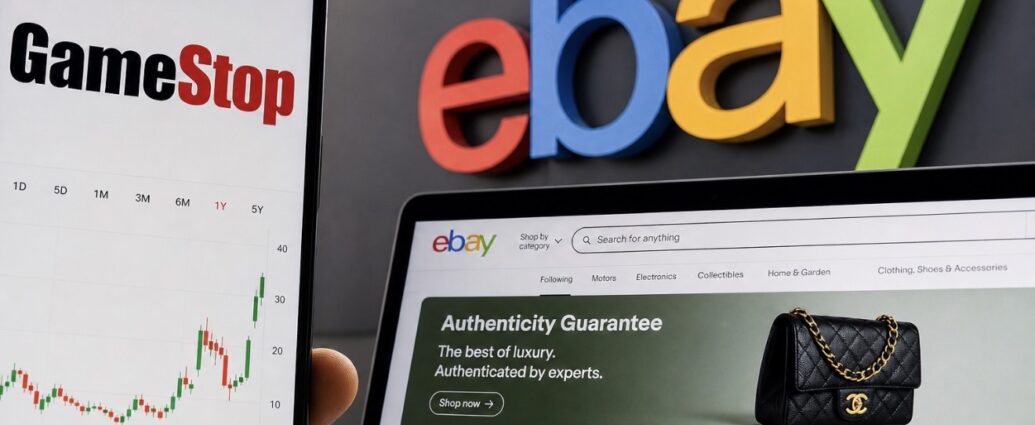
Ryan Cohen’s Unsolicited Offer Highlights eBay’s Transformation Into a Profitable, Luxury-Focused Recommerce Platform Positioned to Challenge Amazon
GameStop Launches $56 Billion Bid for eBay, Sees Platform as Future Rival to Amazon
Ryan Cohen’s Unsolicited Offer Highlights eBay’s Transformation Into a Profitable, Luxury-Focused Recommerce Platform Positioned to Challenge Amazon
By JBizNews Desk | New York — May 4, 2026
GameStop is preparing a takeover offer for the online marketplace eBay, the Wall Street Journal reported — and if the videogame retailer succeeds, it won’t be buying the eBay most Americans think they know.
To understand why Ryan Cohen just put forward a $56 billion bid, you first have to understand what eBay has quietly become.
The platform once defined by garage-sale listings and low-trust auctions has spent the past several years rebuilding itself into a far more disciplined and profitable business — centered on authenticated luxury goods, collectibles, auto parts, and the fast-growing recommerce economy. That transformation has reshaped eBay into a focused, cash-generating marketplace with defensible niches — and one Cohen believes can evolve into a serious competitor to Amazon.
GameStop’s offer, made Sunday, values eBay at $125 per share in a 50-50 cash-and-stock deal — a 20% premium to its most recent close and a roughly 46% premium to where shares traded before GameStop began building its stake earlier this year. The proposal is nonbinding, meaning negotiations may not lead to a final deal.
Cohen told the Wall Street Journal he sees eBay as a credible long-term challenger to Amazon, saying the platform “could be a legit competitor.” He also pledged to deliver $2 billion in annual cost savings within 12 months of closing and signaled he would take the bid directly to shareholders in a proxy fight if the board resists. If successful, Cohen is expected to lead the combined company as CEO.
The bid is as much a statement about eBay’s evolution as it is about GameStop’s ambition.
Under CEO Jamie Iannone, eBay has spent the past three years narrowing its focus — moving away from being a general marketplace and doubling down on high-value categories where trust, authentication, and enthusiast demand matter most. Those “focus categories” now include luxury goods, sneakers, trading cards, auto parts, and premium electronics.
The company’s Authenticity Guarantee program — a cornerstone of that strategy — surpassed one million items inspected in a single quarter for the first time, driven by expansion into luxury apparel across major global brands. In markets like the United Kingdom, eBay now offers what it calls full “head-to-toe” authentication across dozens of premium labels.
The financial results reflect that shift. In a recent quarter, eBay reported $2.8 billion in revenue, up 9% year over year, alongside $20.1 billion in gross merchandise volume. The company generated $934 million in operating cash flow and returned $757 million to shareholders through buybacks and dividends.
Another underappreciated engine is advertising. eBay generated $482 million in ad revenue in a single quarter, with its first-party ad products growing 19% year over year — a high-margin business layered on top of its marketplace.
In short, eBay today is profitable, cash-rich, and increasingly specialized — a combination that makes it an attractive acquisition target for a buyer looking to unlock additional value.
Cohen’s strategy rests on three core ideas.
First, eBay already has global scale — with logistics infrastructure, seller relationships, and integrated shipping systems that would take years to replicate. Second, he wants to leverage GameStop’s roughly 1,600 U.S. retail locations as physical hubs for pickup, returns, and seller drop-offs, creating a hybrid commerce network that Amazon has struggled to replicate at scale. Third, he believes eBay’s cost structure can be aggressively streamlined, with $2 billion in annual savings forming the backbone of his investment case.
But the biggest question is financing.
GameStop has built a roughly 5% stake in eBay and secured a $20 billion debt commitment from TD Securities, alongside $9.4 billion in cash and liquid assets. Even so, a significant gap remains between committed capital and the full $56 billion price tag.
Cohen has floated additional funding options, including new equity, further debt, and potential backing from sovereign wealth funds. He has also suggested the company could liquidate its $368 million bitcoin position, calling the acquisition “way more compelling than bitcoin.”
Investors, however, are not fully convinced. In a tense CNBC interview, Cohen deflected repeated questions about the financing gap, telling anchor Andrew Ross Sorkin that “the details are on our website.” GameStop shares fell more than 10% following the exchange, reflecting concerns about dilution and execution risk.
eBay confirmed it has received the offer and said its board will review it.
For consumers and small businesses, the stakes are real. eBay has become one of the largest platforms in the United States for resale luxury goods, collectibles, and specialty inventory — supporting millions of independent sellers who rely on it as a primary source of income.
Whether Cohen can turn that platform into a true Amazon competitor remains uncertain. But the fact that a $56 billion bid is now on the table sends a clear message: eBay is no longer a legacy marketplace — it is a reengineered commerce platform with strategic value.
And now, it is a takeover target.
JBizNews Desk
© JBizNews.com. All rights reserved.