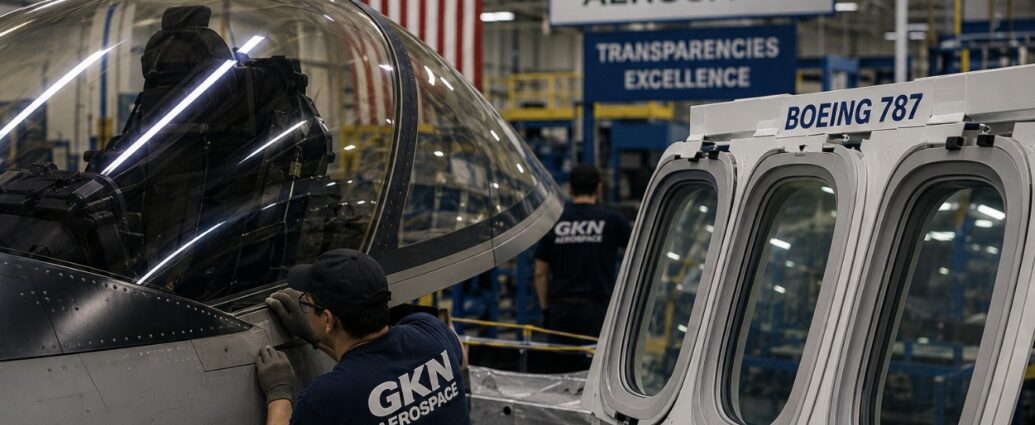
DEVELOPING — Saturday, May 23, 2026. A damaged chemical tank at the GKN Aerospace plant in Garden Grove, California has forced as many as 50,000 people from their homes across four Orange County cities and shut down a critical defense and commercial aerospace factory, after emergency crews concluded the tank can no longer be safely controlled and will either crack open or explode.
Garden Grove, a city of more than 170,000 residents in Southern California’s Orange County, sits roughly 30 miles from downtown Los Angeles and just five miles from Disneyland in neighboring Anaheim. Disneyland officials said Saturday the situation is not affecting their resorts and theme parks, which remain open to visitors.
The plant, at 12122 Western Avenue, is GKN Aerospace’s main U.S. transparencies facility. It is the sole producer of cockpit canopies for the Lockheed Martin F-35 Lightning II, the backbone of American and allied air power. The same factory also makes cockpit windshields and passenger cabin windows for the Boeing 787 Dreamliner, Boeing 737, Airbus A350, HondaJet, and Bombardier C-Series, according to GKN’s corporate website. That places the incident at the intersection of national security supply chains and global commercial aviation.
Orange County Fire Authority Division Chief Craig Covey said at a news conference Friday afternoon that the 34,000-gallon tank — still holding roughly 6,000 to 7,000 gallons of methyl methacrylate, a highly flammable acrylic chemical — cannot be drained or neutralized because of a faulty valve blocking access. “This thing is going to fail, and we don’t know when,” Covey said. Speaking separately to CBS Los Angeles, he added, “This is as bad as I’ve ever seen.”
The crisis began around 3:30 p.m. Thursday when the tank overheated and began venting toxic vapors. Evacuations were ordered, then briefly lifted Thursday night after crews believed cooling efforts were working. Early Friday morning, the tank destabilized again. By Saturday, the mandatory evacuation zone had expanded across Garden Grove, West Anaheim, Cypress, and Stanton, with ABC7 Los Angeles reporting roughly 50,000 residents displaced and CBS Los Angeles placing the figure above 44,000. Schools have closed, roads are shut, and regional events have been canceled.
California Governor Gavin Newsom declared a state of emergency for Orange County on Saturday, unlocking additional response resources and opening state-owned properties as shelter space. “We are mobilizing every state resource available to support local responders,” Newsom said. Evacuation centers at Savanna High School in Anaheim, Ocean View High School in Huntington Beach, John F. Kennedy High School in La Palma, and Freedom Hall at Mile Square Regional Park in Fountain Valley have absorbed displaced residents, with Freedom Hall reaching capacity Friday night.
A GKN Aerospace spokesperson said specialized hazardous-materials teams are assessing the situation and that “there are no reports of injuries at this time and our priority remains the safety of our employees, responders, and the surrounding community.” The company said it is “fully focused on working with emergency services and the relevant authorities.”
The business stakes are significant. GKN Aerospace, now part of Dowlais Group after being spun out of Melrose Industries in 2023, describes itself as “the world-leading supplier of cockpit transparencies and passenger cabin windows.” The Garden Grove site is qualified to build the F-35 canopy — a complex stealth-coated piece essential to the jet’s low-observable design — as well as transparencies for the F-22 Raptor, Boeing F-15 Eagle, F/A-18 Hornet, and AV-8B Harrier II.
For Lockheed Martin, the world’s largest defense contractor, any extended shutdown of canopy supply would add to existing pressure on the F-35 program, which has battled engine, sustainment, and parts-availability problems through the spring. Lockheed Martin shares closed Friday at elevated levels on heightened defense spending expectations tied to the Iran conflict; investors will be watching closely Monday for any guidance on production continuity. The Pentagon has historically kept only limited backup sourcing for military transparencies. PPG Industries runs a parallel canopy line at its Sylmar, California plant for the F-35A and F-35C variants, but qualification work on the F-35B short-takeoff version remains in progress, leaving GKN the dominant qualified supplier for parts of the fleet.
On the commercial side, the timing is rough for both Boeing and Airbus. Boeing, still working through 737 MAX certification and quality issues under chief executive Kelly Ortberg, relies on GKN’s Garden Grove output for windshield and cabin window assemblies on the 787 and 737 programs. Airbus, led by chief executive Guillaume Faury, sources transparencies for the A350 wide-body line from the same site. Both manufacturers are working through multi-year backlogs of thousands of aircraft, and supplier interruptions of even a few weeks have historically caused delivery delays, customer compensation claims, and disruption to airline fleet plans.
Beyond aerospace, the incident has revived broader questions about U.S. industrial safety, aging chemical storage infrastructure, and the concentration of defense-critical manufacturing in dense suburban areas. Methyl methacrylate is a known respiratory irritant; Orange County health officer Dr. Regina Chinsio-Kwong warned that vapor exposure can cause respiratory issues, eye irritation, nausea, and headaches. Crews have built sandbag containment barriers around the plant to prevent any chemical spill from reaching storm drains, creeks, or the nearby Pacific coast.
Wall Street will scrutinize Dowlais Group’s disclosures in the coming days for the financial impact, including potential damages, lost production, business interruption insurance recoveries, and any liability tied to the faulty valve at the heart of the failure. Analysts at major brokerages have not yet published formal notes on the incident, but defense and aerospace supply chain specialists are likely to flag the event as a case study in single-point-of-failure risk across high-value manufacturing.
For residents, the immediate concern is when they can return home. Chief Craig Covey and OCFA Chief TJ McGovern have offered no timeline, with McGovern acknowledging Friday, “We understand how disruptive and frightening this is to the public, particularly for the residents who have been asked to leave their homes for their own safety.” For investors, customers, and Pentagon planners, the more difficult question is how quickly the Garden Grove plant — and the strategic flow of canopies, windshields, and cabin windows it supplies — can be brought back online once the tank crisis is finally resolved.
— JBizNews Desk
© 2026 JBizNews. All Rights Reserved. Reproduction or distribution without written permission is prohibited.