Germany’s intelligence service refers to the image of a watermelon slice as one of the identifying symbols of secular pro-Palestinian antisemitism and extremism. This appears as part of a new webpage on the website for Germany’s Federal Office for the Protection of the Constitution (the BfV) called ‘Secular pro-Palestinian extremism.’
BfV defines secular pro-Palestine extremism in Germany as very heterogeneous, comprising different organizations (older and newer ones), individuals, and networks. These are, however, said to be united by their hostility towards Israel, whose right to exist they refuse to recognize.
BfV explains that pro-Palestinian individuals and groups in Germany act as a link between the various extremist spectrums, creating ideological connections between left-wing and Islamist actors, but also with right-wing extremists.
“A pronounced hatred of Israel and antisemitism serve as the primary unifying elements,” BfV says, adding that these groups are overall seeking Israel’s destruction.
The main point of reference for these groups’ and individuals’ antisemitic agitation is “the existence of the State of Israel, which is usually equated with the Jews.”
Aside from outlining the different actors in this bracket, such as the Popular Front for the Liberation of Palestine (PFLP), Samidoun – Palestinian Prisoner Solidarity Network, and the BDS movement, the BfV also outlines symbols and identifying marks of secular pro-Palestinian extremism.
One of these is the symbolism of the sliced watermelon, alluding to the colors of the Palestinian flag. It also provides the example of when the outline of the entire state of Israel is depicted in the colors of the Palestinian flag (as a sliced watermelon), “thereby denying Israel’s right to exist.”
Hidden messages, antisemitic codes and ciphers
Other symbols include Hamas’s inverted red triangle, which the BfV notes was originally used in Hamas propaganda as a target marker, as well as slogans such as ‘from the River to the sea’ and ‘yalla yalla intifada.’
BfV says ‘from the river to the sea’ “does not constitute a binding call for armed struggle against Israel” but “can also be interpreted as a call for the elimination of the State of Israel.”
BfV also condemns the chant ‘Baby killer Israel’ as a “slogan based on antisemitic conspiracy theories and invoking the medieval ‘ritual murder’ allegation.”
While Germany has put in place bans on or restrictions on gatherings, BfV notes that these are repeatedly disregarded, for example, through the display of prohibited symbols or anti-Israel and anti-Semitic statements.
Furthermore, BfV notes that the often aggressive atmosphere among participants frequently culminates in physical altercations. Outside of the demonstrations, property damage is often committed, primarily in the form of graffiti with anti-Israel content.
Particularly in Berlin, “the protest hotspot,” BfV says that a hard core has formed within the secular pro-Palestinian scene, comprised to a considerable extent of extremist individuals and groups.
“This core is increasingly appearing more emotionally charged and radicalized at pro-Palestinian events,” BfV explains. “Secular pro-Palestinian extremists, in particular, act as mobilization drivers, participating in pro-Palestinian protests as organizers and participants, or through speeches, slogans, and banners containing anti-Israel and anti-Semitic content. The aim is to amplify the protests and expand them across Germany.”
At the same time, BfV released an 80-page document named ‘Hidden Messages, Antisemitic Codes and Ciphers’ with the stated goal of sensitizing readers to “encrypted forms of antisemitism,” explaining their origins and dangers, and providing practical examples from the BfV’s own departments.
While it is aimed at teachers, educators, and interested citizens, it explicitly says it is not a full dictionary or legal rulebook for decoding antisemitism.
The document refers to antisemitism as “one of the most powerful and longest-lasting bridge phenomena.”
It says Jew hatred has the power to bring together actors who otherwise have little in common, with Jews or Israel serving as a shared enemy image.
It specifically says the October 7 Hamas attack showed how shared enemy images can have an effect, saying parts of the left to far left scene expressed solidarity with what they described as a “Palestinian liberation struggle,” helping make Hamas terror socially acceptable in some protest contexts.
The particular focus of the report, as mentioned, is on the use of codes and ciphers as tools of indirect communication. This kind of cryptic antisemitism is challenging as it often cannot be understood from the wording or image alone, and requires historical knowledge or familiarity with certain political subcultures. This means insiders can decode the message immediately, while outsiders may find it harmless.
However, the BfV stresses that no single word or image can always be decoded automatically, and full context is important.
For example, not every use of words like “globalists” is automatically antisemitic, but repeated patterns, coded references, and context can reveal antisemitic meaning.
On the topic of ‘globalists,’ one of the report’s main examples is finance coding.
Terms like “Globalists,” “high finance,” BlackRock, Soros, and Rothschild are identified by BfV as codes to suggest a hidden Jewish financial elite.
The report says references to Larry Fink, George Soros, or Rothschild can function as stand-ins for Jews as a collective, turning criticism of capitalism or globalization into a conspiracy about Jewish control.
Linking to this – the report’s second major category – is the myth of a Jewish world conspiracy. BfV gives examples such as puppet master imagery, the “Great Reset,” the “Kalergi Plan,” Freemasons, and “the powers that be.”
BfV uses the example of a caricature in which an Arab figure is revealed as a puppet controlled by a man marked with a Star of David.
The third main category in the report is titled “Poison, blood, and distorted images.” This focuses on antisemitic conspiracies, often connected to medieval blood libel. These are often coded with terms such as “Illuminati,” the eye symbol, “adrenochrome,” and “occult child sacrifice.”
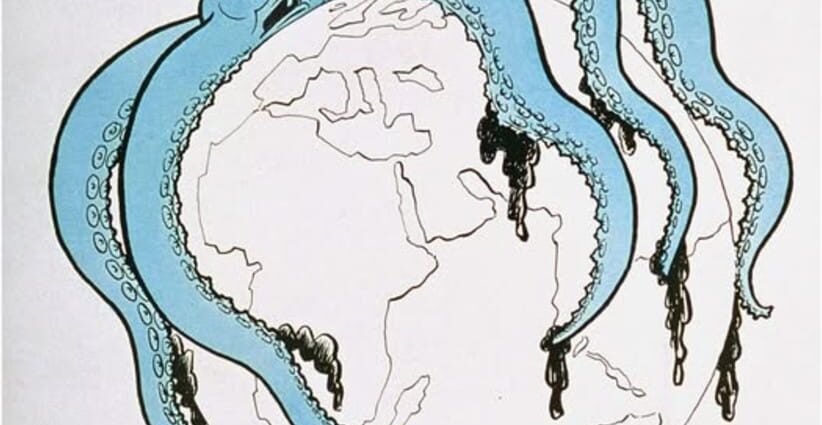
Connected to this is dehumanizing language and imagery, predominantly that which identifies Jews as not human. A key example provided by BfV is the octopus image, in which George Soros is shown as the head of an octopus whose tentacles reach into institutions, countries, politicians, and topics such as the WEF, WHO, EU, Ukraine, Democrats, and Antifa. The BfV says this draws on the old conspiracy narrative of Jewish global control.
The final two main categories are ‘Holocaust inversion and victimhood’ and ‘Israel as the projection screen for old antisemitic myths.’
The former looks at coded attempts to present Germans or other groups as the “true victims” or terms such as “cult of guilt,” and the use of yellow star imagery by anti-vaccine protesters.
BfV says, “These examples denigrate the remembrance culture supported by the majority of the German population as a tool of oppression.”
BfV says these narratives create a perpetrator-victim reversal, portraying Holocaust remembrance either as a “genocide” against Germans or as a “protective shield for Israel.”
The final focused section is titled “Projection surface Israel: All antisemitic myths in one state,” in which BfV identifies the core pattern as the claim that Jews are collectively responsible for Israel’s actions and that Israel is “the ultimate evil in the world.”
Why are codes so dangerous?
BfV says codes and symbols are dangerous in a very covert way.
It explains that the moment someone encounters a code, it begins to trigger a process in their mind. Most often, the messages are directed at people who already share a similar worldview. However, codes can also serve as an entry point into antisemitic ways of thinking for people who are still in a “gray area” and have not yet fully adopted such views.
People who do not (yet) understand the codes can then gradually become accustomed to antisemitic messages.
Reflecting on the case studies, BfV says codes ultimately operate on four different levels.
The first level is the emotional level. The purpose is to bypass rational thinking and instead trigger instinctive reactions in the subconscious. Most often, they evoke negative emotions such as fear (for example, by portraying an alleged “secret power”). Anger and moral outrage may also be provoked (such as through depictions of suffering children).
The second is the cognitive level: they establish interpretive frameworks that make messages appear plausible. Characteristics here are codes with strong recognizability that connect to existing narratives (for example, through the use of Nazi imagery). Also significant is the construction of enemy images through seemingly clear distinctions between “good” and “evil.”
The third is the moral level. Here, BfV says codes can gradually undermine democratic values and pave the way for exclusion and violence. The central tool here is dehumanization, through which other people are denied dignity (for example, if Jews are portrayed as monsters). Dehumanization can then, in turn, lower inhibitions against verbal abuse and physical attacks.
In some contexts, BfV says codes can also contribute to the normalization of antisemitism (for example, through the public display of symbols such as the red triangle).
And the fourth level is action; many of the case studies in the document directly target the level of action. This means they encourage viewers to leave their passive role and become active themselves. Ultimately, BfV says there is also a risk that such codes can mobilize direct violence. By creating the perception of an immediate threat, they can create fertile ground for physical attacks.
The report ends with a broader warning: “Antisemitic images develop their effect in broader society precisely because they are often passed on and spread unrecognized, are not questioned, or are simply played down.”
The BfV said the brochure aims to sensitize readers to antisemitic codes and strengthen judgment, calling this “a necessary foundation for standing up for democratic principles.”