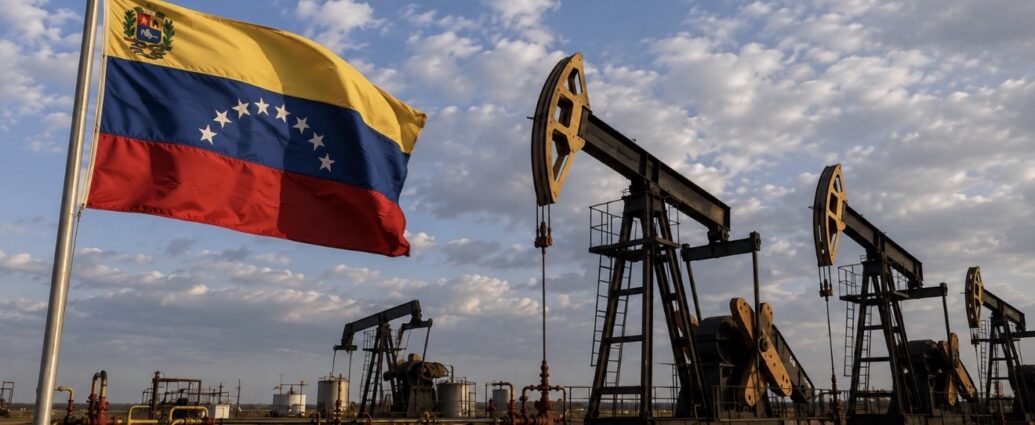
Venezuela has the largest proven oil reserves in the world. For years, much of that oil has effectively been trapped underground by sanctions, deteriorating infrastructure, political instability and a state energy industry that has struggled to maintain production.
That may now be changing.
A newly announced U.S.-Venezuela energy agreement is no longer simply about bringing some additional Venezuelan crude back to market. If the production targets are reached, it could begin changing the balance of global oil supply itself.
Venezuela’s interim president Delcy Rodríguez said Sunday that the agreement will run for 25 years, begin with the development of 17 strategic oilfields and target production of more than 1.5 million barrels per day.
The plan also includes eight additional oil blocks.
President Donald Trump said Friday that U.S.-backed partnerships would gain majority control over development tied to more than 65 billion barrels of Venezuelan proven reserves, while Venezuela maintains sovereign ownership of the oil itself.
That distinction is important.
The agreement does not mean the United States suddenly owns Venezuela’s oil reserves. It means American companies and U.S.-backed investment could gain substantially more control over how a large portion of those reserves are developed, financed, produced and brought to market.
And that is where this becomes much bigger than Venezuela.
Venezuela currently produces roughly 1.25 million barrels of oil per day, a fraction of the more than 3 million barrels a day it produced at its peak.
If American capital, technology and oilfield expertise can restore even part of that lost production, millions of additional barrels could eventually become available to the global market.
That would create a new source of supply at exactly the moment the world is dealing with instability in the Middle East, constrained traffic through the Strait of Hormuz and uncertainty surrounding Iranian and Russian energy exports.
The timing could hardly be more significant.
For months, oil markets have carried a geopolitical premium because so much of the world’s energy supply depends on regions vulnerable to war, sanctions or shipping disruptions.
A revived Venezuelan oil industry would give the United States and global refiners another major supply source in the Western Hemisphere.
It could also reduce America’s dependence on crude traveling through vulnerable international shipping routes.
But none of this happens overnight.
Venezuela’s oil infrastructure has suffered from years of underinvestment, equipment failures and declining technical capacity. Pipelines, refineries, storage facilities and production sites will require enormous amounts of capital.
Trump has said the broader effort could attract close to $100 billion in private investment.
Chevron is already moving toward expanding its Venezuelan operations, while oil-services giant SLB has secured access to key Venezuelan oilfield data as part of efforts to modernize the country’s energy infrastructure.
The Treasury Department has also been steadily removing legal barriers to U.S. participation.
On August 27, Treasury amended a series of Venezuela-related licenses covering oil, petrochemicals, services and transactions involving state oil company PDVSA. Treasury said the changes were designed to support U.S. businesses reinvesting in Venezuela following investment reforms there.
That means this is no longer simply political rhetoric.
The legal framework, corporate participation and capital structure are beginning to move into place.
The impact could eventually reach consumers directly.
More global oil supply generally puts downward pressure on crude prices, which can eventually feed through to gasoline, diesel, airline fuel, trucking costs and the price of goods transported across the economy.
It could also change the calculations inside OPEC+, where producers carefully manage supply in an effort to influence global prices.
If Venezuela eventually adds hundreds of thousands — or potentially more than a million — barrels per day of sustainable production, other producers may have to decide whether to cut their own output, accept lower prices or fight for market share.
There is still substantial execution risk.
Venezuela has a long history of political intervention in its oil industry, unpaid obligations, nationalizations and disputes with foreign companies. Rebuilding production on this scale will require not only money but years of stability and confidence that contracts will be honored.
That is why investors should not treat 1.5 million barrels per day as oil that will suddenly appear tomorrow.
But they also should not dismiss what is happening.
For decades, one of the world’s largest pools of oil has been operating far below its potential.
If U.S. capital and technology begin unlocking that supply again, the consequences could stretch far beyond Caracas or Washington.
It could change where America gets its oil, reduce some of the world’s dependence on Middle Eastern supply routes, pressure OPEC’s market power and ultimately change what consumers pay for energy.
That is why the real story is no longer simply that Washington reached an oil agreement with Venezuela.
It is that one of the largest untapped sources of additional oil supply in the world may be coming back into play.
JBizNews Desk | Washington / Caracas
© JBizNews.com All Rights Reserved. Reproduction or distribution without written permission is prohibited.