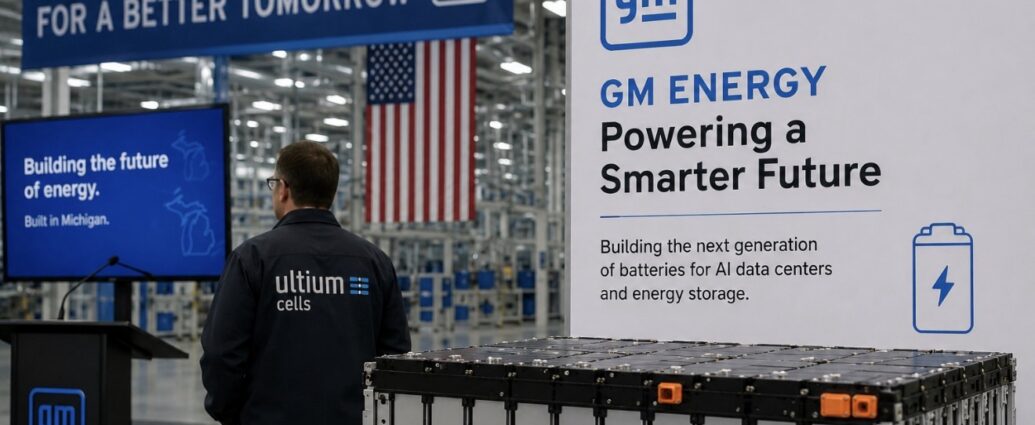
General Motors (NYSE: GM) is making a major bet that the next growth opportunity for batteries may not be inside vehicles at all.
The automaker announced that it is developing sodium-ion battery technology designed for energy storage systems serving artificial intelligence data centers and other large-scale power applications.
The work is being conducted at GM’s Wallace Battery Cell Innovation Center in Warren, Michigan.
The move reflects a rapidly changing energy landscape.
As artificial intelligence infrastructure expands, data centers require enormous amounts of reliable electricity and increasingly need battery systems capable of storing and delivering power efficiently.
At the same time, automakers have invested billions of dollars building battery manufacturing capacity for electric vehicles, only to discover that EV demand has grown more slowly than many forecasts predicted.
GM sees an opportunity to bridge those two trends.
“Sodium is one of the most abundant elements on Earth,” said Kurt Kelty, GM’s Vice President of Battery and Sustainability.
Unlike lithium-ion batteries used in vehicles, sodium-ion batteries rely on lower-cost and more widely available materials. While they typically offer lower energy density, they can be highly attractive for stationary applications where size and weight are less important.
That makes them particularly well suited for energy storage supporting AI data centers.
GM’s strategy includes a partnership with Peak Energy, a startup focused on sodium-ion battery systems. GM Ventures is investing in the company while GM retains exclusive manufacturing rights for the battery cells.
Industry analysts note that no major Western automaker has previously committed to manufacturing sodium-ion batteries at scale.
GM is also expanding existing battery operations.
Its Ultium Cells joint venture with LG Energy Solution recently committed $70 million toward producing lower-cost lithium iron phosphate batteries at its Spring Hill, Tennessee facility.
The project has already helped bring back approximately 700 workers who were laid off earlier this year as EV demand softened.
The company is additionally exploring ways to repurpose retired EV batteries.
GM and Redwood Materials, founded by former Tesla executive J.B. Straubel, are deploying approximately 10,000 used GM battery packs into energy infrastructure projects, including AI-related facilities.
The broader market opportunity is enormous.
Residential electricity prices have risen nearly 48% since January 2020, according to government data, while analysts expect power demand from AI infrastructure to continue increasing sharply.
Morgan Stanley estimates that major technology companies could spend more than $1 trillion on energy infrastructure during 2025 and 2026.
GM is not alone.
Ford Motor Co. (NYSE: F) recently launched its own stationary energy-storage division and announced significant investments in commercial battery systems.
For both automakers, energy storage offers a hedge against a slower-than-expected transition to electric vehicles.
GM’s message is clear.
Continue building EVs.
Continue investing in batteries.
But find new customers beyond the automotive market.
The strategy transforms what once looked like excess battery capacity into a potentially valuable new business line tied directly to one of the fastest-growing industries in the world.
As AI data centers consume increasing amounts of electricity, the next major customer for Detroit’s battery expertise may not be drivers.
It may be the power grid itself.
JBizNews Desk — Technology
© JBizNews.com All Rights Reserved. Reproduction or distribution without written permission is prohibited.