By JBizNews Desk
May 11, 2026
Gold prices slipped at the start of the new trading week after President Donald Trump rejected Iran’s latest proposal aimed at ending the war and reopening the Strait of Hormuz, strengthening the U.S. dollar, lifting oil prices, and reinforcing inflation concerns that continue to dominate global financial markets.
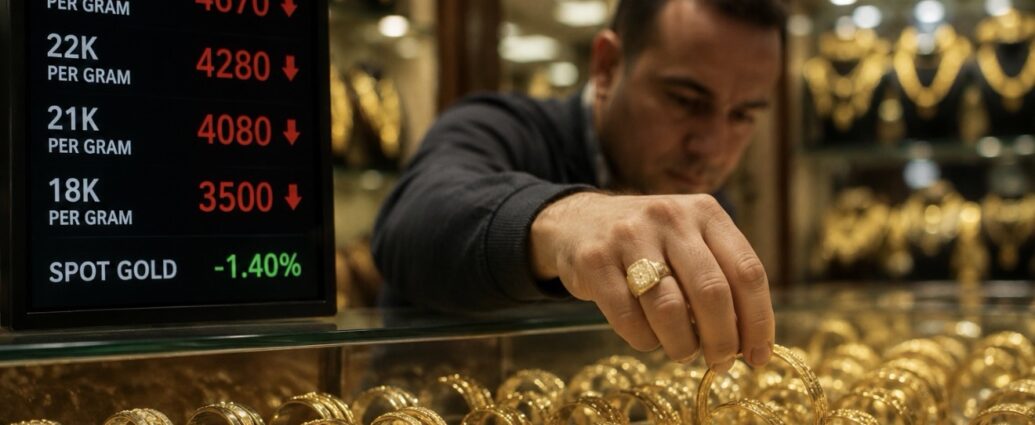
Spot gold eased from Friday’s close near $4,739 per ounce as trading opened across Asian markets Monday, reversing part of the late-week rally that had briefly emerged on hopes diplomatic negotiations might finally produce a breakthrough.
The shift came after Trump posted a blunt rejection of Iran’s latest counterproposal Sunday evening on Truth Social.
“I have just read the response from Iran’s so-called ‘Representatives.’ I don’t like it — TOTALLY UNACCEPTABLE!” Trump wrote.
The statement effectively extinguished the optimism that had developed late last week after Iran reportedly submitted a revised proposal through mediators in Pakistan.
The market reaction was immediate.
The U.S. dollar strengthened as investors rotated into traditional safe-haven currency positions, making dollar-denominated gold more expensive for international buyers holding foreign currencies.
At the same time, oil prices moved higher again, with both Brent crude and West Texas Intermediate futures climbing on renewed concerns that the Strait of Hormuz disruption may continue far longer than markets had hoped.
That combination — rising energy prices and a stronger dollar — created fresh pressure on bullion.
“The latest news clearly didn’t give the market confidence that everything is going to be okay and again raised the specter of inflation issues, along with fairly hawkish signals to the market on interest rates,” said Bart Melek, global head of commodity strategy at TD Securities.
The dynamic now driving gold markets has become increasingly unusual.
Historically, a geopolitical crisis of this scale would strongly benefit gold prices as investors seek protection from instability and financial stress.
But the Iran conflict has produced a different macroeconomic outcome.
Instead of driving aggressive monetary easing, the war has triggered an energy-driven inflation shock that continues pushing gasoline prices, transportation costs, and inflation expectations sharply higher.
National average gasoline prices reached approximately $4.54 per gallon last week, according to the American Automobile Association, while one-year consumer inflation expectations climbed to 4.5% in the latest University of Michigan survey.
The same survey also showed U.S. consumer sentiment collapsing to the lowest reading recorded in the survey’s 74-year history.
That inflation picture has kept the Federal Reserve trapped in an increasingly difficult position.
Higher energy costs are making it harder for the central bank to justify interest-rate cuts even as broader consumer spending and economic confidence weaken.
And higher interest rates directly pressure gold because bullion itself produces no yield.
“Gold continues to take its cues from the oil market, with rising energy costs keeping the risk of near-term dollar strength and elevated inflation in focus,” said Ole Hansen, head of commodity strategy at Saxo Bank.
Several major Wall Street institutions have now shifted their rate expectations accordingly.
Barclays joined Goldman Sachs and JPMorgan this past week in forecasting no Federal Reserve rate cuts during 2026 as long as war-related energy inflation continues filtering through the broader economy.
The Fed held rates steady at its most recent policy meeting in what analysts described as one of the central bank’s most divided decisions since the early 1990s, with policymakers citing uncertainty tied directly to the Iran conflict and energy markets.
Investors now face a critical week for inflation data.
The Bureau of Labor Statistics is scheduled to release the Consumer Price Index on May 12, followed by the Producer Price Index on May 13.
Consensus forecasts currently expect headline CPI inflation to rise to approximately 3.8% year over year, while core CPI — which excludes food and energy — is projected to climb to roughly 2.7%.
A hotter-than-expected inflation reading would likely strengthen expectations that the Fed keeps rates elevated longer, potentially placing additional downward pressure on gold.
A softer report, however, could revive hopes for eventual monetary easing and provide support for bullion prices.
TD Securities currently forecasts a broad year-end trading range for gold between approximately $4,400 and $5,500 per ounce.
The firm noted that sustained movement toward the upper end of that range would likely require a meaningful easing of Middle East tensions alongside a decline in energy-driven inflation pressures.
As long as oil prices remain elevated — Brent crude continues hovering near $100 per barrel — analysts say gold may struggle to sustain upside momentum despite ongoing geopolitical instability.
Structurally, however, long-term institutional demand for gold remains exceptionally strong.
China’s central bank reported its 18th consecutive month of official gold reserve purchases in April, continuing a broader trend among central banks diversifying reserves away from dollar-denominated assets.
The World Gold Council recently reported that approximately 76% of central bank officials globally expect gold to comprise a larger share of international reserves over the next five years.
That persistent sovereign demand has helped limit downside pressure on gold even as higher interest-rate expectations weigh on prices.
For now, however, gold remains trapped between two competing forces.
On one side stands its traditional role as a hedge against geopolitical crisis and financial instability.
On the other stands the inflation and interest-rate arithmetic created by the very same conflict driving demand for safety.
Until the Strait of Hormuz reopens and energy markets stabilize, investors increasingly expect that tension to remain unresolved.
— JBizNews Desk
© JBizNews.com. All rights reserved. This article is original reporting by JBizNews Desk. Unauthorized reproduction or redistribution is strictly prohibited.