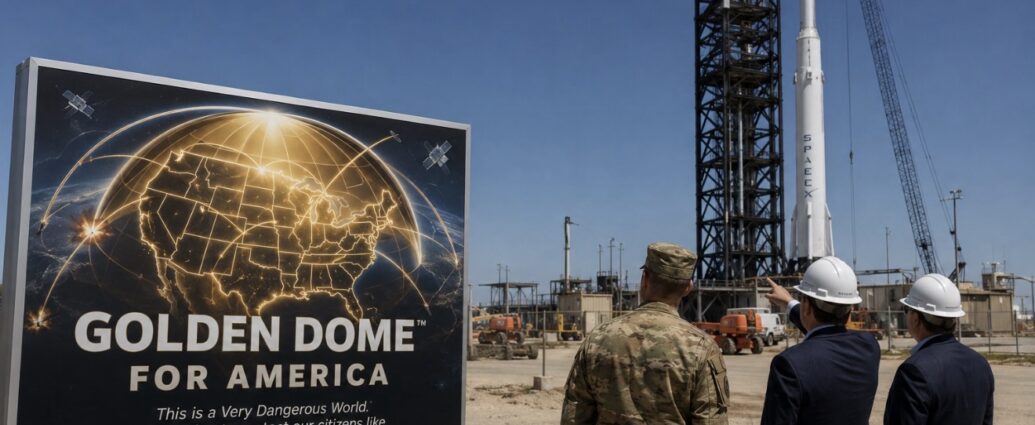
President Donald Trump’s Golden Dome missile defense initiative would cost roughly $1.2 trillion to build, deploy and operate over two decades, according to a new analysis published Tuesday by the nonpartisan Congressional Budget Office — a figure dramatically above the $175 billion estimate the president floated in May 2025 and far exceeding the roughly $185 billion currently envisioned in Pentagon long-term planning.
The Congressional Budget Office report, requested by Senator Jeff Merkley of Oregon, the ranking Democrat on the Senate Budget Committee, examined a “notional” national missile-defense architecture aligned with the executive order Trump signed during his first week back in office. The proposal calls for a layered defense shield capable of detecting and intercepting ballistic, cruise and hypersonic missiles during multiple phases of flight.
The agency stressed that its projection represented “one illustrative approach rather than an estimate of a specific Administration proposal,” but the underlying economics were striking. According to the CBO, acquisition costs alone would exceed $1 trillion, with the space-based interceptor layer accounting for roughly 70% of acquisition costs and about 60% of the system’s total long-term expense.
That orbital layer is where the numbers become especially daunting.
The CBO modeled a constellation of roughly 7,800 low-Earth-orbit satellites designed to engage up to 10 simultaneously launched intercontinental ballistic missiles. The acquisition price for that space-based layer alone was estimated at approximately $723 billion. Ground- and sea-based interceptor systems would add another $139 billion, while long-term operations and sustainment costs would ultimately push the total program price near $1.2 trillion over 20 years.
Gabe Murphy, a policy analyst at Taxpayers for Common Sense, told Responsible Statecraft that even the CBO estimate “could be low,” warning that the number of space interceptors required to stop a major adversary strike could become economically overwhelming. Some missile-defense analysts estimate the interceptor-to-threat ratio could approach 1,000-to-1 during a large-scale attack scenario involving Russia or China.
The CBO was also unusually direct about the system’s strategic limitations.
The report concluded that the notional architecture “would not be an impenetrable shield or be able to fully counter a large attack of the sort that Russia or China might be able to launch,” though it could successfully defend against a more limited strike from regional adversaries such as North Korea.
Even Pentagon officials have acknowledged the enormous technical and financial uncertainty surrounding the effort.
General Michael Guetlein, the Space Force officer selected to oversee the Golden Dome initiative, told lawmakers during congressional testimony last month that while the underlying technology largely exists, the defining question remains whether the United States can deploy it “at scale” and “affordably.” Guetlein added that if space-based interceptors cannot be produced at sustainable costs, “we will not go into production.”
For the defense industry, however, Golden Dome has already emerged as the most consequential procurement opportunity of the decade.
Initial funding has largely flowed through the One Big Beautiful Bill Act, which allocated approximately $24 billion to the program last year. The Defense Department is now seeking another $17.5 billion for fiscal 2027, with nearly all of the funding routed through congressional reconciliation rather than the Pentagon’s traditional base budget.
Last month, the U.S. Space Force awarded roughly $3.2 billion in rapid-development Other Transactional Authority contracts to 12 companies tasked with prototyping space-based interceptor systems.
The contractor roster reflects a collision between traditional defense giants and Silicon Valley’s rapidly expanding national-security sector. Legacy firms including Lockheed Martin, Northrop Grumman, RTX’s Raytheon unit, General Dynamics, and Booz Allen Hamilton are competing alongside venture-backed defense newcomers such as Anduril Industries, Palantir Technologies, Scale AI, True Anomaly, and Turion Space.
Elon Musk’s SpaceX is expected to provide much of the heavy-launch infrastructure and is reportedly working alongside Anduril and Palantir on satellite tracking and interceptor systems. Anduril and Palantir are also jointly developing the command-and-control software architecture that Guetlein has described as the program’s “secret sauce.”
Additional contractors including Boeing, L3Harris, and Leonardo DRS are widely expected to secure roles as the program advances into larger deployment phases.
Wall Street has already begun pricing the opportunity into aerospace and defense stocks. Analysts have pointed to Golden Dome as a potential multi-year growth engine for traditional prime contractors while also viewing it as a transformational moment for venture-backed defense firms seeking to establish themselves as permanent Pentagon suppliers.
Politically, the widening gap between the administration’s original cost estimate and the CBO’s projection is rapidly becoming the program’s defining flashpoint.
Merkley called the initiative “nothing more than a massive giveaway to defense contractors paid for entirely by working Americans” and pledged to oppose additional appropriations. Republican defense hawks counter that even a trillion-dollar investment is justified given the accelerating missile capabilities of China and Russia, particularly in hypersonic weapons systems that existing U.S. missile-defense architecture struggles to intercept.
Supporters also point to Israel’s Iron Dome as proof that layered missile-defense systems can significantly reduce civilian vulnerability during sustained attacks, though critics note that defending the continental United States presents a vastly larger and more complex challenge.
The Pentagon is under pressure to demonstrate an initial operational capability by summer 2028, with broader deployment expected sometime during the 2030s. Whether Congress is willing to sustain the level of spending implied by the CBO’s projections is now emerging as one of the central questions looming over the next generation of U.S. defense budgeting.
JBizNews Desk
© JBizNews.com. All rights reserved. This article is original reporting by JBizNews Desk. Unauthorized reproduction or redistribution is strictly prohibited.